If you’ve noticed that your arms look thinner, your legs tire faster on the stairs, or the weights at the gym feel heavier than they used to, it’s natural to wonder about hormones. Searching for low testosterone and muscle loss usually turns up two kinds of pages: clinic pages that suggest testosterone is the answer, and health articles that list muscle loss as one symptom among many. Both contain some truth. Neither tells you how to decide whether a hormone problem is actually part of your picture.
This guide fills that gap. It explains what the research shows about testosterone and muscle, why the link is real but far from one-to-one, what a blood test can and can’t tell you, and which questions are worth bringing to a visit. It doesn’t interpret your own numbers or recommend a treatment, because that takes a clinician who knows your history. For the broader hormone overview, see our guide to low testosterone symptoms. Two close companions cover low testosterone and fatigue and low testosterone and mood, since muscle changes rarely show up alone.
One more thing before we start. Losing strength can feel personal, especially if training or physical work has been part of how you see yourself. It says nothing about your worth or your masculinity. It’s a health signal, and health signals are meant to be looked into calmly and without blame.
Understanding Low Testosterone and Muscle Loss
Before looking at tests or treatments, it helps to get the vocabulary straight. People use “low T,” “hypogonadism,” and “muscle loss” loosely, and that looseness creates much of the confusion online. This section defines the terms, separates muscle loss from general weakness, and explains where testosterone fits among the other forces that shape muscle over a lifetime.
Key Concepts
This subsection separates two ideas that often get blended together: a hormone level and a change in your body. Once each is defined on its own terms, the relationship between them is much easier to think about clearly.
What Low Testosterone and Muscle Loss Means
Testosterone is the main male sex hormone, made mostly in the testicles, and it has effects far beyond sex drive. Low testosterone, often shortened to low T, is a lab finding. Hypogonadism is the medical term for when the testicles don’t produce enough testosterone or the brain signals that control them aren’t working properly, and it’s diagnosed when low levels come with symptoms. Cleveland Clinic lists decreased muscle strength and mass among those symptoms, and Mayo Clinic lists less muscle mass as well.
Muscle loss, by contrast, is something you or a clinician observe: smaller muscles, reduced strength, or trouble with tasks that used to feel easy. The two ideas connect, but they aren’t interchangeable. A man can have low testosterone with little muscle change, and a man can lose muscle with testosterone in the usual range. The relationship is a possibility to examine, not a conclusion to assume.
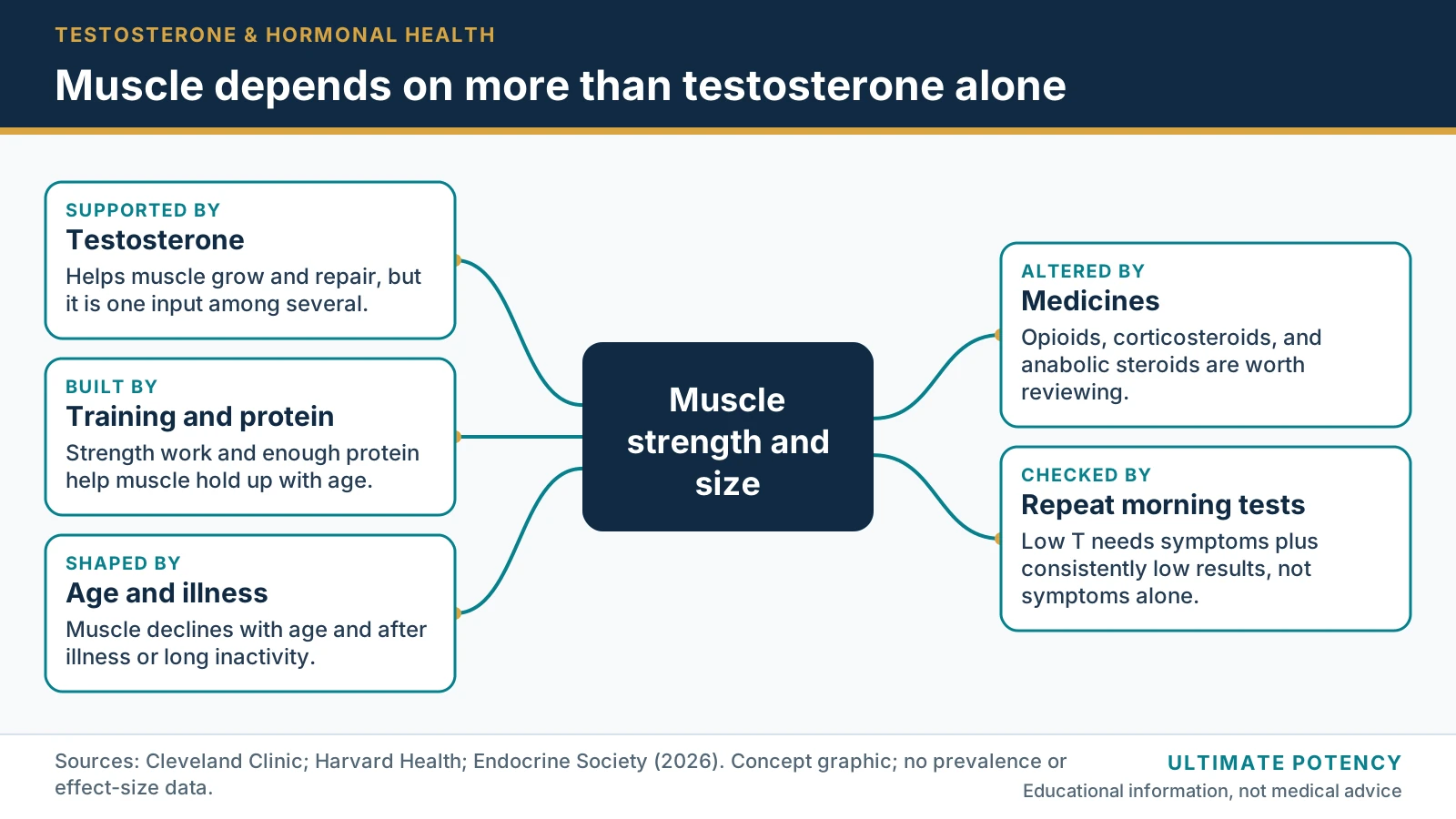
Text version: Muscle strength and size are supported by testosterone, built by training and protein, shaped by age and illness, altered by some medicines, and checked by repeat morning blood tests that are read together with symptoms.
Muscle Loss, Sarcopenia, and Everyday Weakness
Three terms get mixed up here, and separating them makes conversations with a clinician clearer. Sarcopenia is the medical word for a gradual loss of muscle mass and strength, most often tied to aging. Lean mass is everything in the body that isn’t fat, and muscle makes up much of it, which is why researchers often track it as a stand-in for muscle. Weakness is a feeling or a measured loss of force, and it can come from muscles, nerves, energy levels, or illness.
Because these overlap, a single complaint such as “I feel weaker” can point in several directions. The table below separates the terms and the usual misunderstandings.
This table separates words that are often used interchangeably so you can describe your own changes more precisely.
| Term | Plain-English meaning | Common misunderstanding |
|---|---|---|
| Low testosterone | A blood result below a laboratory’s expected range | That the number alone explains how you feel |
| Hypogonadism | Low testosterone together with symptoms, from a testicular or brain-signal cause | That it only happens in older men |
| Sarcopenia | Gradual loss of muscle mass and strength, usually with aging | That it’s unavoidable and can’t be slowed |
| Lean mass | Body weight that isn’t fat, mostly muscle, organs, and water | That a rise in lean mass always means stronger muscles |
| Weakness | A felt or measured drop in force or stamina | That it always starts in the muscle itself |
Source: editorial summary informed by Cleveland Clinic, Mayo Clinic, and Harvard Health pages cited in this article. Definitions are simplified for education.
Where Testosterone Fits In
Testosterone is one of several signals that influence how the body builds and maintains muscle. This subsection looks at what the hormone does in muscle and why it can’t be considered in isolation from age, activity, and food.
What Testosterone Does in Muscle Tissue
Testosterone is an androgen, a hormone that promotes male characteristics and also helps the body build and maintain tissue, including muscle and bone. In general terms, adequate levels support muscle growth and repair, while very low levels make it harder to hold on to muscle. That’s why the abstract of a 2010 trial in older men with mobility limitations opens by noting that earlier research found testosterone could increase muscle mass and strength in healthy older men, according to the published abstract.
There’s an important distinction, though. Muscle responds to many inputs at once: the work you ask of it, the protein and calories you eat, sleep, overall health, and hormones. Testosterone is a contributor, not a switch. Raising a low level in someone who is truly deficient is a different situation from adding hormone on top of a normal level, and the evidence for the two cases shouldn’t be blended. Later sections look at what trials in men with low levels have found, and where the evidence runs thin.
Why Age, Activity, and Nutrition Also Matter
Even with perfectly normal hormones, muscle tends to shrink with age. Harvard Health reports that adults who don’t do regular strength training can lose roughly 4 to 6 pounds of muscle per decade, and that sarcopenia affects nearly half of adults over 80. Those figures describe general populations, not any one man, and they show how much muscle change happens without any hormone problem.
Activity and food are the two levers most within reach. The same Harvard Health page notes that protein combined with heavy resistance exercise produced the greatest gains in muscle mass and strength in healthy older adults. So when muscle loss appears, the useful starting question isn’t only “Is it my testosterone?” It’s also “How much have I been training, how well am I eating, and what else has changed?” Hormones can be part of the answer, but they rarely work alone, and a clinician will want to look at the whole picture before attributing the change to any single cause.
How Muscle Changes Show Up in Daily Life
Muscle loss isn’t always obvious in the mirror. Sometimes it shows up as a slower pace, a harder climb, or a lift you can no longer finish. This section describes what men commonly notice, why the pattern of change gives useful clues, and why no pattern can confirm a hormone problem by itself.
What Men Describe
People describe muscle changes in different ways, and the words they choose can guide a conversation. Here are the most common patterns, along with the other changes that sometimes travel with them.
Strength, Stamina, and Size
Some men notice size: shirts fit differently, or arms and thighs look smaller. Others notice performance. A weight that used to feel moderate feels heavy, recovery after exercise takes longer, or everyday tasks such as carrying groceries, rising from a low chair, or climbing stairs take more effort. Cleveland Clinic notes that low testosterone can reduce muscle strength and mass and that endurance may drop as well.
Size, strength, and stamina don’t always move together. Strength can fall before muscles visibly shrink, and body fat can mask a loss of muscle if your weight stays about the same. That’s why a scale number alone is a poor guide. If you track anything, a simple log of what you can lift or how long you can walk comfortably gives a clinician more to work with than a vague sense of decline. Keep the descriptions concrete and specific, because a detail such as “I stopped being able to carry two bags up one flight” is more useful than “I’m weaker.”
Changes Beyond the Muscles
Low testosterone rarely announces itself through muscle alone. Cleveland Clinic lists low libido, erectile problems, hot flashes, loss of body hair, increased body fat, low mood, and trouble with memory or concentration alongside muscle changes. Fatigue, in particular, tends to come up in the same breath, which is why our guide to low testosterone and fatigue is a natural companion to this one, and the mood connection is covered in low testosterone and mood.
Why does this matter for muscle? Because a cluster of changes tells a clinician more than one change does. Weaker legs plus a lower sex drive plus new fatigue points in a different direction than weaker legs after months of bed rest. Still, every item on that list also has other explanations. A cluster is a reason to ask questions and consider testing, not a diagnosis. Noting which changes appeared first, and roughly when, can help separate a hormone story from a lifestyle or health story.
Why the Pattern Helps but Does Not Decide
Patterns in time and context can narrow the possibilities without settling them. This subsection explains what a clinician may infer from how your muscle changes began and what no pattern can tell anyone.
Gradual, Sudden, or Tied to an Event
Timing is one of the most useful clues you can offer. A slow, steady decline over years fits better with aging or a long-term condition. A noticeable drop over weeks or a few months raises questions about something that changed: a new medicine, an illness, a hospital stay, an injury, a major diet shift, or a period of very little activity. Low testosterone can develop gradually or after an event such as a testicular injury, so neither pattern excludes a hormone cause.
Context matters just as much as speed. Muscle loss that started after a surgery, after you stopped training, or alongside rapid unintended weight loss has obvious candidates to check first. Sudden or severe weakness, especially if it affects one side of the body, comes with trouble speaking, or makes it hard to stand, needs urgent medical attention and should never be assumed to be a hormone issue. For slower changes, a rough timeline of when things began and what else was happening is genuinely valuable at an appointment.
What Weakness Cannot Tell You Alone
Here’s the central caution. The Endocrine Society states in its July 2026 statement that symptoms alone are not diagnostic of hypogonadism, and that low energy, libido, and mood are common in aging men and often have reversible contributors that should be ruled out first. The same logic applies to muscle. Smaller muscles and lower strength are common findings with many causes, so they can’t confirm or exclude low testosterone.
This cuts both ways. Strength loss doesn’t prove a hormone problem, and a normal-looking physique doesn’t rule one out. What helps is combining three things: what you’ve noticed, what a clinician finds on history and exam, and what repeated blood tests show. None of the three is enough by itself. If an online quiz or an advertisement tells you that your symptoms prove low T, treat that as marketing rather than medicine, and bring your actual observations to a professional instead.
Other Common Reasons for Muscle Loss
Before anyone points to a hormone, a careful clinician looks at the more common explanations. This section covers the everyday and medical factors that cause muscle loss far more often than low testosterone does, and it ends with the medicines and substances that can lower testosterone itself.
Aging, Activity, and Nutrition
Muscle is a use-it-or-lose-it tissue, and what you eat feeds it. These two subsections cover the ordinary, often fixable reasons muscles shrink, starting with how much the body has been asked to do and then what it has been given to work with.
Inactivity, Illness, and Recovery
Muscle responds quickly to how much it’s used. Long stretches of sitting, a desk job paired with little exercise, a stay in the hospital, an injury that limits movement, or a period of serious illness can all reduce muscle even in a man whose hormones are fine. Recovery can be slow, and it often takes deliberate strength work rather than just returning to normal routines. That’s one reason Harvard Health emphasizes resistance exercise in its discussion of age-related muscle loss.
Illness matters in another way too. Cleveland Clinic points out that being sick can temporarily lower testosterone, which is why a clinician wants to know if you were ill around the time of a blood draw. So illness can cause muscle loss directly and can also muddy the lab picture. If your decline followed a hospital stay or surgery, say so plainly. That detail may change which explanations a clinician considers first and when they suggest checking hormones.
Protein, Calories, and Unintended Weight Loss
Muscle needs raw material. Harvard Health reports that in one study of nearly 12,000 people aged 51 and older, about 46 percent didn’t meet daily protein recommendations, and that low protein intake makes it harder to maintain or build muscle. Men who eat less as they age, who follow restrictive diets, or who have poor appetite because of illness or low mood can fall short without noticing.
Unintended weight loss deserves its own flag. Losing weight without trying, especially alongside weakness, is something to mention to a clinician promptly, because it can signal conditions that have nothing to do with testosterone. More protein isn’t automatically better, either. The same Harvard page cautions that very high intakes can be harmful, particularly for people with kidney problems, so it’s worth asking a clinician or registered dietitian what amount suits your health, rather than adopting a high-protein plan on impulse. Food and training work best together.
Health Conditions and Medicines
Some health conditions and medicines reduce muscle on their own, and some also lower testosterone, which makes the picture harder to read. Here we look at the conditions clinicians consider and the medicines and substances worth reviewing.
Conditions Clinicians Consider
Several long-term conditions are linked both to muscle loss and to lower testosterone. Cleveland Clinic lists obesity, poorly managed diabetes, sleep apnea, chronic kidney or liver disease, and HIV among risk factors for low testosterone, and Mayo Clinic names untreated obstructive sleep apnea, obesity, and HIV/AIDS as well. Hormone problems elsewhere in the body, such as thyroid disease, can also affect energy and muscle, which is one reason a clinician may check more than testosterone.
This overlap is the heart of the difficulty. A man with diabetes and sleep apnea may have low testosterone, lost muscle, or both, and the conditions can feed each other. Treating the underlying condition sometimes improves several things at once. You can read more about how these conditions connect in our guides to obesity and low testosterone and thyroid problems and testosterone. The practical takeaway is to give your clinician a full list of diagnoses, including ones that feel unrelated.
Medicines and Substances Worth Reviewing
The Endocrine Society’s 2026 statement says clinicians should first rule out reversible contributors, naming corticosteroid and opioid use, before attributing symptoms to hypogonadism. Cleveland Clinic also lists opioid use and anabolic steroid use among causes of low testosterone from the brain’s signaling side. Corticosteroids can also affect muscle directly, so a long course may matter for both reasons.
Anabolic steroids deserve a plain explanation: taking synthetic androgens can signal the body to make less of its own testosterone, and the testosterone label notes that high doses of outside androgens may suppress sperm production. Be honest with your clinician about any such use, including supplements marketed for muscle, since they can change how lab results should be read and what treatment is safe. Don’t stop or change a prescribed medicine on your own because of something you read. Some medicines are unsafe to stop suddenly, so bring the full list to your clinician and ask whether any could contribute. Our guide to medications that lower testosterone goes deeper on this.
How Testing Fits In
A blood test is the only way to learn whether testosterone is actually low, but it’s easy to over-read. This section explains when labs enter the conversation, why a single number can mislead, how to think about low, borderline, and normal results, and what other tests a clinician may add.
When Labs Join the Conversation
Testing isn’t automatic for everyone with muscle changes. These subsections describe when a clinician typically considers it and why technique and timing matter so much.
Symptoms Plus Consistent Results
The American Urological Association’s testosterone deficiency guideline defines testosterone deficiency as low testosterone levels combined with symptoms or signs, and says therapy is indicated only when both are present. It also cautions that the associated symptoms are nonspecific and can result from other conditions, such as chronic fatigue, chronic stress, or depression. In other words, a hormone test is most meaningful when there’s a reason to run it.
The Endocrine Society goes further on what counts as confirmation. Its 2026 statement describes diagnosing hypogonadism on both symptoms and consistently low, accurately measured total and free testosterone, based on at least two early-morning, fasting tests, with a common clinical threshold near 300 ng/dL. The Society also finds insufficient evidence to support screening men who have no symptoms. If you’re curious about timing, our articles on when to test testosterone levels and the morning testosterone blood test walk through the details.
Why One Number Can Mislead
Testosterone isn’t steady. MedlinePlus explains that blood is usually drawn between 7 and 10 a.m., when levels are typically highest, and that some people need to fast beforehand. Levels also shift with illness and other conditions, so a single reading may land lower or higher than your usual level.
Labs themselves differ. The Endocrine Society notes that non-standardized assays, meaning the lab methods used to measure the hormone, can make the same sample read low or normal depending on the lab, which can lead to both over- and under-diagnosis. It recommends assays certified through the CDC’s HoST program, which are standardized. You don’t need to memorize that, but it’s fair to ask, “Was this measured in the morning, and is a repeat test needed?” A single borderline result is a reason to repeat, not a reason to start treatment. And if MedlinePlus’s advice about medicines applies to you, follow it: don’t stop anything unless your provider says so.
Reading a Result With Muscle Loss in Mind
Once results arrive, the next question is what they mean for the muscle changes you’ve noticed. These subsections cover how to think about different outcomes and what a clinician might order next.
Low, Borderline, and Normal Results
A clearly and repeatedly low result, together with symptoms, supports a hormone explanation and leads to a search for the cause. A borderline result is trickier. Reference ranges, the span a lab considers typical, differ between labs, and the 300 ng/dL figure that Cleveland Clinic cites as a general definition of low is a guide, not a bright line for every man. Our guide to testosterone reference ranges in adult men explains why.
A normal result is informative too. It suggests that something else is more likely driving muscle loss, and that’s useful news because it points the search toward sleep, nutrition, medicines, activity, and other health conditions. MedlinePlus adds that results depend on the type of test, your age, your symptoms, and other conditions, and that abnormal results don’t always mean treatment is needed. So don’t treat any one result as a verdict. Ask your clinician what it means for you and what the plan is if the results don’t match your symptoms.
Related Tests a Clinician May Add
If testosterone is low, the next question is why, and that’s where additional tests come in. Cleveland Clinic explains that luteinizing hormone (LH) and prolactin tests help identify whether a pituitary problem is involved. LH is the brain’s signal telling the testicles to make testosterone. Whether the testicles are failing to respond or the brain isn’t sending the message changes the likely cause and the treatment conversation.
A clinician may also look at related measures such as free testosterone, which is the portion not bound to proteins, or at blood counts, blood sugar, thyroid function, or other labs depending on your history. Our articles on free vs total testosterone and LH and FSH blood tests in men explain these in more detail. You don’t need to ask for every test. A better approach is to ask, “What are you trying to rule in or out with this test?” That question keeps the testing purposeful and helps you understand the reasoning behind each step.
Comparing Relevant Factors
By now a pattern should be visible: muscle loss has many possible contributors, and low testosterone is only one of them. This section puts the contributors side by side, shows a practical way to sort them into questions, and then weighs what the research on testosterone treatment can and can’t tell us.
Symptoms and Their Look-Alikes
Because several explanations can produce the same complaint, it helps to match what you notice with the questions it raises. These subsections offer a decision aid and a worked example of what happens when more than one factor is in play.
A Decision Aid for Sorting Contributors
The table below is an original decision aid, not a diagnostic tool. It pairs a common observation with the contributors a clinician may consider and a question worth asking. Treat it as a way to organize your thoughts before an appointment, because the right answer for you depends on your history, exam, and test results. Several rows lead to the same advice: describe the change specifically, list your medicines, and ask what else could be involved.
This table links common observations to contributors a clinician may weigh and to a question you can bring to a visit.
| What you notice | Contributors a clinician may weigh | A useful question to ask |
|---|---|---|
| Slow loss of strength over years, little exercise | Aging, inactivity, low protein intake | Would a supervised strength program and a diet review be a sensible first step? |
| Muscle loss after surgery, illness, or a hospital stay | Reduced activity, illness, temporary hormone dips | Should we wait and retest once I’ve recovered? |
| Weaker muscles with low sex drive and new fatigue | Possible hypogonadism, mood changes, sleep problems | Do my symptoms and history justify morning blood tests? |
| Weaker muscles with snoring, poor sleep, or weight gain | Sleep apnea, obesity, metabolic problems | Could sleep apnea or weight be affecting both strength and hormones? |
| Muscle loss after starting a new medicine | Corticosteroids, opioids, other prescriptions | Could any of my medicines be contributing, and is there an alternative? |
| Weight loss without trying, with weakness | Many conditions unrelated to testosterone | What evaluation do I need promptly? |
Source: original editorial decision aid informed by Cleveland Clinic, Mayo Clinic, Harvard Health, and Endocrine Society material cited in this article. It is not a diagnostic tool.
When Several Factors Overlap
Real life rarely offers a single clean explanation. Consider a hypothetical situation: a man in his late fifties works at a desk, hasn’t lifted weights in a few years, and has noticed that carrying luggage and climbing stairs feels harder. He’s also sleepy during the day, his partner says he snores, and he took a course of oral steroid medicine for a breathing problem last winter. He reads online that low T causes muscle loss and wonders if that’s the whole story.
A clinician hearing this account would likely want to look at several threads at once. Inactivity, the steroid course, possible sleep apnea, and age could each contribute to weaker muscles, and sleep apnea and some medicines can also lower testosterone. Morning blood tests might be part of the plan, but so might a sleep evaluation and a review of the medicine history. The point isn’t that his testosterone is or isn’t low. It’s that treating a hormone number in isolation could miss the larger picture, and that several fixable factors may be present.
Evidence and Limitations
Research can tell us a lot about what testosterone does in men who truly have low levels, but it can’t be stretched to every man with muscle loss. These subsections review what the main studies found and how far their conclusions reach.
What Treatment Trials Have Shown
Randomized trials assign people by chance to a treatment or a placebo, an inactive look-alike, which makes cause and effect easier to judge. A handful of such trials, plus one observational study, are summarized below. The pattern is consistent in one respect: testosterone treatment improved measures of muscle strength or lean mass in several trials of older men with low levels, but the studies were small, short, or limited to specific groups, and one was stopped early over safety concerns.
This evidence matrix summarizes five studies so you can see what each can and cannot support.
| Study and design | Who was studied | What it reported | Main limitation |
|---|---|---|---|
| Randomized trial, testosterone with or without finasteride vs placebo, 36 months | 70 men aged 65 and older with low testosterone (50 finished) | Better timed physical performance and grip strength than placebo; lean mass rose and fat mass fell | Small; older men with low levels only |
| Randomized trial, testosterone gel vs placebo, 6 months | 274 men aged 65 and older, intermediate-frail or frail, low to borderline-low testosterone | Higher knee-extension strength than placebo (adjusted difference 8.6 N·m, 95% CI 1.3 to 16.0) | Single center; short; frail group |
| Randomized trial, testosterone gel vs placebo, 6 months | 209 men, average age 74, with mobility limitations and low testosterone | Greater leg-press, chest-press, and loaded stair-climbing performance; more cardiovascular events (23 of 106 vs 5 of 103) | Stopped early; small; many chronic conditions |
| Testosterone Trials, daily gel vs placebo, 1 year | 790 men aged 65 and older with low testosterone | Sexual function and mood improved; energy did not; walking distance was not significantly better in the physical function trial | Too small to judge long-term risks |
| Observational cohort, about 4.5 years | Almost 1,200 men aged 65 | Higher baseline testosterone linked to less lean mass loss in arms and legs | Association only; other factors such as diabetes may explain it |
Sources: University of Washington record of Page et al. (2005); University of Auckland record of a trial in frail older men; QxMD abstract of Basaria et al. (2010); Penn Medicine news release on the Testosterone Trials (2016); HealthDay report on an observational cohort (2011). Summaries are condensed from abstracts and news pages, not full papers.
How the Evidence Applies
Reading the table together, three cautions stand out. First, nearly all of this research involves men aged 65 and older with low testosterone, so it can’t be applied directly to a 35-year-old with normal levels who wants to build muscle. Second, the benefits for muscle were measured in specific ways, such as strength tests or scans of lean mass, and a gain on a test doesn’t always translate into an everyday difference. The Penn Medicine summary of the Testosterone Trials notes that the principal investigator called the sample too small to draw conclusions about risk.
Third, the safety signal in the 2010 trial abstract is a reminder that older men with many health conditions may respond differently, and that trial’s authors cautioned against broad conclusions about therapy safety. The observational study, reported by HealthDay, shows an association, and the experts quoted stressed that it doesn’t support treating every man with low levels. The graphic below summarizes how to weigh the evidence.
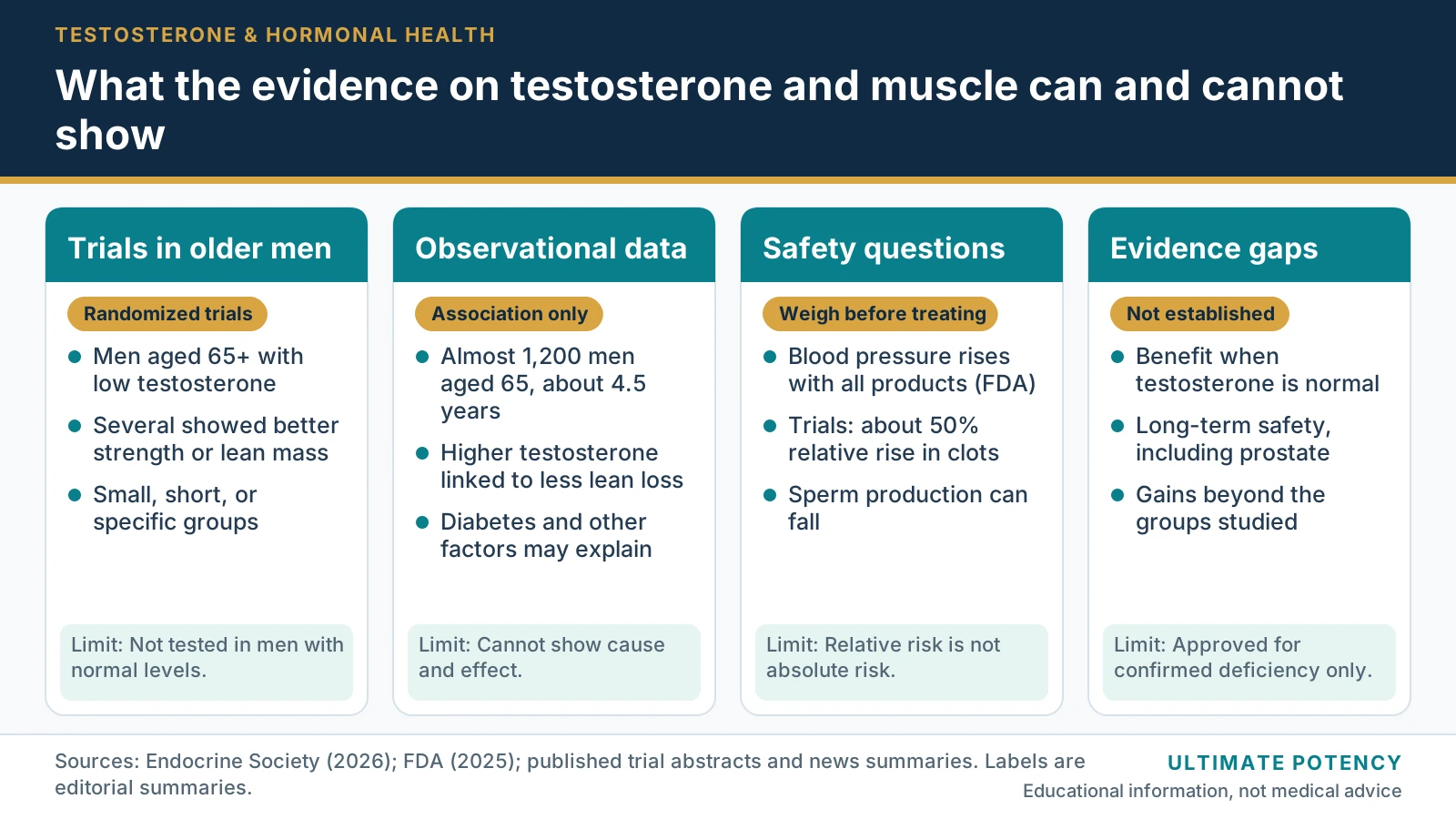
Text version: Trials in older men with low testosterone showed better strength or lean mass in several studies, but were small or short. Observational data show association only. Safety questions include blood pressure, clots, and sperm production. Gaps remain for men with normal levels and for long-term safety.
Treatment Paths and Muscle
When muscle loss and low testosterone appear together, treatment is rarely a single step. This section covers the first-line changes clinicians usually consider, how other conditions get managed alongside hormone questions, and where testosterone therapy fits when it is appropriate.
Addressing Contributing Factors First
Many of the most effective steps are not hormonal. These subsections describe training, nutrition, and weight, then the management of conditions that affect both muscle and hormones.
Strength Training, Protein, and Weight
Cleveland Clinic names nutrition and physical activity as first-line approaches for low testosterone, with further treatment considered if there’s no improvement after 6 to 12 months or if symptoms are severe. The Endocrine Society goes a step further for one common situation: when low testosterone is linked to overweight or obesity (a body mass index above 27) with no other identified cause, its 2026 statement says weight loss is typically the first-line therapy.
For muscle specifically, Harvard Health highlights that protein paired with heavy resistance exercise produced the greatest muscle and strength gains in healthy older adults. Notice the balance this creates: losing fat without protecting muscle can backfire, so training and adequate protein belong in the same plan as weight loss. A clinician, physical therapist, or registered dietitian can set a program that fits your health, joints, and medicines. Specific amounts and exercise routines are individual decisions, so this article leaves them to the professionals who know you.
Treating Other Conditions Alongside Hormone Questions
Because conditions and hormones affect each other, managing one can change the other. Treating sleep apnea, improving diabetes control, correcting a thyroid problem, or adjusting a medicine may improve energy and muscle and may change testosterone results on a repeat test. Cleveland Clinic also notes that testosterone treatment may not be appropriate when sleep apnea is untreated, along with several other conditions such as poorly managed high blood pressure, so addressing those first can be part of making treatment possible at all.
That’s a useful reason to ask for a stepwise plan. A reasonable one might include repeating labs after contributing factors are managed, rather than committing to hormone treatment from a single result. It also helps to ask which changes you should expect to see and over what timeframe, so you can judge whether the plan is working. If it isn’t, that’s a conversation to have rather than a failure on your part, and the next step might be further testing for the cause.
Testosterone Therapy in Context
Testosterone therapy is a real treatment for a real condition, and it also carries trade-offs. These subsections explain who it is meant for and what to weigh before and after starting.
Who Therapy Is Meant For
The FDA’s class-wide labeling announcement states that testosterone products are approved solely for men who lack or have low testosterone levels along with an associated medical condition, and that the Limitation of Use for age-related hypogonadism is retained. A testosterone cypionate label lists primary hypogonadism (a problem in the testicles) and hypogonadotropic hypogonadism (a problem with the brain’s signals) as its indications, and says safety and efficacy in age-related hypogonadism haven’t been established.
So therapy is not approved as a muscle-building or anti-aging product. The Endocrine Society’s 2026 statement says treatment at a dose similar to what a man would naturally produce has clear benefits for appropriately diagnosed hypogonadism caused by disease of the testes, pituitary, or hypothalamus. The same label describes testosterone as a Schedule III controlled substance and warns that abuse can cause serious cardiovascular and psychiatric reactions. For a broader look, see our guides to TRT benefits and risks and who should not take testosterone.
Trade-Offs, Fertility, and Monitoring
Every benefit comes with questions. The FDA reports that completed blood-pressure monitoring studies confirmed an increase in blood pressure with all testosterone products, and that the boxed warning language about cardiovascular outcomes was removed after the TRAVERSE trial concluded there was no increase in adverse cardiovascular outcomes. That doesn’t mean every risk disappeared. The Endocrine Society’s statement says the trials, which enrolled more than 5,200 men, showed roughly a 50 percent relative increase in pulmonary embolism, a blood clot in the lungs, and more fractures. Relative figures don’t reveal the absolute risk, so ask your clinician what they mean for you.
Testosterone therapy can reduce sperm production, so anyone who wants children should raise fertility before starting. MedlinePlus says testosterone injections may reduce sperm production and that men who want children should talk to their doctor, and the testosterone cypionate label notes the need to check hemoglobin and hematocrit for polycythemia, an overly high red blood cell count. Our guides on TRT and fertility and TRT monitoring blood tests cover these points.
Consider a hypothetical situation: a man in his early forties has two morning tests confirming low testosterone, a clinician has found a testicular cause, and he and his partner hope to have a child within two years. The right conversation covers how therapy could affect sperm production, whether other options exist, how often blood pressure and blood counts would be checked, and what happens if plans change. The decision belongs to him and his clinician, and a thorough plan includes follow-up.
Common Questions
Readers who search for low testosterone and muscle loss tend to land on the same handful of questions. This section answers them in plain terms, grouped by whether they’re about symptoms and testing or about treatment and products, and each answer points back to what the evidence can and can’t support.
Questions About Symptoms and Testing
The first group covers what low testosterone can and can’t explain, and what to consider when lab results don’t match how your body feels.
Can Low Testosterone Cause Muscle Loss on Its Own?
It can contribute, but “on its own” is rarely the right frame. Major sources including Cleveland Clinic and Mayo Clinic list reduced muscle strength or mass among the symptoms of low testosterone, and trials in older men with low levels have found strength and lean mass improving with treatment. That supports a real connection.
Still, muscle is shaped by training, food, sleep, medicines, illness, and age, and these often operate together. The Endocrine Society’s 2026 statement is blunt that symptoms alone aren’t diagnostic. In practice, a man with a clearly and repeatedly low level and several matching symptoms is a more convincing case than a man with weaker muscles and a single borderline number. If the question is whether your testosterone is responsible, the honest answer is that it takes repeat morning testing and a review of other causes to say. A clinician can weigh both and tell you how much of the change a hormone problem might explain.
If My Result Is Normal, What Else Could Explain Weakness?
A normal result is useful information because it shifts attention to other explanations. Common ones include reduced activity, too little protein or too few calories, poor sleep, sleep apnea, the effects of a medicine, an ongoing illness, and the gradual muscle loss that comes with aging. Harvard Health notes that adults who don’t strength train can lose several pounds of muscle per decade, which shows how much change can happen with hormones in the usual range.
It’s also worth asking whether the test was done at the right time. MedlinePlus says blood is usually drawn in the morning, and an afternoon draw can look different. If the result was borderline or the timing was off, a repeat is reasonable. If weakness is significant, getting worse, or comes with other symptoms such as unexplained weight loss, numbness, or trouble with balance, tell the clinician, since conditions affecting nerves, muscles, or other organs need their own evaluation. A normal testosterone level doesn’t mean your symptoms aren’t real.
Questions About Treatment and Products
The second group looks at what testosterone therapy can realistically do for muscle and what to think about before reaching for over-the-counter products.
Will Testosterone Therapy Rebuild My Muscle?
For men with a confirmed deficiency, therapy can improve some measures of muscle. In the trials summarized earlier, older men with low levels who received testosterone showed better strength tests or more lean mass than those on placebo in several cases, such as the 36-month trial that found improved grip strength and physical performance and the trial in frail older men that found higher knee-extension strength.
But “can improve” isn’t the same as “will rebuild,” and the gains in those studies were measured in specific groups under supervision. Therapy isn’t a substitute for training and nutrition, and it isn’t approved for building muscle in men whose levels are normal. The FDA’s labeling announcement says these products are approved solely for men with low or absent testosterone and an associated medical condition. A realistic way to frame the question for a clinician is, “If my deficiency is confirmed, what changes in strength should I expect, how will we measure them, and what are the risks for someone with my health history?”
Are Over-the-Counter T Boosters a Shortcut?
Not a reliable one. “Natural” doesn’t mean safe, and supplements aren’t reviewed the way prescription drugs are. Cleveland Clinic warns against relying on over-the-counter supplements for bothersome symptoms of low testosterone. The FDA’s sexual enhancement and energy product notifications page, updated October 15, 2026, warns that many products marketed for sexual enhancement or energy are likely to be contaminated, that they are not guaranteed to work, and that a product missing from its list isn’t necessarily safe.
That page focuses on sexual enhancement and energy products rather than muscle-building supplements, so its warning shouldn’t be stretched beyond what it covers. Still, the principle carries over: research on a single ingredient doesn’t show that a finished product works, and labels can omit what’s inside. If you’re taking or considering any supplement, tell your clinician, because some products can affect lab results or interact with medicines. And any product claiming to raise testosterone and build muscle quickly deserves extra skepticism.
Your Next Steps
You don’t need all the answers to take a useful next step. This section helps you prepare for an appointment, shows what to ask, and explains what happens afterward so you can stay involved in the plan.
Preparing for Care
Good preparation turns a short visit into a productive one. These subsections cover what to track and which questions to bring.
Tracking What You Notice
A clinician can do much more with specifics than with general impressions. Over a week or two before your visit, jot down what has changed, when it began, and how it affects daily life. Write down what you can do now compared with before, such as how many flights of stairs you manage, what weight you used to lift, or how far you can walk comfortably. Note changes in sleep, mood, energy, sex drive, and weight at the same time, since low testosterone rarely shows up as a single symptom.
Then gather the context. Bring a list of every prescription, over-the-counter product, and supplement you take, including anything for muscle or energy, and mention any recent illness, surgery, injury, or hospital stay. If you’ve had blood work, bring the results or know where to find them. The table below turns these ideas into a simple checklist. Think of it as a way to get the ball rolling before the appointment, not as a test you need to pass.
This preparation table lists what to note, why each item helps, and how to bring it up.
| What to note | Why it helps | How to bring it up |
|---|---|---|
| When the muscle change began and how fast it progressed | Gradual and sudden changes point toward different causes | “It started about X months ago after…” |
| Everyday tasks that are harder now | Concrete examples are easier to assess than “I feel weak” | “I used to do X, and now I struggle with it.” |
| Other changes: sleep, mood, sex drive, weight, energy | A cluster of changes helps a clinician decide on testing | “Along with this, I’ve also noticed…” |
| All medicines, supplements, and any steroid or hormone use | Medicines and substances can affect muscle and testosterone | “Here is my full list, including anything I buy without a prescription.” |
| Recent illness, surgery, injury, or inactivity | These can cause muscle loss and temporary hormone dips | “Before this started, I had…” |
| Fertility goals and family plans | Testosterone therapy can reduce sperm production | “We may want children, so I’d like to discuss that first.” |
Source: original editorial preparation guide informed by MedlinePlus and Cleveland Clinic guidance on history, medicines, and testing. It is not a self-diagnosis tool.
Questions About Low Testosterone and Muscle Loss
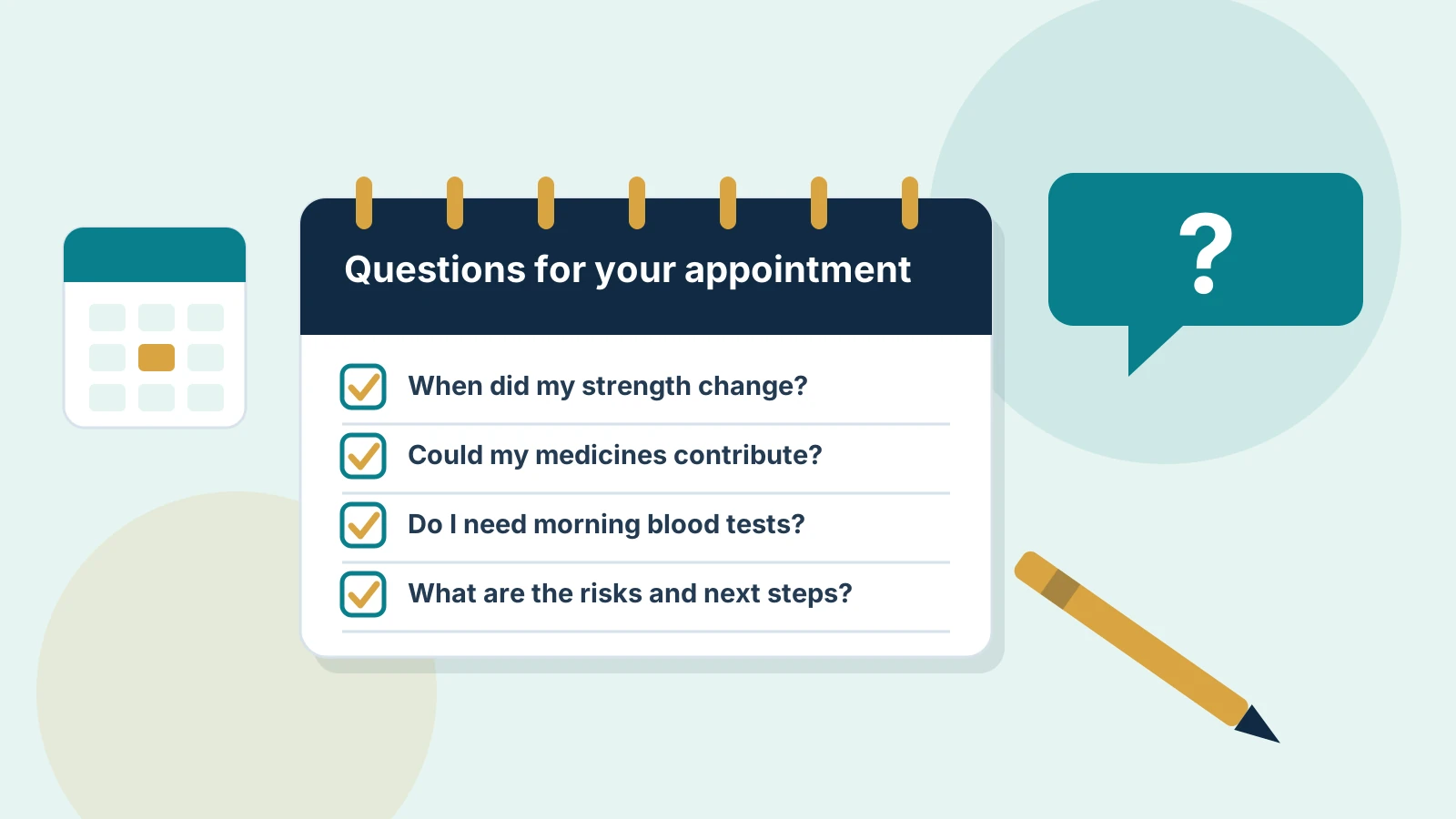
Questions help you stay in the conversation. A few worth considering: What do you think is most likely behind my muscle loss, and what else are you considering? Do my symptoms and history justify morning blood tests, and should any be repeated? Could my medicines, sleep, weight, or another health condition be contributing? What would you want to see in the results before recommending any treatment?
If hormone treatment comes up, you can ask what the benefits are likely to be for you, what the risks are given your health history, how it could affect fertility, and what monitoring would involve. It’s also fair to ask about alternatives, including a structured exercise and nutrition plan, and how long to try them before rechecking. Finally, ask what to expect and when you’ll follow up. The checklist below summarizes the preparation steps. Writing questions down in advance helps you remember them when the visit gets busy, and a clinician will usually welcome them because they show you’re an active partner in the decision.
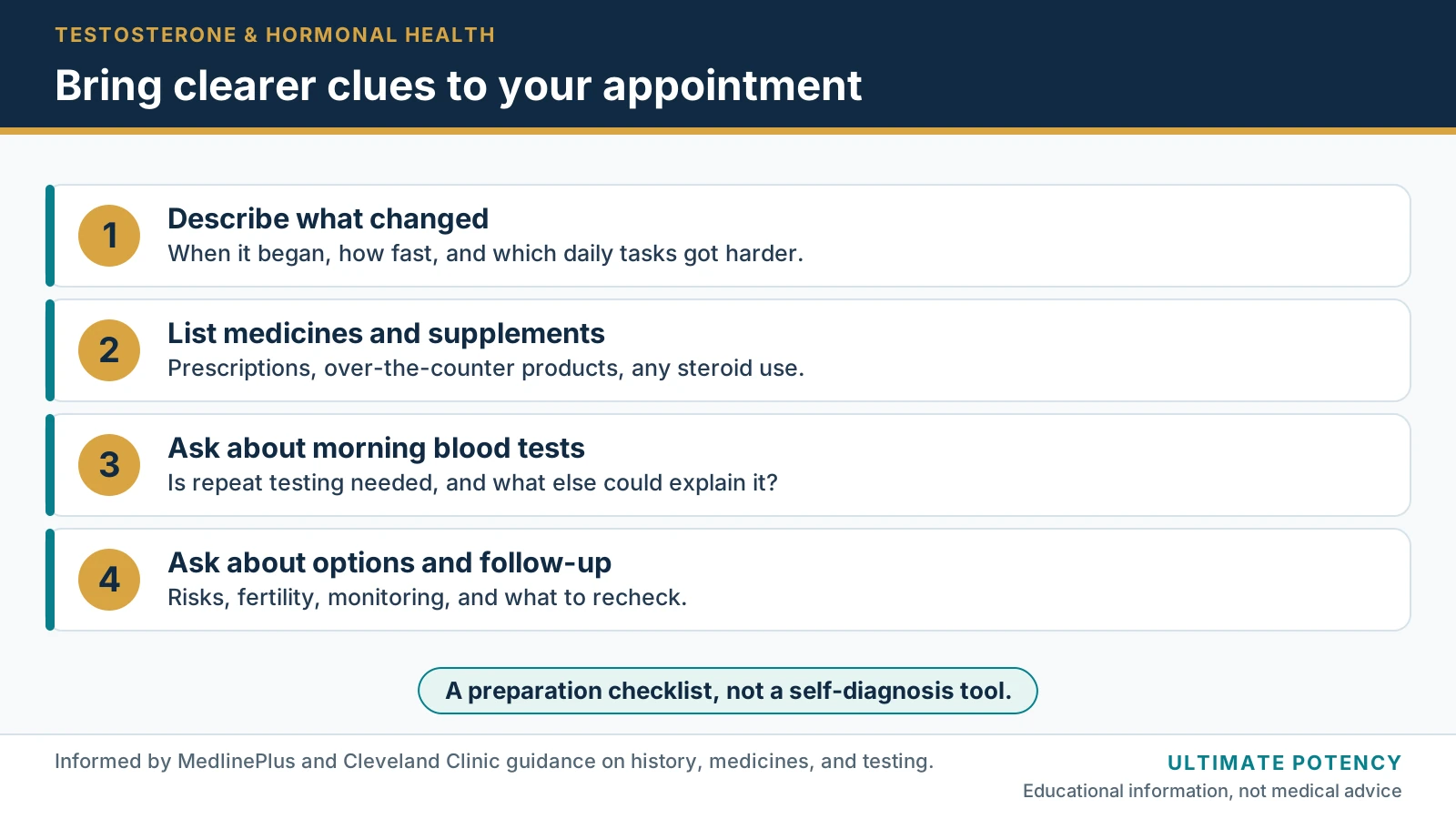
Text version: Step 1: describe what changed and which tasks got harder. Step 2: list every medicine and supplement. Step 3: ask about morning blood tests and other explanations. Step 4: ask about options, risks, fertility, monitoring, and follow-up.
After the Visit
What happens after the appointment matters as much as the visit. These subsections cover making sense of the plan and keeping your sense of self steady while you follow it.
Understanding the Plan and Follow-Up
Before you leave, try to be able to say in your own words what the plan is. Which tests are being repeated, and when? Which contributing factors are being addressed first? What would prompt a change in direction? If testosterone therapy is chosen, Cleveland Clinic says follow-up is typically once or twice a year, and MedlinePlus describes blood pressure checks before starting and regularly during treatment, plus blood tests to check levels and response. Ask for copies of your results so you can compare them over time.
If something feels off after starting any treatment, don’t wait for the next scheduled visit. Report new symptoms such as swelling or pain in a leg, trouble breathing, or a big change in mood. Seek emergency care for chest pain, severe shortness of breath, or signs of a stroke. Also keep your clinician informed about any supplements you add later. Results take time, so agree on a realistic timeline for judging whether the plan is working, and ask what you’ll do next if it isn’t.
Keeping Perspective on Strength and Worth
Muscle changes can sting, particularly if you’ve tied strength to identity, to work, or to how you show up for the people around you. It helps to remember that your worth doesn’t rise or fall with your muscle mass or your testosterone level. A hormone result is a piece of health information, and strength is a skill you can build in many ways at many ages.
Take the pressure off by focusing on what you can control. Regular resistance exercise, enough protein, decent sleep, and good medical follow-up all help whether or not testosterone turns out to be low. If you’re feeling down or anxious about your body, that deserves attention too, and our guide to low testosterone and mood explains how mood and hormones can interact. Talk with a partner, friend, or counselor if that helps. Small, steady improvements usually matter more than a dramatic fix, and a good plan keeps your whole health in view rather than a single number.
Sources
- Statement on Testosterone Replacement Therapy. Endocrine Society. July 16, 2026. Checked 2026-10-16.
- FDA issues class-wide labeling changes for testosterone products. U.S. Food and Drug Administration. February 28, 2025. Checked 2026-10-16.
- Low Testosterone (Male Hypogonadism). Cleveland Clinic. Last reviewed February 23, 2026. Checked 2026-10-16.
- Male hypogonadism: Symptoms and causes. Mayo Clinic. Review date not shown on page. Checked 2026-10-16.
- Testosterone Levels Test. MedlinePlus (NIH). Last updated June 5, 2025. Checked 2026-10-16.
- Testosterone Injection: MedlinePlus Drug Information. MedlinePlus (NIH). Revised May 15, 2025. Checked 2026-10-16.
- Testosterone Cypionate injection prescribing information. Pfizer (FDA-approved labeling). Revised 6/2025. Checked 2026-10-16.
- Evaluation and Management of Testosterone Deficiency. American Urological Association. Published 2018; validity confirmed 2024. Checked 2026-10-16.
- Researchers find testosterone treatment has some benefits for older men with low testosterone (Testosterone Trials). Penn Medicine. February 2016. Checked 2026-10-16.
- Exogenous testosterone alone or with finasteride increases physical performance, grip strength, and lean body mass in older men with low serum testosterone (Page et al.). University of Washington ResearchWorks record; J Clin Endocrinol Metab 2005. 2005. Checked 2026-10-16.
- Randomized trial of testosterone gel in intermediate-frail and frail older men (strength, function, body composition). University of Auckland ResearchSpace record. Year not shown on record page. Checked 2026-10-16.
- Adverse events associated with testosterone administration (Basaria et al.). QxMD Read abstract record; N Engl J Med 2010. July 2010. Checked 2026-10-16.
- For Older Men, Lowered Testosterone May Mean Muscle Loss. HealthDay. October 2011 news report. Checked 2026-10-16.
- Muscle loss and protein needs in older adults. Harvard Health Publishing. August 14, 2024. Checked 2026-10-16.
- Sexual Enhancement and Energy Product Notifications. U.S. Food and Drug Administration. Page updated October 15, 2026. Checked 2026-10-16.
Ultimate Potency is an educational publication. It does not diagnose, prescribe, or provide medical care. This article does not replace advice from a licensed healthcare professional who knows your history.