If your waistline has crept up and you’ve started wondering about low T, you’re asking a reasonable question. Searching for low testosterone and weight gain tends to produce two loud answers. One says a hormone problem is quietly behind every extra pound. The other says hormones have nothing to do with it. The research sits between those two, and the middle ground is more useful than either slogan, because it points toward what is actually worth checking.
This guide focuses on that overlap. It explains what clinicians mean by low testosterone, why body weight and testosterone influence each other, what studies can and can’t show, which other conditions and medicines can cause weight gain, and how a blood test fits in. It won’t tell you what your own numbers mean, because only a clinician who knows your history can do that. For the broader hormone picture, see our guide to low testosterone symptoms. Two closely related symptom guides cover low testosterone and mood and low testosterone and muscle loss.
A quick note on tone. Weight changes can feel loaded, and a hormone result can too. Neither says anything about your discipline, your worth, or your masculinity. They’re health information, and health information is meant to be looked into calmly and without blame.
Understanding Low Testosterone and Weight Gain
Before looking at studies or lab reports, it helps to get the vocabulary straight. People use “low T,” “hypogonadism,” “belly fat,” and “weight gain” as if they were interchangeable, and that blurring causes much of the confusion online. This section defines the terms, separates weight from body composition, and explains why the relationship between testosterone and body weight is real but not a simple one-way street.
Key Concepts
This subsection sets out the building blocks: what low testosterone means in clinical language, and how weight, fat, and muscle differ from one another. Once those are clear, the rest of the topic is much easier to follow.
What Low Testosterone and Weight Gain Means
Low testosterone, often shortened to low T, describes a blood level of the hormone that is lower than expected. Clinicians use hypogonadism (when the testicles, or the brain signals that drive them, don’t produce enough testosterone) when low levels come with symptoms. The Endocrine Society’s July 2026 statement says diagnosis requires both symptoms and consistently low, accurately measured total and free testosterone. Weight gain simply means the scale number is rising, whatever the reason.
Put together, “low testosterone and weight gain” describes two things that can show up in the same person, and sometimes influence each other. It does not mean that one automatically explains the other. A man can gain weight with perfectly normal testosterone, and a man can have low testosterone and a stable weight. The useful question is whether the two are connected in your case, and that takes a clinician, a history, and a lab report to sort out.
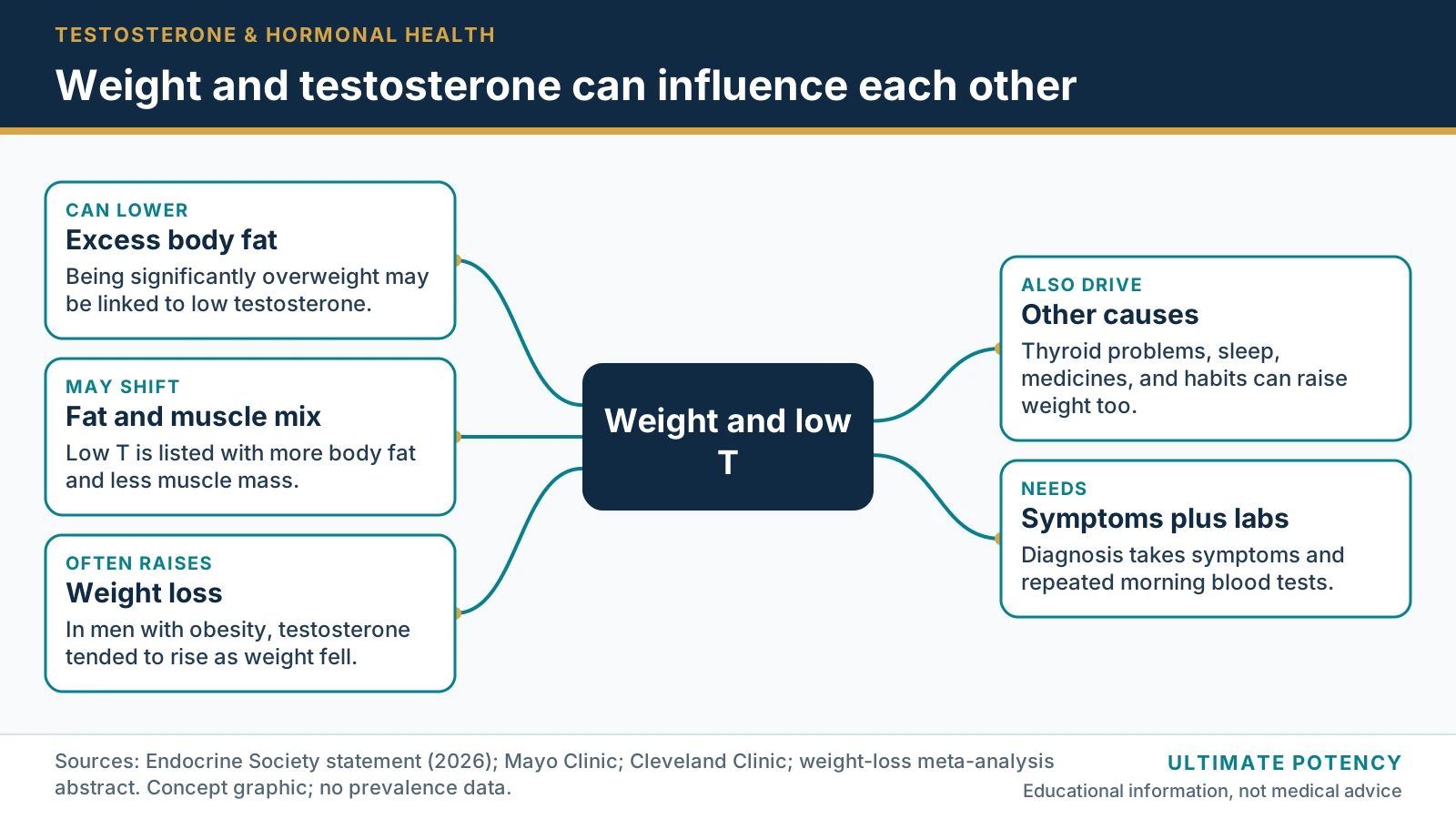
Text version: Weight and low T sit at the center. Excess body fat can lower testosterone. Low T is listed with a shift in fat and muscle mix. Weight loss often raises testosterone in men with obesity. Other causes such as thyroid problems, sleep, medicines, and habits also drive weight. Diagnosis needs symptoms plus labs.
Weight, Body Fat, and Muscle Are Different Measures
Body weight is a blunt number. It adds up fat, muscle, bone, water, and everything else, which is why two men at the same weight can look and feel quite different. When sources discuss low testosterone, they usually talk about body composition, meaning the mix of fat and muscle, rather than weight alone. Cleveland Clinic’s overview of low testosterone lists increased body fat and decreased muscle mass and strength among the possible symptoms.
That distinction matters because fat gain and muscle loss can offset each other on the scale. Someone could gain fat and lose muscle while the number barely moves. The table below sorts out the terms you’re likely to meet, along with the most common misunderstanding about each one.
This table separates the words people use for hormone levels and body changes, so each one is easier to discuss with a clinician.
| Term | Plain-language meaning | Common misunderstanding |
|---|---|---|
| Low testosterone (low T) | A blood level lower than expected | That any low number explains how you feel |
| Hypogonadism | Low testosterone together with symptoms or signs, from a testicular or brain-signal cause | That it is the same thing as getting older |
| Weight gain | A rising number on the scale | That it always means more fat |
| Body composition | The mix of fat, muscle, and other tissue | That weight alone captures it |
| Waist size | A rough sign of fat carried around the middle | That it diagnoses a hormone problem |
Sources: Endocrine Society statement (July 16, 2026); Cleveland Clinic; MedlinePlus. Plain-language summaries, not clinical definitions.
Why the Link Is a Two-Way Street
Many people assume the arrow points one direction, from hormone to weight. The evidence suggests it points both ways, and that is the single most important idea in this article. The next two subsections explain why, and why a single cause is rarely the whole story.
Why Cause and Effect Can Run Both Directions
Mayo Clinic’s page on male hypogonadism notes that being significantly overweight at any age might be linked to hypogonadism, which means excess weight can be on the cause side of the equation. Cleveland Clinic goes further, saying most men with low testosterone symptoms have an issue linked to obesity or diabetes. At the same time, low testosterone is associated with less muscle and more fat, so the hormone may also be on the effect-of-weight side.
Picture a loop rather than a line. More body fat can be associated with lower testosterone, lower testosterone may make it harder to hold on to muscle and easier to gain fat, and the cycle can feed itself. Loops like this are common in medicine, and they’re why ”which came first?” is often impossible to answer from a single blood test. It’s also why the same step, such as improving sleep or activity, may help on both sides at once.
Why Bodies Rarely Gain Weight for One Reason
Weight gain is almost never a one-factor story. Calories, activity, sleep, stress, medications, age, and medical conditions all take a turn. The MedlinePlus page on unintentional weight gain lists aging, certain medicines, hormone-related conditions such as hypothyroidism and Cushing syndrome, fluid retention, and quitting smoking among the possible causes.
Low testosterone isn’t on that list, which is a useful reminder of how many other explanations exist. It doesn’t mean testosterone is irrelevant. It means a thoughtful evaluation starts broad. If you’ve gained weight and you also notice a drop in sex drive, energy, or muscle, those details help a clinician decide whether a hormone check makes sense. If weight is the only change, other explanations usually deserve a look first.
Where Body Changes Fit Among Symptoms
Weight is only one of several changes people link to low testosterone, and it is far from the most specific one. This section looks at how major medical sources describe body changes, why the scale can hide what’s happening underneath, and which other signs make a hormone question more or less likely.
What Medical Sources Say
Reputable sources describe low testosterone symptoms a bit differently, and the differences are informative. Reading them side by side shows where body fat sits in the list and where it doesn’t.
How Major Sources List Body Changes
The sources agree on some body changes and diverge on others. Cleveland Clinic lists increased body fat along with reduced muscle strength and endurance. Mayo Clinic lists less muscle mass but doesn’t name body fat in the page I reviewed. MedlinePlus names loss of muscle mass, along with reduced sex drive, erectile dysfunction, infertility, and enlarged breasts, and doesn’t mention weight or fat on its testosterone test page.
That pattern is telling. Muscle loss shows up in every source; fat gain shows up in some. It suggests that weight gain is a softer, less specific clue than reduced muscle or changes in sexual function. None of these pages says weight gain on its own indicates low testosterone, and none offers a number that separates ordinary weight gain from a hormone problem.
Fat Gain and Muscle Loss Can Hide Each Other
Imagine two men who both weigh the same as they did five years ago. One has kept his muscle and stayed lean. The other has lost some muscle and gained fat in the middle of his body. The scale can’t tell them apart, but their health and strength may differ. This is why a clinician may ask about clothing fit, strength, and stamina instead of focusing only on pounds.
If muscle is the part that worries you, our guide on low testosterone and muscle loss goes deeper. The takeaway here is practical: track more than the scale. A waist measurement taken the same way each time, a note about how heavy things feel to lift, and a record of how your clothes fit can add details that weight alone leaves out. These aren’t diagnostic tools, but they give your clinician a clearer story than one number.
Signs That Travel Together
No single sign points to low testosterone, but certain combinations raise the question more convincingly than weight alone. This subsection covers the companions of weight change that clinicians tend to ask about, and why the overall pattern outweighs any one item.
Sex Drive, Energy, and Sleep Clues
Cleveland Clinic describes low libido, loss of morning or spontaneous erections, and trouble getting or keeping an erection as the most specific signs of low testosterone. MedlinePlus likewise lists reduced sex drive and erectile dysfunction. If weight gain comes with changes like these, a hormone question becomes more reasonable than if weight gain stands alone.
Energy and sleep are trickier. Fatigue and poor sleep can follow from low testosterone, but they also drive weight gain by changing appetite and activity, and conditions such as sleep apnea can sit behind both. For a closer look at the sleep connection, read our guide to low testosterone and sleep apnea. Mentioning these changes at an appointment is helpful, even if they feel unrelated to your weight.
Why a Pattern Matters More Than One Sign
The American Urological Association’s testosterone deficiency guideline page describes a man as testosterone deficient only when low levels are combined with symptoms or signs, and it notes that symptoms linked to low testosterone are very nonspecific and can reflect other conditions, such as chronic stress, fatigue, or depression. In plain terms, one clue rarely settles the question.
That’s why a pattern carries more weight. Rising weight, shrinking muscle, a lower sex drive, and less morning erection activity, all appearing around the same time, tell a clearer story than any single item. Timing helps too. A change that began after a new medicine, a stressful year, or a move to a desk job points somewhere different than one that crept in without an obvious trigger. Write the timeline down before your visit, because memory fades quickly and details change the conversation.
What the Research Shows
Studies on this topic fall into two broad groups: those asking whether losing weight changes testosterone, and those asking whether testosterone treatment changes body weight and composition. Each group answers a different question, and each has limits worth knowing before you draw conclusions. This section walks through both without overstating what they show.
Obesity and Testosterone Levels
The first body of evidence looks at men with obesity and asks what happens to their hormone levels when weight comes down. The results help explain the direction of the loop described earlier, with some important caveats.
What Weight Loss Studies Found
A systematic review and meta-analysis of weight loss in obese men pooled 24 studies that searched the literature through August 2012. Twenty-two looked at low-calorie diets or bariatric surgery, and two compared the two. Total testosterone rose after both approaches, and the rise was larger after bariatric surgery than after diet. The authors reported that the amount of weight lost was the strongest predictor of how much testosterone rose, that gains were larger in younger, non-diabetic men with more severe obesity, and that weight loss also lowered estradiol and raised gonadotropins, the pituitary signals that tell the testicles to work.
The authors concluded that weight loss increases testosterone. Like any pooled analysis, the result depends on the quality of the underlying studies, and the abstract doesn’t lay out those details. It also reports averages for groups of men, not what will happen to any one person.
What the Link Does Not Prove
Finding that testosterone rises when weight falls tells us the two move together. It doesn’t tell us that low testosterone was the original reason for the weight gain, and it doesn’t tell us that every man with a low result will see it normalize. Association isn’t the same as causation, and the loop between fat and hormones makes the question of “which came first” hard to answer even in careful studies.
There’s also a difference between low testosterone that tracks with excess weight and low testosterone caused by a problem in the testicles or pituitary gland. The Endocrine Society statement separates hypogonadism from diseases of the testes, pituitary, or hypothalamus from hypogonadism attributed to overweight or obesity with no other identified cause. The first group is treated differently from the second. Whether your low result fits one group or the other is a question for your clinician, and it shapes the whole plan.
Testosterone Treatment and Body Composition
The second body of evidence asks the reverse question: if you give testosterone to men who carry extra weight, does body composition change? One large trial is especially relevant here, and it’s worth understanding both its findings and its boundaries.
What the T4DM Trial Reported
The T4DM trial, published online in January 2021 in The Lancet Diabetes & Endocrinology, enrolled more than 1,000 Australian men aged 50 to 74 who were overweight or obese. According to the SAHMRI summary of the trial, every man joined a lifestyle program, and half also received long-acting testosterone injections every three months while half received placebo. The main outcome was type 2 diabetes after two years: 21% of the placebo group and 12% of the testosterone group.
For this article, the body composition findings matter most. Both groups lost about 3 to 4 kg on average, but the testosterone group showed greater body fat reduction, more skeletal muscle mass, and better grip strength than placebo. The most common adverse event was a rise in red blood cell concentration, in 22% of treated men. The authors said the results don’t mean testosterone should be routinely prescribed, and that lifestyle weight loss remains the benchmark.
Why Trial Results Do Not Apply to Everyone
A trial answers a narrow question about a specific group of people. T4DM involved men in a certain age range, in one country, receiving a structured lifestyle program, over two years. The summary I reviewed doesn’t state whether the men had low testosterone at the start, so the findings shouldn’t be read as a test of treating diagnosed testosterone deficiency. The authors also flagged open questions: whether benefits last beyond two years, whether longer treatment is safe, and whether other formulations behave the same way. Funding came from public and commercial sources, including drug and weight-management companies, which is common but worth noting.
Notice, too, what the trial did not claim. Testosterone didn’t replace the lifestyle program, and it didn’t make weight loss unnecessary. If you take one point from this trial, make it that body fat shifted modestly, in a particular group, under specific conditions. That is a long way from a general promise that testosterone helps people lose weight.
Comparing Relevant Factors
By now a pattern is emerging: the evidence is suggestive in places, thin in others, and heavily dependent on who was studied. This section lines up the main questions side by side, shows how strong the evidence is for each, and then widens the lens to other reasons weight can climb that have nothing to do with testosterone.
Evidence and Limitations
When a topic sits in the gray zone between hormones and everyday habits, it helps to sort claims by how well supported they are. The next two subsections do that, first with a table and then with a plain-language reading of what it means for you.
Strength of the Evidence by Question
Not every statement about low testosterone and weight gain rests on the same footing. Some come from pooled studies, some from a single trial, and some from symptom lists compiled by medical centers. The table below keeps those categories apart so you can see which claims have stronger backing and which are mostly reasonable inference. Treat it as an editorial summary of the sources opened for this article, not as a ranking of every study that exists.
This table lines up four common questions about low testosterone and weight, the kind of evidence behind each, and the main limitation to keep in mind.
| Question | Evidence type | What it found | Main limitation |
|---|---|---|---|
| Does weight loss raise testosterone in men with obesity? | Systematic review and meta-analysis of 24 studies | Total testosterone rose after diet and rose more after bariatric surgery | Abstract gives few quality details; group averages, not individual outcomes |
| Does testosterone treatment change body fat and muscle? | Two-year randomized, placebo-controlled trial (T4DM) | Greater fat loss and muscle gain than placebo; both groups lost about 3 to 4 kg | Men aged 50 to 74 in a lifestyle program; baseline testosterone not stated in the summary read |
| Is weight gain by itself a reliable sign of low T? | Symptom lists from medical centers | Cleveland Clinic lists more body fat; Mayo and MedlinePlus pages reviewed do not | Nonspecific; many other causes of weight gain |
| What is the usual first step when low T is attributed to excess weight? | Professional society statement | Weight loss is typically first-line when no other cause is found (BMI above 27) | A statement, not a trial; individual care varies |
Sources: PubMed abstract of the weight-loss meta-analysis; SAHMRI summary of the T4DM trial; Cleveland Clinic, Mayo Clinic, and MedlinePlus symptom pages; Endocrine Society statement (July 16, 2026). Evidence labels are editorial summaries.
How the Evidence Applies
Putting the table together, the best-supported idea is that weight and testosterone move together: when men with obesity lose weight, testosterone tends to rise. The next best supported is that testosterone treatment can shift body composition modestly in certain men, though it doesn’t replace lifestyle change. The weakest link is the one most people start with, namely that gaining weight proves you have low testosterone. It doesn’t, and no source I reviewed says it does.
For you, that translates into a sensible order of operations. Look at the whole picture first, including sleep, medicines, thyroid health, and daily habits. Consider a hormone test if the pattern fits. If low testosterone is confirmed and appears tied to excess weight, the Endocrine Society says weight loss is typically the first-line approach. Evidence strength varies, so ask your clinician which parts of the picture are well established for someone like you.
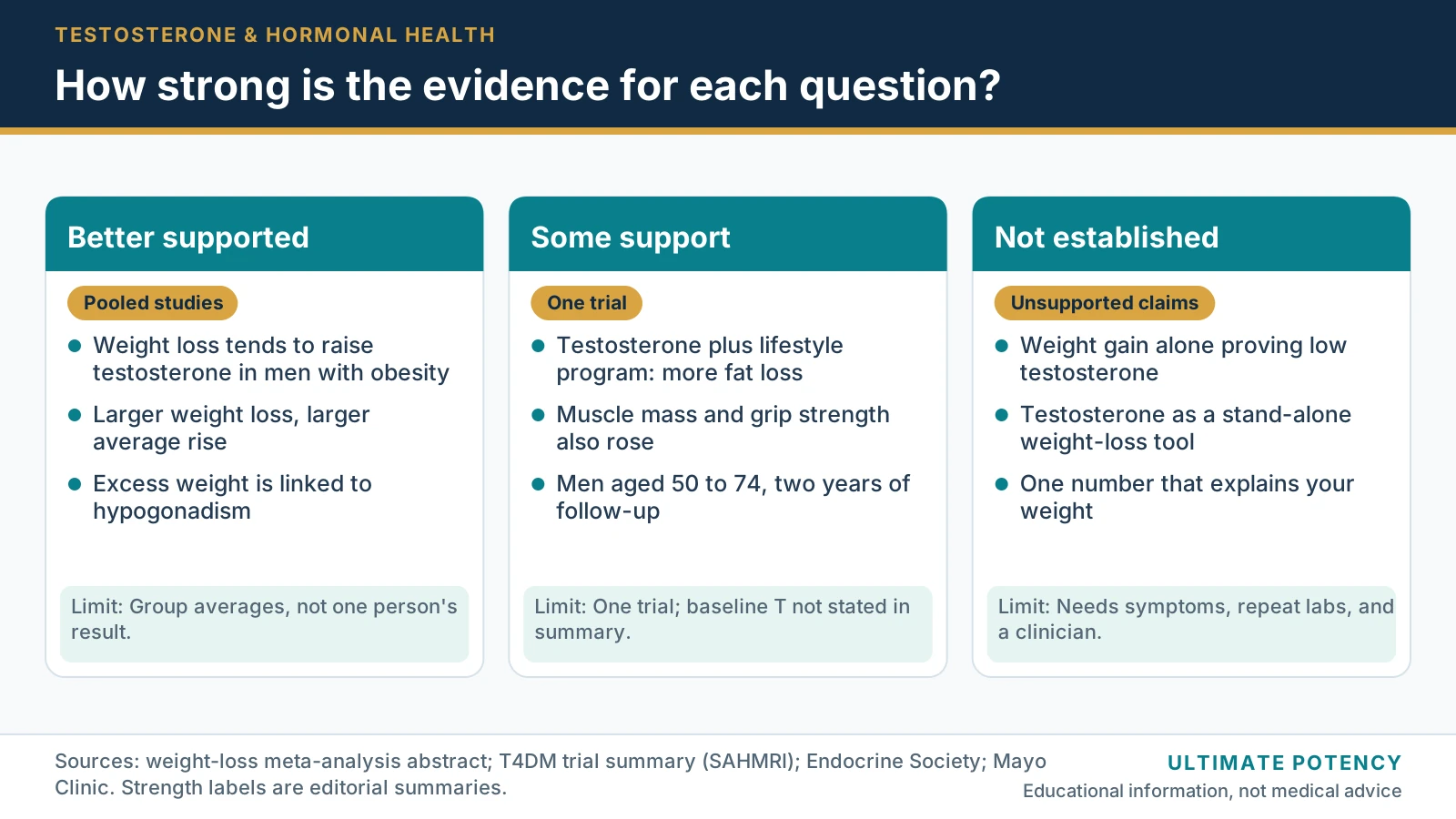
Text version: Better supported: weight loss tends to raise testosterone in men with obesity; larger loss, larger average rise; excess weight is linked to hypogonadism. Some support: one trial of testosterone plus a lifestyle program showed more fat loss and muscle gain. Not established: weight gain alone proving low T; testosterone as a stand-alone weight-loss tool; one number explaining your weight.
Other Reasons for Weight Gain
A thorough evaluation of weight gain doesn’t begin and end with hormones. Several medical conditions, medicines, and life changes can push the scale up, and some look a lot like low T from the inside. Knowing about them helps you ask better questions.
Medical Conditions That Can Mimic the Picture
MedlinePlus names Cushing syndrome and hypothyroidism among hormone-related conditions that can lead to unintentional weight gain. Hypothyroidism means the thyroid gland makes too little thyroid hormone, which can slow the body down. It also lists fluid retention from heart or kidney problems, noting that rapid weight gain may signal dangerous fluid retention and deserves prompt attention. It suggests contacting a provider if weight gain comes with constipation, hair loss, feeling cold more often, or swollen feet with shortness of breath.
Sleep apnea belongs here as well. Mayo Clinic lists untreated obstructive sleep apnea among conditions linked to low testosterone, and the two can travel together. Thyroid problems are another reason clinicians look beyond testosterone, and our guide to thyroid problems and testosterone covers how the two topics relate. This is exactly why a clinician may order more than one test rather than assuming a single cause.
Medicines and Life Changes That Matter
Medicines can affect weight and testosterone separately or together. MedlinePlus lists corticosteroids, some drugs for bipolar disorder, schizophrenia, and depression, and some diabetes medicines among those that can lead to weight gain. The Endocrine Society statement names corticosteroids and opioids among reversible contributors to consider before diagnosing low testosterone. Never stop or change a prescribed medicine on your own because of something you read. Some are essential, and a clinician or pharmacist can review whether one is likely to matter.
Consider a hypothetical situation: a man gains weight over about a year after starting a new prescription and taking a desk job. He assumes low T and searches for a testosterone test. At his visit, the clinician reviews his medicines, sleep, and habits first, then asks about sexual and muscle symptoms before deciding on blood work. The weight change turns out to have several contributors. The table below turns that kind of thinking into questions you can bring.
This decision aid links common companions of weight gain to other explanations a clinician may consider and to a question you can ask.
| If you notice | Other explanations to raise | A useful question to ask |
|---|---|---|
| Weight gain with constipation, hair loss, or feeling cold more often | Thyroid-related causes | Should my thyroid function be checked? |
| Weight gain after starting a new prescription | Medicine effects | Could any of my medicines be contributing, and what are my options? |
| Weight gain with swollen feet or shortness of breath | Fluid retention | Should this be evaluated promptly? |
| Weight gain with loud snoring or daytime sleepiness | Sleep apnea | Should I be evaluated for a sleep problem? |
| Weight gain with lower sex drive, less muscle, or fewer morning erections | A possible hormone question, among other causes | Is a morning testosterone test appropriate for me? |
Sources: MedlinePlus (unintentional weight gain, July 3, 2025); Mayo Clinic; Endocrine Society statement. A conversation guide, not a diagnostic tool.
Testing and Lab Results
If weight gain has you wondering about hormones, a blood test is the tool clinicians use to find out. A test is only useful, though, if it’s done at the right time, interpreted in context, and followed by sensible next steps. This section explains how testing works, why body weight complicates it, and how to read a result without reading too much into it.
What a Blood Test Can Show
A testosterone test measures how much of the hormone is circulating in your blood at one moment. That moment matters, and so does the context around the number. The next two subsections cover timing and the extra complexity that comes with excess weight.
Symptoms Plus Repeated Morning Tests
Testosterone levels are usually highest in the morning, so timing matters. MedlinePlus says blood is usually drawn between 7 and 10 a.m. and that fasting is needed only in certain cases. Cleveland Clinic explains that total testosterone testing usually takes two separate morning samples, and that illness can temporarily lower levels. The Endocrine Society statement calls for at least two early-morning, fasting tests. Sources differ a little on fasting, so ask the lab or clinic which instructions apply to you.
A single reading, especially one taken in the afternoon or while you’re sick, can mislead in either direction. The statement also says there is insufficient evidence to recommend screening men who have no symptoms. Testing without a symptom picture can create confusion rather than clarity. For more on how the process works from start to finish, see our guide on how low testosterone is diagnosed.
Why Weight Can Complicate Interpretation
Excess weight doesn’t just relate to testosterone; it can make the result harder to read. The MedlinePlus entry on hypogonadism notes that testosterone results in older or obese men can be hard to interpret, and that a hormone specialist, called an endocrinologist, should review them. That doesn’t mean your result is unreliable. It means that context, including body weight, other conditions, and the type of test, should shape how it’s read.
Test quality matters too. The Endocrine Society says non-standardized assays can give different results for the same blood sample, and it recommends assays certified through the CDC’s HoST program. In practice, you can’t inspect the method yourself, but you can ask whether the lab uses a standardized, reliable test. Home collection kits exist, and MedlinePlus says to follow the provider’s collection and return instructions if one is used. Whichever route you take, a result is a clue to be interpreted, not a verdict.
Reading Results Without Overreading
Once a report lands in your patient portal, the temptation is to Google the number immediately. A calmer approach is to ask what kind of result you have and what it would and wouldn’t change. Here is how to think about the two most common outcomes.
When a Result Is Low or Borderline
Lab reports show a number, a unit such as ng/dL, and a reference range, and it’s tempting to treat the range as a pass or fail line. The Endocrine Society mentions a common clinical threshold near 300 ng/dL, but reference ranges vary between labs, and a value near the edge is hard to interpret without symptoms and repeat testing. MedlinePlus is clear that a testosterone test alone can’t diagnose a condition, and that levels naturally decline with age.
Consider a hypothetical situation: a man has gained weight and gets one morning result just under his lab’s reference range. His clinician doesn’t jump to treatment. Instead, a repeat morning test is ordered, along with other labs. Cleveland Clinic notes that a luteinizing hormone (LH) test and a prolactin test can help identify the cause, which shows whether the problem lies in the testicles or in the brain’s signals. The clinician also looks for reversible contributors such as weight, sleep apnea, and medicines. The next step is more information, not a rush to decide.
When a Result Is Normal
A normal result is still information. It suggests that low testosterone is unlikely to be the main explanation for your symptoms, which is helpful, because it lets the search move on to other causes. Thyroid function, sleep quality, medicines, blood sugar, mood, and daily habits all come back into focus.
That shift can feel anticlimactic, even disappointing, if you were hoping for a clear, fixable answer. But weight gain with a normal hormone panel is common, and it is still real and still worth addressing. A normal testosterone result doesn’t mean your concerns aren’t valid, only that the explanation lies elsewhere. If symptoms persist or change, tell your clinician, because testing can be repeated and the picture can evolve. Bring the report to your next visit rather than discarding it.
Treatment Conversations and Safety
Treatment depends on what’s actually causing the problem. For many men, that conversation centers on weight, sleep, and overall health long before testosterone therapy comes up. This section covers the weight-focused approach first, then what testosterone therapy is and isn’t, including its risks and its effects on fertility.
Weight-Focused Care First
When low testosterone appears alongside excess weight, professional guidance leans toward addressing the weight first. That can sound like dismissing your concern, but it reflects what the evidence says about how closely the two are tied.
Why Weight Loss Is Often the First Step
According to the Endocrine Society statement, for hypogonadism attributed to overweight or obesity (BMI above 27) with no other identified cause, weight loss is typically the first-line therapy. This fits the meta-analysis described earlier, in which testosterone rose as weight fell, and the T4DM trial, where lifestyle weight loss was the benchmark and testosterone was studied on top of it. Body mass index, or BMI, is a rough ratio of weight to height. It’s a screening tool, not a verdict on health.
Going first doesn’t mean going alone. A clinician, dietitian, or weight-management program can help set realistic, sustainable goals. Small, steady changes in food, movement, and sleep are easier to keep than dramatic ones, and they tend to help blood pressure, blood sugar, and energy too. Our guide to obesity and low testosterone takes this angle further. Slow and steady usually beats fast and fragile, which is a rule of thumb rather than a promise.
Working Safely With Your Care Team
Before making big changes, talk with your clinician, especially if you have other health conditions or take regular medicines. MedlinePlus lists rapid, significant weight loss, including after bariatric surgery, among situations associated with central hypogonadism, which is a different scenario from gradual loss in men with obesity. On average, studies show testosterone rising with weight loss, but extreme approaches carry their own risks.
If you’re prescribed medicines for diabetes, blood pressure, or mood, don’t change them on your own as your weight shifts. Doses sometimes need adjusting as health improves, and that’s a clinician’s call. Supplements marketed as testosterone boosters are another area for caution: ”natural” is not a safety guarantee, and research on a single ingredient doesn’t prove that a finished product helps. Share everything you take, including over-the-counter products, so your care team sees the full picture.
Testosterone Therapy Basics
Testosterone therapy is a legitimate treatment for men who are properly diagnosed. It isn’t a general weight-loss tool, and it comes with trade-offs worth understanding before the subject comes up at your appointment.
Who Testosterone Therapy Is Meant For
The FDA’s February 2025 announcement says testosterone remains approved only for men who lack or have low testosterone levels together with an associated medical condition, and that the limitation of use for age-related hypogonadism is being kept. The Endocrine Society statement says treatment at doses similar to what a man would naturally produce has clear benefits for men with appropriately diagnosed hypogonadism caused by disease of the testes, pituitary, or hypothalamus. It advises against terms like “age-related” or “late-onset” hypogonadism.
None of these sources presents testosterone as a treatment for weight gain on its own. A confirmed diagnosis, a look at reversible contributors, and a risk discussion come first. The American Urological Association’s page makes the same basic point, that deficiency means low levels plus symptoms. For the full picture of benefits and downsides, see our guide to TRT benefits and risks.
Risks, Fertility, and Monitoring
Treatment decisions weigh benefits against risks. The Endocrine Society reports that the TRAVERSE trials, which followed more than 5,200 men for one to four years, found no meaningful increase in heart attack or stroke, but did show roughly a 50% relative increase in pulmonary embolism (a blood clot in the lung) and more bone fractures in treated men. Long-term safety, including prostate cancer risk, isn’t yet established. The FDA says testosterone products raise blood pressure as a class, and labels are being updated accordingly.
Fertility deserves its own mention. The MedlinePlus page on topical testosterone says these products may reduce sperm production, especially at high doses, and that men who want children should discuss this with their doctor. In the T4DM trial, about one in five treated men (22%) developed higher red blood cell concentration, which could potentially thicken the blood. Monitoring through lab tests before and after starting treatment is part of safe care.
Common Questions
Readers who land on this topic tend to ask the same handful of questions. Here are straightforward answers, grouped by whether they’re about cause and effect or about testing and treatment. Each answer reflects the sources reviewed for this article and is educational, not a substitute for advice from someone who knows your health history.
Cause and Effect Questions
The most common questions are about which factor drives which. Because the relationship runs both ways, the honest answers include a few “it depends” moments, but they’re still useful.
Does Low Testosterone Cause Weight Gain?
It may contribute, but the evidence doesn’t show that it is the main cause for most people. Sources such as Cleveland Clinic list increased body fat and reduced muscle among possible symptoms, and the T4DM trial found greater fat loss and muscle gain with testosterone treatment than with placebo in a particular group of men. Those findings make a contribution plausible. They don’t establish that low testosterone is behind a given person’s weight gain.
Everyday factors still carry a great deal of weight, including food, activity, sleep, stress, medicines, and conditions like hypothyroidism. A clinician will usually look at all of them. If your weight gain comes with sexual, muscle, or energy changes, a hormone check is more reasonable, and it should still follow a proper evaluation instead of replacing one. Our guide on low testosterone symptoms lays out the wider symptom picture.
Does Gaining Weight Lower Testosterone?
It can, and this is the better-supported direction. Mayo Clinic connects significant excess weight, at any age, with a possible link to hypogonadism, and Cleveland Clinic reports that obesity or diabetes sits behind most men’s low testosterone symptoms. The meta-analysis of weight loss in obese men found that testosterone rose as weight came down, with greater weight loss associated with larger increases.
The practical point is that low testosterone in someone carrying extra weight isn’t necessarily a permanent hormone failure. In some men it may partly reflect the weight itself. That’s why the Endocrine Society calls weight loss the typical first-line approach when low testosterone is attributed to overweight or obesity with no other cause. It isn’t a promise that levels will normalize, and some men have additional causes. Your clinician can help work out which situation fits you.
Testing and Treatment Questions
The second group of questions is about what to do: whether to get tested, and whether treatment will change your weight. The answers lean on caution without discouraging you from seeking help.
Will Testosterone Therapy Make Me Lose Weight?
Not reliably, and not on its own. In the T4DM trial, both the testosterone and placebo groups lost about 3 to 4 kg on average while taking part in a lifestyle program, and the testosterone group showed additional changes in fat and muscle. That is a modest, specific finding in men aged 50 to 74, not a general weight-loss effect. The authors said lifestyle weight loss remains the benchmark.
Testosterone is also not approved as a weight-loss treatment; the FDA describes approval for men with low testosterone and an associated medical condition. Therapy involves real risks, monitoring, and effects on fertility, so it isn’t something to pursue just to move the scale. If you’ve been diagnosed with hypogonadism and treatment is on the table, ask what changes in body composition are realistic for you and what your plan is if they don’t happen. Therapy works best as part of a larger plan, not as a shortcut.
Should I Ask for a Test If I Have Gained Weight?
You can always raise the question, and a good clinician will take it seriously. Whether a test makes sense depends on the whole picture: other symptoms, medicines, sleep, medical conditions, and your goals. The Endocrine Society says evidence is insufficient to recommend routine testing in men with no symptoms, so weight gain alone is usually not a reason to order one.
If you have additional signs, such as lower sex drive, fewer morning erections, or loss of muscle, say so plainly. Saying “I’m worried about low T” is fine, but it helps to add specifics. Ask what the clinician would check first, and whether other causes should be ruled out in parallel. Our overview of low testosterone and muscle loss can help you describe muscle changes in practical terms. If testing is ordered, ask about timing, fasting instructions, and whether it will be repeated.
Your Next Steps
You don’t need a perfect theory about your weight before you see someone. You need a clear story, a complete list of what you take, and a few good questions. This section shows how to prepare for a visit and how to make decisions together afterward.
Preparing for Care
A little preparation turns a short appointment into a productive one. The two subsections below cover what to track and what to ask.
What to Track and Bring
Start with a simple timeline. When did you first notice the weight change, and was it gradual or sudden? Did anything else shift around the same time, such as a new medicine, a job change, an injury, or a rough patch with sleep? Bring a list of everything you take, including prescriptions, over-the-counter products, and supplements, plus any earlier lab results. If you may want to have children, mention it early, because it shapes which options make sense.
The table below organizes these pieces. It isn’t a self-assessment, and nobody expects you to fill in every row. Even a few notes help your clinician see patterns that memory alone might miss. Bring what you have rather than waiting until it’s perfect.
This table lists what to track before a visit, why each item helps, and how to raise it with your clinician.
| What to note | Why it helps | What to bring up |
|---|---|---|
| Weight and waist timeline | Shows how fast and when changes began | “My weight changed over about this period.” |
| Sexual and energy changes | Helps judge whether a hormone question fits | “I’ve noticed changes in desire, erections, or stamina.” |
| Medicines and supplements | Some can affect weight and hormones | “Could anything I take be contributing?” |
| Sleep, snoring, and daytime sleepiness | Sleep problems link to weight and low testosterone | “Should I be checked for a sleep problem?” |
| Fertility plans and prior lab results | Affect which options are suitable | “I may want children, and here are my earlier results.” |
Informed by MedlinePlus, Cleveland Clinic, and the Endocrine Society statement. A preparation aid, not a self-diagnosis tool.
Questions About Low Testosterone and Weight Gain
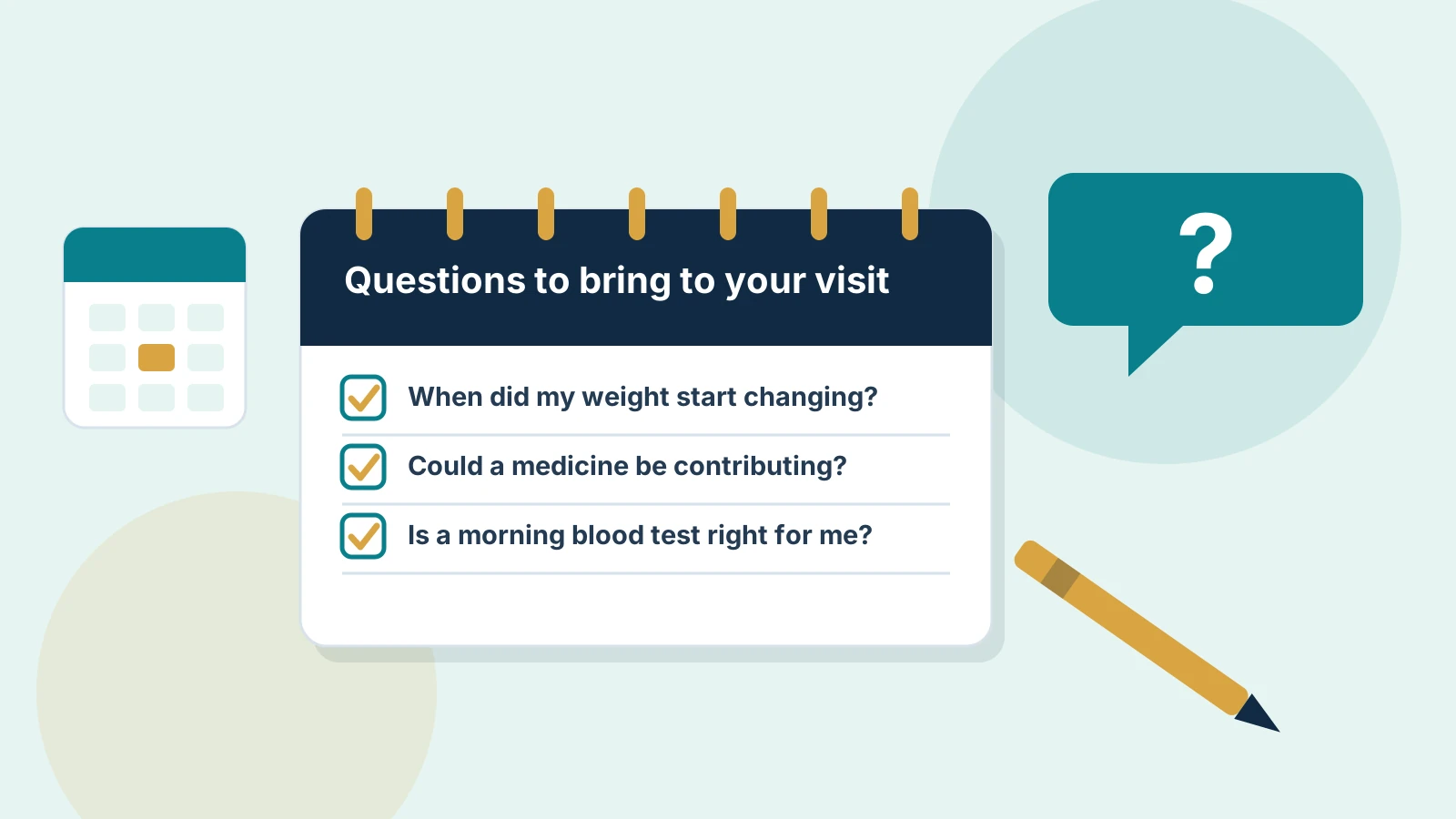
Good questions are specific and open. They give your clinician room to explain, and they signal what matters to you. You might ask what is most likely behind your weight change, and what you’d check first. You might ask whether a morning testosterone test makes sense, and what other tests could be done at the same time, such as thyroid or blood sugar tests.
If a result comes back low, ask whether it should be repeated, what might be driving it, and how weight, sleep, or medicines fit in. If treatment comes up, ask about benefits, risks, fertility, monitoring, and what the plan is if things don’t improve. Write the questions down, because the room has a way of emptying your head. The checklist below pulls the essentials together.
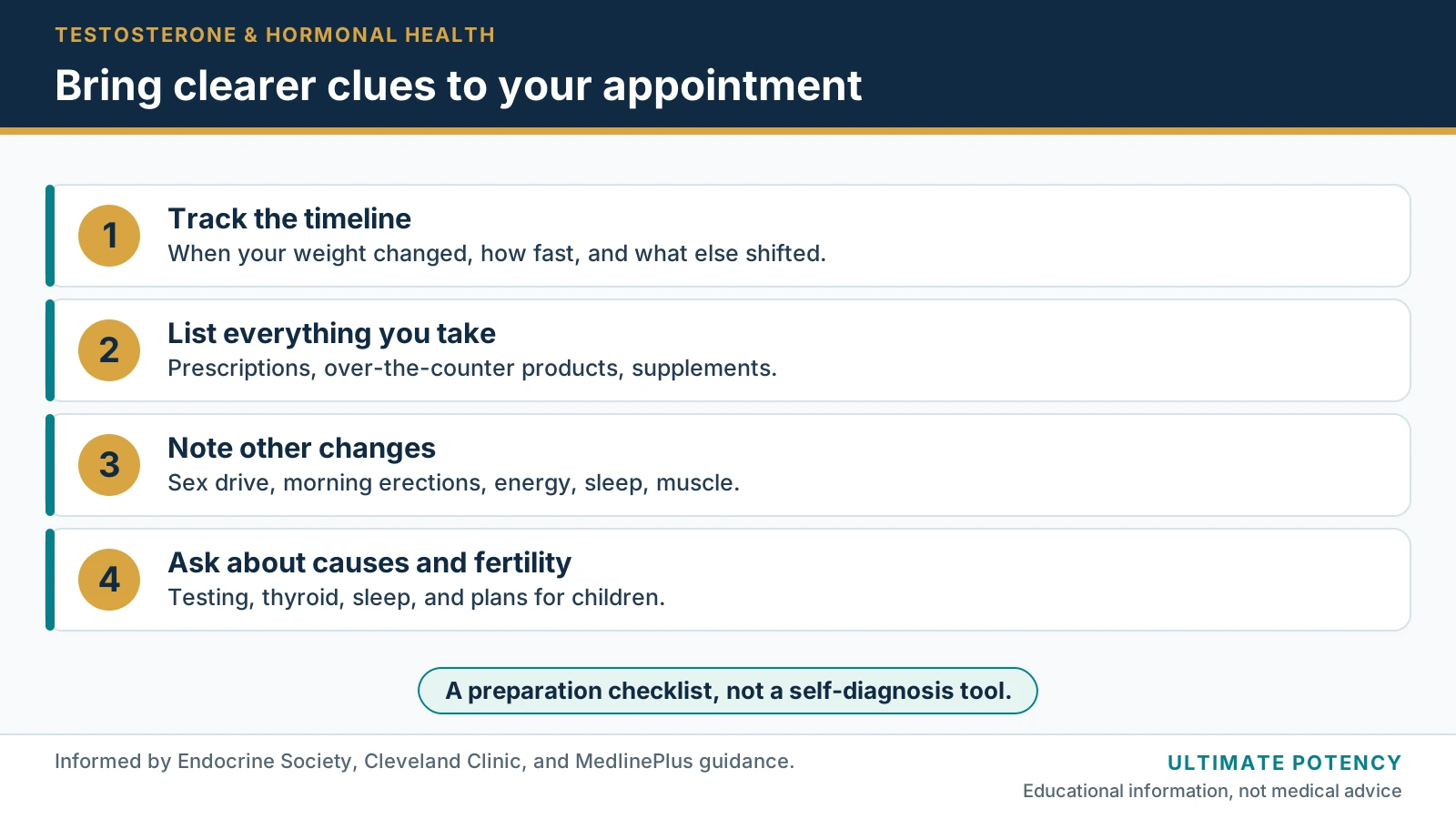
Text version: Step 1: track the timeline of your weight change. Step 2: list every prescription, over-the-counter product, and supplement. Step 3: note other changes such as sex drive, morning erections, energy, sleep, and muscle. Step 4: ask about causes, testing, thyroid, sleep, and fertility plans.
Making a Plan Together
Information is only useful if it leads to a plan you understand and can follow. This subsection focuses on the conversation after the tests: weighing options and agreeing on what comes next.
Weighing Benefits, Risks, and Fit
Every option has upsides and trade-offs. Weight-focused care carries few risks but takes time and support. A sleep evaluation may uncover a treatable problem. Testosterone therapy, if you’re a candidate, may help certain symptoms but involves monitoring, possible effects on fertility, blood pressure, and other risks discussed earlier. The right balance depends on your health, your priorities, and what you want from treatment.
It can help to ask your clinician to lay out the options in plain terms: what each one is expected to do, what could go wrong, how long it takes, and what it costs in time and money. A second opinion is a normal part of care, especially for a decision with long-term consequences. You’re allowed to take your time, and a thoughtful clinician will welcome your questions rather than hurry you.
Agreeing on Follow-Up
A plan without follow-up tends to fade away. Before you leave, ask when you’ll hear about results, who will explain them, and what should prompt you to call sooner. If you start new habits, agree on how progress will be checked, whether by weight, waist size, strength, energy, or lab values. If you start any treatment, ask how and when it will be monitored.
Keep your expectations realistic too. Body changes usually move slowly, and hormone levels can take time to settle after a change in weight or health. If something feels off, don’t wait for the next scheduled visit to speak up. And remember: weight, hormone levels, and sexual function say nothing about your worth. They’re information you and your care team can use to make good decisions.
Sources
- Statement on Testosterone Replacement Therapy. Endocrine Society. July 16, 2026. Checked 2026-10-16.
- Male hypogonadism: Symptoms and causes. Mayo Clinic. September 20, 2024. Checked 2026-10-16.
- Low Testosterone (Male Hypogonadism). Cleveland Clinic. Last updated February 23, 2026. Checked 2026-10-16.
- Testosterone Levels Test. MedlinePlus (NIH). Last updated June 5, 2025. Checked 2026-10-16.
- Hypogonadism. MedlinePlus (NIH). Reviewed July 21, 2024. Checked 2026-10-16.
- Weight gain – unintentional. MedlinePlus (NIH). Reviewed July 3, 2025. Checked 2026-10-16.
- Body weight loss reverts obesity-associated hypogonadotropic hypogonadism: a systematic review and meta-analysis (abstract). PubMed (NIH). Abstract; literature searched through August 2012. Checked 2026-10-16.
- Testosterone can help prevent type 2 diabetes in men (summary of the T4DM trial). South Australian Health and Medical Research Institute (SAHMRI). Trial published online January 14, 2021. Checked 2026-10-16.
- FDA issues class-wide labeling changes for testosterone products. U.S. Food and Drug Administration. February 28, 2025. Checked 2026-10-16.
- Testosterone Topical. MedlinePlus (NIH). Last revised May 15, 2025. Checked 2026-10-16.
- Evaluation and Management of Testosterone Deficiency (2024). American Urological Association. Published 2018; validity confirmed 2024. Checked 2026-10-16.
Ultimate Potency is an educational publication. It does not diagnose, prescribe, or provide medical care. This article does not replace advice from a licensed healthcare professional who knows your history.