
If you’ve been wondering whether you have low T, you’re probably holding two different kinds of information: how you’ve been feeling and, maybe, a number from a lab report. Each one matters, but neither one answers the question alone. A symptom without a lab result is a question, and a lab result without symptoms is a number waiting for context. This guide explains how low testosterone is diagnosed, step by step, so you can follow what a clinician is doing and why. It covers the symptom conversation, the physical exam, the blood tests and their timing, how cutoffs and labs work, what follow-up testing looks for, and how to prepare for an appointment.
Here’s the short version of why the process has several steps. Testosterone rises and falls over the day and from one day to the next, and laboratories don’t all measure it the same way. Common complaints such as tiredness, low mood, and a lower sex drive have plenty of other explanations, including poor sleep, sleep apnea, depression, medications, and weight changes. That’s why the Endocrine Society’s 2026 statement on testosterone therapy asks for symptoms plus repeated, accurately measured low results, and why it says symptoms alone are not diagnostic.
This article stays focused on the diagnostic process itself. For a closer look at the symptoms, see our guide to low testosterone symptoms. For how testosterone and erections fit together, read low testosterone and erectile dysfunction, and for the wider picture of erection problems, the erectile dysfunction guide is the place to start. Treatment decisions are covered in separate articles so we don’t repeat them here, though you’ll see where diagnosis and treatment connect, because the rules for confirming a diagnosis come straight from how testosterone products are labeled and studied. Along the way you’ll find tables that compare how major sources describe timing and thresholds, a checklist for preparing for a visit, and a few labeled hypothetical situations that show how the pieces fit together. They’re illustrations, not advice about any real person. This guide is educational, it can’t diagnose you, and it never suggests starting, stopping, or changing a medicine or supplement on your own.
Understanding How Low Testosterone Is Diagnosed
Before getting into blood draws and cutoffs, it helps to be clear about what a diagnosis of low testosterone actually is and why it takes more than one piece of information. This section sets out the core idea, defines the terms you’ll meet on lab reports and in articles, and explains why testosterone is harder to pin down than a measurement like height or weight.
Key Concepts
Two ideas anchor the whole diagnostic process, and a handful of terms sound interchangeable even though they aren’t. Getting the vocabulary straight first makes everything that follows easier to read.
Two Pieces of Evidence, Not One
The central rule is simple to state. A clinician looks for symptoms or signs that fit testosterone deficiency and for blood testosterone that is consistently and accurately measured as low. The Endocrine Society’s 2018 guideline page says to diagnose hypogonadism only when both are present, and its 2026 statement applies the same approach to a man of any age. The American Urological Association’s public guideline summary puts it the same way: to be testosterone deficient is to have low levels combined with symptoms or signs.
Why insist on both? A low number without any fitting symptoms may not point to a problem that needs action, and the 2018 guideline notes that low testosterone can be common without symptoms. Symptoms without a confirmed low level, on the other hand, often come from something else entirely, because fatigue, low mood, and a lower sex drive have many causes. Think of it as a lock with two pins: one pin alone doesn’t open it. That’s also why a first visit usually involves more questions than lab orders.
Low T, Hypogonadism, and Testosterone Deficiency
People use several terms for this topic, and they overlap without being identical. Low T is everyday shorthand, and it’s perfectly fine in conversation as long as it gets connected to something more precise. Hypogonadism is the medical term for the testicles (the gonads) not producing normal amounts of testosterone, sperm, or both. Clinicians divide it into primary hypogonadism, where the problem sits in the testicles, and secondary hypogonadism, where the pituitary gland or hypothalamus in the brain isn’t sending the right signals. Testosterone deficiency is the term used in the AUA guideline title, and it stresses both the lab result and the clinical picture.
None of these labels is a verdict on your health or worth. They are working descriptions that tell a clinician where to look next. The table below sorts out the words you’re most likely to see, along with the misunderstandings that tend to travel with them.
This table translates common terms into plain language and flags the misunderstandings that most often cause confusion.
| Term | Plain-language meaning | Common misunderstanding |
|---|---|---|
| Low T | Everyday shorthand for a low testosterone result, a set of symptoms, or both | That a low number and the symptoms are always the same thing |
| Hypogonadism | The testicles are not making enough testosterone, sperm, or both | That it only happens with age |
| Testosterone deficiency | Low testosterone levels together with symptoms or signs | That a single lab value is enough to qualify |
| Total testosterone | All testosterone in the blood, both free and attached to proteins | That it shows how much hormone your tissues can use |
| Free testosterone | The small unattached share that tissues can use most readily | That it is the better test for everyone |
| Reference range | The span of results seen in a reference group, not a pass-or-fail line | That anything inside it is automatically normal for you |
Sources: Endocrine Society guideline page and 2026 statement; Mayo Clinic male hypogonadism overview; MedlinePlus testosterone levels test. Definitions are simplified for education.
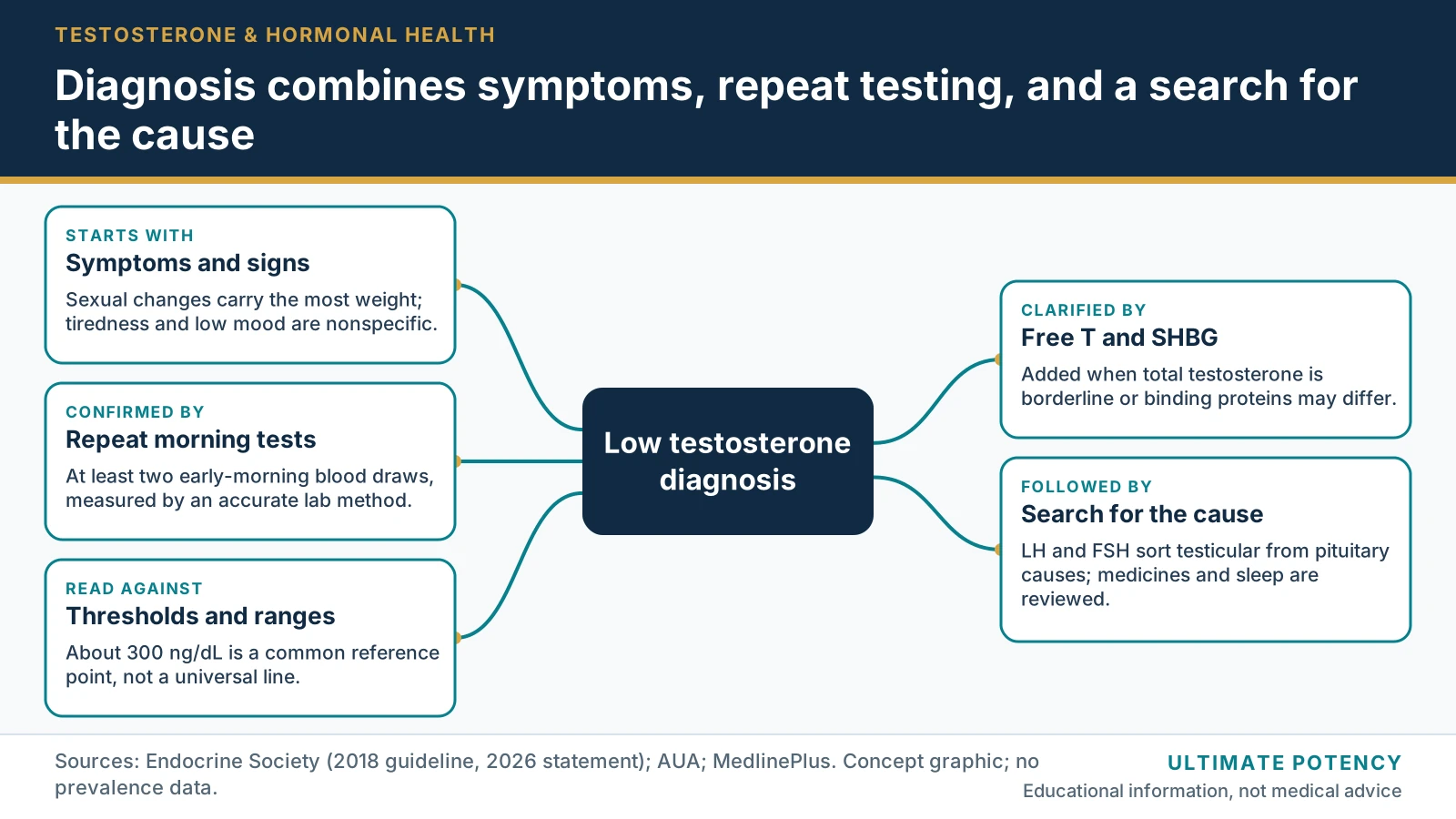
Text version: Low testosterone diagnosis starts with symptoms and signs, is confirmed by repeat early-morning tests, is read against thresholds and reference ranges such as about 300 ng/dL, is clarified when needed by free testosterone and SHBG, and is followed by a search for the cause using tests like LH and FSH and a review of medicines and sleep.
Why Diagnosis Is Harder Than It Looks
Testosterone looks like a tidy lab number, but several features of the hormone and the testing process make a single result hard to interpret. Knowing these features explains why guidelines ask for repeat testing and careful timing.
A Hormone That Moves Through the Day and the Years
Testosterone follows a daily rhythm. Mayo Clinic notes that levels are most often highest in the morning, and MedlinePlus says samples are usually drawn between 7 and 10 a.m. for that reason. An American Urological Association white paper on laboratory diagnosis describes evening values about 15 percent below morning values on average, and notes that day-to-day swings can be large enough that one measurement may be inadequate. That paper carries a 2013 copyright, so treat its numbers as background rather than current practice.
Levels also drift over a lifetime. Harvard Health explains that testosterone tends to dip with age, and illness, weight gain, and some medicines can nudge it down further. A clinician therefore has to ask whether a low result reflects a lasting problem, a temporary dip, or just the time of day the blood was drawn. Timing is part of the measurement, not a technicality.
Why One Number Cannot Carry the Whole Decision
If testosterone were steady and every lab measured it identically, one result could settle the matter. In practice, a first low value often doesn’t hold up. The Endocrine Society’s full 2018 guideline reports that about 30 percent of men whose first result falls in the low range have a normal result when it’s repeated, and the AUA white paper describes a similar share among men with mildly low first values.
Symptoms add a second layer of uncertainty. They develop slowly, they overlap with sleep problems and depression, and they shift with stress and life circumstances. A number taken out of that context can mislead in either direction. That’s why the diagnostic process is built like a funnel: a careful story, an exam, a properly timed blood test, a repeat, and then a search for the reason, with each stage checking the one before. If you want the details of how results are read, our guides on testosterone reference ranges and free versus total testosterone go further.
Starting With Your Story and Symptoms
The diagnostic process usually begins with a conversation rather than a needle. What you describe shapes which tests make sense, how urgent they are, and what else a clinician needs to rule out. This section covers the symptoms that carry the most weight, what large studies say about them, and why a checklist can’t replace an evaluation.
What Clinicians Ask About
A good symptom history looks at several parts of life at once, because testosterone touches many systems. Clinicians usually sort what you report into groups, then look at how the groups fit together.
Sexual Changes and Morning Erections
Sexual symptoms carry the most diagnostic weight, so clinicians tend to ask about them first. The Endocrine Society guideline describes low libido, erectile dysfunction, and fewer spontaneous erections (including fewer morning erections) as symptoms suggestive of testosterone deficiency, and it lists infertility and breast tissue enlargement in the same suggestive group. Clinicians may also ask about delayed ejaculation, which the Cleveland Clinic’s clinician-facing review places among the more specific symptoms.
You can help by describing the pattern in your own words. When did you first notice a change? Is it desire that has dropped, erections that have changed, or both? Desire and erections are related but different, and the answer steers the workup. Low desire points toward hormones, mood, sleep, and relationships, while trouble with firmness has a long list of vascular and nerve causes too, as the NIDDK evaluation page for erectile dysfunction outlines. Our guide to low libido in men covers desire in more depth. A change in morning erections is a useful clue to mention, but it isn’t proof of anything on its own.
Energy, Mood, Sleep, and Body Changes
Beyond sexual symptoms, clinicians ask about energy, mood, concentration, sleep, strength, and body changes. The Endocrine Society guideline groups low energy, depressed mood, poor concentration, sleep disturbance, mild anemia, reduced muscle, and increased body fat as nonspecific, meaning they can accompany low testosterone but just as easily come from something else. Mayo Clinic’s symptoms and causes page lists lower sex drive, low energy, and depression among early adult symptoms, with erection problems, infertility, loss of body hair, reduced muscle mass, breast tissue growth, and bone loss as possible later ones.
Because these changes are so common, expect follow-up questions that sound like they wander. How are you sleeping? Do you snore? Have you gained weight? Any new medicines? Those questions aren’t a detour. They’re how a clinician separates symptoms that may come from a hormone problem from symptoms that have a more everyday explanation. For a symptom-by-symptom walk-through, see our low testosterone symptoms guide.
What the Research Says About Symptoms
Symptom lists are only as useful as the studies behind them. Two pieces of research shape how clinicians think about symptoms and diagnosis: a large European survey and the cautious guidance on questionnaires.
What the European Male Aging Study Found
The European Male Aging Study surveyed 3,369 men aged 40 to 79 at eight European centers, measuring testosterone in morning blood samples and asking about a long list of symptoms. According to the published abstract, six symptoms were significantly related to testosterone level, including poor morning erections, low sexual desire, erectile dysfunction, inability to perform vigorous activity, depression, and fatigue. But only the three sexual symptoms showed a syndromic association with lower testosterone, meaning they clustered with it in a meaningful way.
The authors proposed that a diagnosis of late-onset hypogonadism should rest on those three sexual symptoms together with a total testosterone below 11 nmol/L (3.2 ng/mL, about 320 ng/dL) and a free testosterone below 220 pmol/L (64 pg/mL). Two cautions apply. This was a survey of mostly middle-aged and older men in Europe at one point in time, so it can’t show that low testosterone caused the symptoms. And the thresholds are research-derived, not a universal rule. Still, the finding explains why clinicians weigh sexual symptoms more heavily than tiredness or mood when deciding whether to test.
Why Symptom Questionnaires Are Not a Diagnosis
Many online quizzes and clinic questionnaires score a list of symptoms and suggest whether you might have low testosterone. They can feel convincing, but the research record is humbling. A review published in The Aging Male by Lunenfeld and colleagues says that these questionnaires are sensitive but have low specificity, which means they catch most men who do have low testosterone while also flagging many who don’t. The authors recommend using them to gauge symptom severity and follow treatment response rather than to diagnose.
The Endocrine Society’s guideline goes further, noting that case-finding questionnaires lack sufficient validation and suggesting against using them in men who come to care for unrelated reasons. In practice, a questionnaire can be a conversation starter. It can help you organize what you’ve noticed before a visit. What it can’t do is stand in for a clinician’s evaluation and a properly timed blood test. If an online quiz told you that you likely have low T, treat it as a prompt to ask a question, not as an answer.
Who Gets Tested and Who Does Not
Testing isn’t automatic, and it isn’t withheld without reason either. Guidelines try to balance two risks: missing men who would benefit from an evaluation and sending healthy men down a path of unnecessary tests and labels. This section explains who is typically tested, who generally isn’t, and why age alone doesn’t change the standard.
Reasons a Clinician May Order a Test
A test is usually ordered when the story, the exam, or the health background raises a specific question. The trigger can be a symptom pattern, a medical situation, or both.
Symptoms That Raise the Question
The strongest trigger is a combination of symptoms that fit testosterone deficiency, especially sexual ones, such as a clear drop in desire, fewer morning erections, or new erection difficulty. Cleveland Clinic’s patient page says that when you have symptoms, a provider will order blood tests. The Urology Care Foundation adds that a single symptom may not mean testosterone deficiency, while a mix of symptoms over time is more of a reason to check.
That framing is practical. One tired week after a bad night’s sleep rarely calls for a hormone panel, but months of reduced desire, changed erections, low energy, and low mood together deserve a conversation. Persistence and clustering matter more than any one symptom. It also helps to remember that testing is a way to answer a question, not a way to prove you’re healthy or unhealthy. If you’re unsure whether what you’re noticing is worth raising, mention it anyway and let the clinician decide how far to go.
Health Situations That Prompt Testing
Some situations make testing more reasonable even before symptoms are dramatic. The Endocrine Society guideline suggests looking for low testosterone in men with pituitary or sellar disease, long-term opioid or glucocorticoid use, withdrawal from anabolic steroids, HIV-related weight loss, infertility, osteoporosis or a low-trauma fracture, or low libido and erectile dysfunction. In each case, there is a plausible biological reason for testosterone to be affected.
The same logic applies to some findings on exam or labs. Very small testicles, unexplained anemia, or signs of a pituitary problem would make a clinician more alert. Notice what these situations have in common: each one gives the clinician a reason to suspect a cause, not just a feeling that testosterone might be “off.” If you’re taking an opioid, a steroid medicine, or have a condition on this list, it’s worth asking whether testing makes sense, rather than assuming it does or doesn’t. Never stop or change a prescribed medicine on your own to try to affect a result.
Why Routine Screening Is Not Recommended
Screening means testing people who have no particular reason to be tested. For testosterone, the major guidance is cautious about it, for reasons that are worth understanding.
Testing Men With No Symptoms
The Endocrine Society guideline recommends against routine screening of men in the general population, and its 2026 statement says there is insufficient evidence to support blood testing in men without symptoms. The American College of Physicians’ 2020 guideline announcement similarly suggests that screening men without sexual or erectile dysfunction is unlikely to be effective.
Why not test everyone? Because testosterone results fluctuate, a screening program would turn up many borderline or transient low values. Each one could trigger repeat tests, anxiety, and sometimes treatment decisions made for the wrong reasons. The 2018 guideline also notes that no trials have tested screening strategies, so nobody knows whether finding low testosterone in men without symptoms improves their health. Wanting a number is not the same as needing a test, and a clinician who declines to screen is following the evidence, not dismissing you. If you have symptoms, that changes the conversation.
Age, Normal Decline, and One Standard
Because testosterone declines with age, people often ask whether older men should be judged differently. The 2026 Endocrine Society statement says the diagnostic approach is the same for a man of any age. It also points out that labels like “late-onset” or “functional” hypogonadism are hard to define and can blur the line between a treatable condition and normal aging. In other words, being older doesn’t lower the bar for diagnosis, and it doesn’t mean symptoms get explained away.
The FDA draws a related line on the treatment side. In its February 2025 announcement of class-wide labeling changes, the agency retained the limitation of use for age-related hypogonadism, and the Pfizer testosterone cypionate label states that safety and efficacy in men with age-related hypogonadism have not been established. The AUA’s myths-versus-facts release makes a matching point: a natural decline doesn’t by itself mean a man has low testosterone. The practical takeaway: age is context for the evaluation, not a substitute for it. Our guide on testosterone levels by age covers what changes with time.
The Medical History and Physical Exam
Before any blood is drawn, a good evaluation gathers context that a lab number can’t supply. The history and exam help a clinician decide whether testing makes sense, which causes are plausible, and what else needs checking. This section walks through the questions you may be asked and what an exam looks for, so none of it comes as a surprise.
The Conversation
Much of the diagnostic work happens in conversation. The answers you give about medicines, health history, and daily life often point toward explanations that a blood test can only confirm later.
Medications, Substances, and Supplements
Expect a detailed question about everything you take, and be ready to include items you might not think of as medicine. The Endocrine Society’s 2026 statement says clinicians should first rule out reversible contributors such as obesity and medicines like corticosteroids or opioids. MedlinePlus also lists alcohol use disorder among the possible reasons for low results, and the Endocrine Society guideline includes withdrawal from anabolic steroids in its list of situations that prompt testing.
Supplements count too. Biotin, for example, can interfere with some hormone assays, and the Endocrine Society’s full guideline suggests stopping it for at least 72 hours before LH and FSH testing, so ask the clinician or lab what applies to you. “Testosterone booster” products belong on the list as well. Our guides on medications that lower testosterone and male enhancement and booster products go deeper. Bring a complete list, including over-the-counter products, and don’t stop anything on your own. MedlinePlus is explicit on this point: tell your provider about everything you take, and don’t stop a medicine unless your provider says to. If a medicine does turn out to be part of the picture, the decision about changing it belongs to the clinician who prescribed it.
Health History, Family Plans, and Mood
Your broader history shapes the differential, which is the clinician’s working list of possible explanations. The Urology Care Foundation says the doctor will ask about medical history, medications, and family history. Mayo Clinic’s overview of causes points to past testicular injury, mumps that affected the testicles, undescended testicles in childhood, chemotherapy or radiation, and conditions such as HIV and sleep apnea, so expect questions along those lines.
Two other topics deserve a clear answer from you. The first is family plans. Treatments that raise testosterone can reduce sperm production, and the Urology Care Foundation says tests such as FSH and a semen analysis are done before hormone therapy if you want children, so tell the clinician early if a pregnancy is part of your future. The second is mood and sleep. Persistent low mood, loss of interest, or trouble sleeping are worth raising directly, since they can both mimic and accompany low testosterone. Our guide to male fertility explains why timing matters. Life context can come up as well, not to assign blame but because stress, conflict, and major changes affect desire and sleep. You decide how much to share, and a partner is never the problem to be solved. If you have earlier blood work, mention it, since previous results can show whether a low value is new or long-standing.
The Physical Exam
The exam is short, but it gives a clinician information that blood tests can’t. It also helps decide whether the picture points toward the testicles, the pituitary, or something else entirely.
What the Exam Looks At
A typical exam is straightforward and professional. Mayo Clinic’s diagnosis page says a member of your healthcare team checks signs of sexual maturing, such as pubic hair, muscle mass, and testicular size, and compares them with what would be expected for your age. The Cleveland Clinic’s clinician-facing review adds findings that support the diagnosis, including testicular atrophy or masses, varicoceles (enlarged veins around the testicle), gynecomastia (breast tissue growth), and a large waist circumference.
The Urology Care Foundation notes that the doctor may also check body mass index, blood pressure, and prostate size. None of this is meant to judge your body. Weight and blood pressure matter because obesity and cardiovascular health are tightly linked to hormone levels and to treatment safety later. If an exam makes you uncomfortable, say so. You can ask what the clinician is checking and why, and many find that knowing the purpose of each step makes the visit easier. The exam is also a good moment to mention any pain, lumps, or swelling you’ve noticed.
Findings That Point Toward Specific Causes
Certain findings steer the workup. The Endocrine Society guideline describes incomplete or delayed sexual development, loss of body hair, and small testes (under 6 mL) as the most specific signs of testosterone deficiency, in contrast to common symptoms like tiredness. Very small testicles can suggest a testicular cause, such as Klinefelter syndrome, which Mayo Clinic describes as an extra X chromosome that limits testicular growth and testosterone production.
Breast tissue growth prompts a different question. The Cleveland Clinic review says that when gynecomastia is present, clinicians may check estradiol, since a low testosterone-to-estrogen balance can contribute. A testicular lump needs its own evaluation, separate from hormone testing. Symptoms that suggest a pituitary mass, such as persistent headaches or vision changes, would also change the plan, because the guideline reserves pituitary imaging for specific situations. None of these findings is a diagnosis on its own, but each narrows the list of possibilities and helps decide which blood tests come next. The guideline also notes that many cases of secondary hypogonadism are functional, linked to obesity, opioids, or serious illness, and may be reversible without testosterone treatment. An exam with no unusual findings doesn’t cancel out symptoms or lab results; it simply means the history and the blood tests carry more of the weight.
The Blood Test: Timing, Repeats, and Preparation
Blood testing is the objective half of the diagnosis, and it’s where small details change the answer. When the sample is drawn, whether you’re ill, and whether the test is repeated all influence what the number means. This section explains how a reliable sample is obtained and how sources differ on the details.
Getting a Reliable Sample
A reliable result starts before the needle. Timing, illness, and preparation determine whether the number reflects your usual testosterone or just that particular morning.
Why the Morning Matters, and Who Is the Exception
Testosterone peaks early in the day, so guidelines point toward morning sampling. MedlinePlus says the sample is usually drawn between 7 and 10 a.m., the AUA’s myths-versus-facts release suggests about 8 to 10 a.m., and the Cleveland Clinic’s clinician review gives a 7 to 11 a.m. window. A mid-morning slot is common in practice, which Mayo Clinic’s diagnosis page also describes.
There are exceptions. The Cleveland Clinic review excludes shift workers from the usual window, and the AUA white paper advises that men who work nights have testosterone checked on days off. The Endocrine Society’s full guideline adds that the difference between morning and afternoon results can be smaller in older men, but many men aged 65 to 80 with a low afternoon value still have a normal morning one. If you work nights or have an unusual sleep schedule, tell the clinician before scheduling the draw. A well-timed sample for your body clock may differ from the textbook window, and your clinician can plan around it.
Fasting, Illness, and Sleep Before the Draw
Preparation guidance isn’t perfectly uniform. The Endocrine Society’s full guideline recommends measuring total testosterone in the morning after an overnight fast, because food and glucose can suppress it. The Aging Male review by Lunenfeld and colleagues, in contrast, does not currently recommend fasting for testing. MedlinePlus takes a middle path: some people must fast for several hours, and you should ask your provider. Given that disagreement, the best move is to follow the lab’s or clinician’s instructions rather than guess.
Illness is a clearer rule. The Endocrine Society guideline advises against testing men who are recovering from an acute illness, and Cleveland Clinic notes that illness can temporarily lower levels, so mention any recent sickness. The Urology Care Foundation says the doctor may wait if you’re sick because the result could be false. Poor sleep also matters. The Cleveland Clinic review notes that testosterone follows a daily pattern and is affected by sleep disturbance. Don’t skip a prescribed medicine to “prepare” for the test; ask first if you’re unsure.
Confirming a Low Result
A first low result is a starting point, not a conclusion. Confirmation means repeating the measurement under good conditions and asking whether the pattern holds.
Why a Single Low Value Is Not Enough
The case for repeating comes from how often first results change. According to the Endocrine Society’s full guideline, around 30 percent of men with an initial result in the low range have a normal value on repeat testing, and the AUA white paper reports about the same for men whose first result was mildly low. Day-to-day variation, time of day, recent illness, and lab differences all play a part.
That’s why recent guidance consistently asks for more than one measurement. The 2026 Endocrine Society statement calls for at least two early-morning, fasting tests. The Pfizer testosterone cypionate label tells prescribers, before starting treatment, to confirm the diagnosis by ensuring that serum testosterone has been measured in the morning on at least two separate days. Repeating the test isn’t a sign that anyone doubts you. It protects you from a diagnosis, and potentially a long-term treatment, based on a result that may not hold. If a clinician orders a second draw, that’s the system working as intended.
How Sources Differ on Timing and Spacing
Reading several reputable sources side by side shows more agreement on the principle than on the details. Almost all agree on morning draws, repeat testing, and a symptom requirement. They differ on fasting, on how far apart the draws should be, and on how precisely to state the cutoff. The comparison below lays out what each source says, based on the pages we could open.
This table compares what several authoritative sources say about timing, repeat testing, and thresholds, so you can see where they agree and where they differ.
| Source | Timing and fasting | Number and spacing of tests | Threshold language |
|---|---|---|---|
| Endocrine Society guideline (2018) | Morning, after an overnight fast | Repeat on a second morning; roughly 30% of first low results are normal on repeat | “Unequivocally and consistently low” total testosterone; no single universal number |
| Endocrine Society statement (July 2026) | Early morning, fasting | At least two tests; interval not specified | A common clinical threshold near 300 ng/dL |
| Cleveland Clinic clinician review (2024) | 7 to 11 a.m., shift workers excepted | At least two low values, drawn at least two to three weeks apart | Total testosterone below 300 ng/dL (AUA-endorsed cutoff) |
| Harvard Health (March 2026) | Fasting | Two fasting tests two days apart, per a quoted endocrinologist | Below 300 ng/dL |
| Pfizer testosterone cypionate label (6/2025) | Morning | At least two separate days before treatment starts | Not stated in the text we read |
| Lunenfeld and colleagues, The Aging Male (2015) | Preferably 7 to 11 a.m.; fasting not currently recommended | Repeat to exclude temporary illness-related dips | Lower limit of 12.1 nmol/L by LC-MS/MS, roughly 350 ng/dL |
Sources as linked in the text. Where a source did not state a detail in the text we read, the cell says so. Wording is paraphrased; the Harvard Health entry quotes an endocrinologist rather than a guideline.
The table shows that “two tests” is the common thread, while the gap between them ranges from days to weeks. That variation isn’t a contradiction so much as a reminder that these are clinical judgments, not laws of nature. If you’re asked to come back for a repeat, ask when and under what conditions, and treat the clinician’s instructions as the standard to follow. Another useful reading is that stricter wording aims to reduce false low results, while more flexible wording keeps testing practical for people who work shifts, travel, or struggle to get early appointments. Neither goal is unreasonable. If a 7 a.m. slot is hard to get, tell the clinic; a later morning time within the usual windows described above may be workable, and your clinician can say what fits your situation.
Making Sense of the Numbers
Once a result is on the page, the next question is what it means. Cutoffs, reference ranges, and the difference between total and free testosterone all affect interpretation. This section explains where common numbers come from, why they’re imperfect, and how to read a report alongside a clinician.
Thresholds and Reference Ranges
A threshold looks like certainty, but each one comes from a particular source, population, and purpose. Understanding the origin of a number helps you use it sensibly.
The 300 ng/dL Figure in Context
The number you’ll meet most often is 300 ng/dL (nanograms per deciliter), which equals roughly 10.4 nmol/L if you divide by about 28.8. The AUA’s public materials describe levels below 300 ng/dL as low, the Urology Care Foundation cites the same definition, and the Endocrine Society’s 2026 statement refers to a common clinical threshold near 300 ng/dL. The large TRAVERSE trial also required two fasting results under 300 ng/dL for enrollment, according to the published paper.
Still, the AUA white paper cautions that rigid use of a 300 ng/dL cutoff may lead to unnecessary treatment of men without symptoms and to undertreatment of men with symptoms. The figure works as a practical reference point for a population, not as a biological cliff where health changes overnight. A man at 310 ng/dL isn’t fundamentally different from a man at 290, and a clinician should weigh symptoms, repeat results, the lab used, and other health factors. Treat 300 ng/dL as a guidepost, not a verdict. Our article on testosterone reference ranges in adult men explores how different ranges compare.
What the Harmonized Reference Range Shows
A reference range describes what’s typical in a defined group. One widely cited effort, published by Travison and colleagues, pooled data from four cohorts totaling 9,054 community-dwelling men and re-measured samples against a CDC reference method so results from different labs could be compared. For 1,185 healthy, nonobese men aged 19 to 39, the middle 95 percent of total testosterone values ran from 264 to 916 ng/dL, with a median near 531 ng/dL.
The authors are open about limits. Values came from single morning samples, so they don’t capture within-person swings. The cohorts were mostly white men in the United States and Europe. It’s unresolved whether the nonobese ranges apply to men with obesity. And the paper presents age-specific ranges, showing that the lower percentiles decline with age, while leaving open whether clinicians should compare older men with a young reference group or with age-matched peers. Your lab report may print a different range based on its own method, which is why the lab’s range and the clinician’s judgment both matter.
Total, Free, and Binding Proteins
Most testosterone in the blood is attached to proteins, which changes how a total value should be read. Clinicians sometimes look beyond the total number to understand what your tissues can actually use.
When Free Testosterone Adds Information
Total testosterone counts everything, bound and unbound. Free testosterone counts only the small unattached share, which the AUA white paper puts at about 2 to 3 percent of the total. MedlinePlus explains that total testosterone is the most common test, while free testosterone is less common and may help diagnose certain conditions.
The Endocrine Society’s full guideline gives practical direction. It suggests measuring free testosterone in men whose total value sits near the lower limit and in men with conditions that alter binding proteins, and it says free testosterone is generally unnecessary when total testosterone is far below normal. It recommends equilibrium dialysis or a calculation from total testosterone, SHBG, and albumin, and it advises against direct analog free-testosterone immunoassays because they’re inaccurate. In plain terms, the method used to get a free value matters as much as the value. If your report shows a free testosterone result, it’s reasonable to ask how it was measured. Our guide to free versus total testosterone covers this in more detail.
SHBG, Obesity, and Results That Seem to Disagree
Sex hormone-binding globulin (SHBG) is a protein that carries testosterone through the blood. When SHBG changes, total testosterone can move with it without reflecting how much active hormone is available. The Cleveland Clinic review notes that obesity is associated with lower SHBG, so total testosterone can look low while free testosterone is normal. The Endocrine Society guideline lists many conditions that can alter SHBG, including obesity, diabetes, hypothyroidism, hyperthyroidism, cirrhosis, HIV, aging, estrogens, and certain anticonvulsants.
This is why two results can seem to disagree: a low total value and a normal free value, or the reverse. The Cleveland Clinic review does not recommend routine SHBG testing, while the Endocrine Society suggests free testosterone testing in specific circumstances, which shows that experts weigh the trade-offs differently. If your numbers don’t line up, the clinician is likely asking whether binding proteins explain the gap. Weight-related patterns are covered in our article on obesity and low testosterone, and the reverse situation in high SHBG and low free testosterone.
Lab Quality, Home Kits, and Result Pitfalls
A testosterone result is only as trustworthy as the process that produced it. Different laboratories use different methods, some substances can distort a measurement, and a growing number of home and online kits promise answers without a clinic visit. This section explains why labs can disagree, what can quietly throw off a result, and how to think about testing you arrange yourself.
Why Labs Can Disagree
Two laboratories can analyze the same blood and report different numbers, and the gap tends to be widest in the low range, which is exactly where a diagnosis is decided. Understanding why helps you ask better questions about a result.
Assays and Certification
An assay is the laboratory method used to measure a substance. For testosterone, the two broad families are immunoassays and mass spectrometry (LC-MS/MS). The Endocrine Society’s full guideline says LC-MS/MS generally performs better than immunoassays, especially at low concentrations, and recommends accurate assays, ideally certified by the CDC’s Hormone Standardization Program. The AUA white paper reports that commercial immunoassay platforms have adequate accuracy in men with normal levels but not below 300 ng/dL, and that eight U.S. reference laboratories measuring a 299 ng/dL standard returned values from 198 to 364 ng/dL. That paper dates from 2013, so current performance may be better, but the principle still stands.
The CDC’s program page explains that testosterone certification began in 2010, uses blinded samples tested each quarter over four consecutive quarters, applies a mean bias criterion of plus or minus 6.4 percent, and issues certificates that last one year. The Endocrine Society’s 2026 statement also says many assays carry improper reference ranges. It’s reasonable to ask whether your lab uses a certified method. You can’t always choose the laboratory, but a clinician often can, and knowing the question exists is useful.
Biotin, Sample Handling, and Other Interference
Beyond the method, several practical issues can distort a result. Biotin, a common ingredient in hair, skin, and nail supplements, can interfere with some hormone assays. The Endocrine Society guideline suggests stopping biotin supplements at least 72 hours before LH and FSH testing, though whether and when to pause is a decision to make with the clinician or lab rather than on your own. Telling them what you take is the simplest safeguard.
Sample handling also matters. The AUA white paper describes how storing blood in certain tubes can distort SHBG measurements, which in turn affects calculated free testosterone, and how afternoon samples held overnight can compromise results. Illness and some medicines can lower testosterone temporarily, which is why the guideline advises waiting out acute illness before testing and why shift workers need special timing. None of these pitfalls means results are unreliable by default. They mean that a surprising number deserves a second look before anyone acts on it, and that repeat testing under good conditions is the best protection.
At-Home and Online Testing
Kits that you order, collect at home, and mail to a lab have become a common first step. They can be convenient, but they answer a narrower question than a clinical evaluation does.
What Home Kits Can and Cannot Tell You
MedlinePlus notes that some at-home kits collect a blood or saliva sample for laboratory analysis and advises asking your provider first and following the kit’s instructions. A commercial telehealth page from Hims & Hers, published in November 2025, describes lancet, finger-prick, and saliva options, says research on at-home tests is limited, and notes that saliva kits measure only free testosterone. We treat that page as a market benchmark rather than clinical authority, but its own conclusion is worth noting: a home test is a first step, not a diagnosis, and only a healthcare professional can confirm low testosterone, rule out other causes, and recommend treatment.
That matches the guidelines. A home result is a single measurement, while diagnosis calls for repeated morning results, a symptom review, an exam, and a search for causes. A kit can’t examine you, ask about sleep apnea, or review your medicines. A normal-looking home result also can’t reassure you if symptoms persist, and a low-looking one can’t confirm anything by itself. If you use a kit, bring the report to a clinician rather than acting on it, and avoid starting any product based on it.
Questions to Ask Before Using a Kit
If you’re considering a home or online test, a few questions help you judge what you’d actually get. What does it measure: total testosterone, free testosterone, or both? Is the sample finger-prick, saliva, or a blood draw processed by a lab, and does the company say anything about accuracy for that sample type? The Hims page cites CLIA certification of the lab, timing, and hygiene as factors that affect results, which gives you a few concrete things to look for.
Ask what happens after a result. Does a licensed clinician review it with you? Does the service talk about repeating the test, other causes, and your medical history, or does it move straight to selling a treatment? Cost and coverage are fair questions too. The Hims page says such tests are rarely covered by insurance, though that comes from a seller and policies vary, so check with your own plan. Finally, consider whether the money might go further toward a visit with a clinician who can order a properly timed, repeated test and interpret it alongside your history. Our guide to the morning testosterone blood test explains what a clinical draw involves.
Finding the Cause After a Low Result
A confirmed low testosterone level answers one question and opens another: why is it low? The cause shapes everything that follows, from whether anything reversible can be addressed to whether fertility needs special attention. This section covers the follow-up tests that sort primary from secondary hypogonadism and the common, sometimes reversible contributors clinicians look for next.
Primary and Secondary Hypogonadism
The first sorting question is where the problem starts. Either the testicles aren’t responding, or the brain’s signals to the testicles aren’t reaching them.
What LH and FSH Add
Luteinizing hormone (LH) and follicle-stimulating hormone (FSH) are pituitary hormones that tell the testicles to make testosterone and sperm. Measuring them is the standard way to separate the two types. The Endocrine Society guideline recommends measuring LH and FSH to distinguish primary from secondary hypogonadism. MedlinePlus explains that high LH can point to a testicular problem, such as injury, mumps, Klinefelter syndrome, or damage from chemotherapy or radiation, while low LH in adults is often a sign of a problem with the pituitary gland or hypothalamus.
In everyday terms: if the testicles are underperforming, the brain turns up the signal, so LH is high. If the signal itself is weak, LH is low or inappropriately normal. That distinction matters because the likely causes and next tests differ. Our articles on primary versus secondary hypogonadism and LH and FSH blood tests in men go further. The table below puts these and other commonly discussed tests side by side so you can see what each one contributes.
This table summarizes what each test examines and why a clinician might order it, to help you follow the workup rather than to predict it.
| Test | What it looks at | Why a clinician may order it | Limitation |
|---|---|---|---|
| Total testosterone, early morning | All testosterone in the blood | Core test for diagnosis; repeated to confirm | Varies by time of day, illness, and lab method |
| Free testosterone | The unattached, readily usable share | Total result near the low end, or conditions that change SHBG | Method matters; analog immunoassays are discouraged |
| SHBG | The protein that binds testosterone | Helps explain a gap between total and free values | Not recommended routinely in one clinician review |
| LH and FSH | Pituitary signals to the testicles | Separates testicular from pituitary or hypothalamic causes | Biotin can interfere; ask about supplements |
| Prolactin | A pituitary hormone | Checks for a pituitary cause when LH is low or normal | A high value is often repeated before conclusions |
| Iron studies (ferritin, transferrin saturation) | Iron stores in the body | Looks for iron overload as a cause | Ordered in specific situations, not for everyone |
| Semen analysis | Sperm count and quality | When fertility matters, before hormone therapy | Needs proper collection and often repeating |
| Pituitary MRI | Structure of the pituitary gland | Reserved for specific findings, such as very low testosterone or mass symptoms | Not a routine test |
Sources: Endocrine Society 2018 guideline text; MedlinePlus; Urology Care Foundation; Cleveland Clinic clinician review; Mayo Clinic. Which tests you need depends on your history and results.
When Prolactin, Iron Studies, or Imaging Come Up
When LH is low or normal, the pituitary and hypothalamus come under scrutiny. The Cleveland Clinic review says to measure prolactin in that situation to look for a prolactinoma (a benign pituitary tumor that makes prolactin), and the Urology Care Foundation notes that a high prolactin level may be repeated. The Endocrine Society guideline also suggests measuring iron saturation or ferritin in secondary hypogonadism, since iron overload (hemochromatosis) is among the causes Mayo Clinic lists for testicular problems.
Imaging isn’t routine. According to the guideline, pituitary MRI is reserved for situations such as panhypopituitarism, persistently high prolactin, total testosterone below 150 ng/dL, or symptoms from a mass pressing on nearby structures. Genetic testing, such as a karyotype, is considered when the testes are small (under 6 mL), which the guideline gives as the cutoff. Mayo Clinic’s diagnosis page likewise mentions pituitary hormone testing, semen analysis, pituitary imaging, and gene studies as possible next steps. A longer list of tests isn’t a sign that something is wrong; it usually reflects a careful clinician ruling things out. Our article on prolactin and low testosterone explains one common branch.
Reversible and Overlapping Contributors
Not every low result reflects a permanent problem in the testicles or pituitary. Many are linked to health conditions or medicines that can be addressed, which is why the search for a cause comes before any talk of treatment.
Weight, Sleep Apnea, and Metabolic Health
Body weight and metabolic health are among the most common companions of low testosterone. Mayo Clinic lists obesity and obstructive sleep apnea among both causes and risk factors of secondary hypogonadism. Harvard Health describes a cycle in which excess abdominal fat and diabetes can lower testosterone, and lower testosterone can in turn worsen insulin resistance. The Endocrine Society’s 2026 statement says that for hypogonadism due to obesity (BMI above 27) without another identified cause, weight loss is typically the first-line approach.
Sleep deserves special mention. Mayo Clinic’s sleep apnea page lists daytime sleepiness, mood changes, and decreased interest in sex among its symptoms, which overlap with those of low testosterone, and the Cleveland Clinic review calls out sleep disorders as a timing and interpretation issue. Untreated sleep apnea can both mimic low T and contribute to it, so snoring, gasping at night, or heavy daytime sleepiness are worth mentioning. Weight change cuts both ways. Because the 2026 statement names weight loss as first-line for obesity-related cases, a clinician may suggest addressing weight, sleep, and activity and then rechecking, rather than moving straight to hormone treatment. That can feel like a delay, but it reflects an effort to treat the driver instead of the number. Nothing here is a reason to blame yourself; weight, sleep, and testosterone influence one another in both directions. For more, see our guide on low testosterone and sleep apnea.
Medications, Illness, and Other Hormone Problems
Medicines are another major category. The Endocrine Society’s 2026 statement singles out corticosteroids and opioids as examples of reversible contributors to review first, and the Cleveland Clinic review emphasizes that conditions or medicines that explain low testosterone should be addressed first. Harvard Health adds anabolic steroids, testicular injury, hypothyroidism, sleep disorders, and pituitary conditions to the list of possible explanations. MedlinePlus also names chronic liver or kidney disease and alcohol use disorder among causes of low results in males.
The Cleveland Clinic review mentions that cannabis use has been suggested as a cause but says higher-quality evidence is needed, which is a fair reminder that some links are still uncertain. If a medicine turns out to be a plausible factor, never stop a prescribed medicine on your own; the prescriber can weigh alternatives and risks. Thyroid problems, including an underactive thyroid, can also look similar, which is why a clinician may order thyroid tests as part of a broader evaluation, as discussed in our article on thyroid problems and testosterone.
Comparing Relevant Factors
By this point, you’ve seen many moving parts: symptoms, timing, thresholds, assays, and causes. This section compares them directly. It looks at what to do when symptoms and numbers disagree, how overlapping conditions complicate the picture, and how much weight the research can bear, so you can see which parts of the diagnostic process rest on firm ground and which rest on judgment.
Symptoms, Numbers, and Look-Alikes
Symptoms and lab values don’t always point the same way, and several common conditions produce the same complaints as low testosterone. Sorting them out is the heart of the clinical judgment.
When Symptoms and Labs Disagree
Disagreement is common. Someone may have strong symptoms and a result within the reference range, or a low result and few symptoms. In both cases, the framework from the guidelines is the same: a diagnosis needs both, so a mismatch calls for more questions, not a quick label. Cleveland Clinic’s clinician review notes that symptoms are nonspecific and that historically inconsistent cutoffs have made diagnosis difficult, and the AUA white paper recommends repeat testing when results don’t match symptoms.
Consider a hypothetical situation: a man in his late forties reports low energy and a lower sex drive for several months. His first early-morning result is slightly below his lab’s range, but a repeat on another morning, after a bout of the flu has passed, comes back within it. He also mentions loud snoring and poor sleep. A reasonable next conversation with a clinician might focus on sleep, mood, and medicines rather than on hormones, and might include retesting later. The example is illustrative, not advice. The table below turns this reasoning into questions you can bring to a visit.
This original decision aid pairs common observations with questions that keep an evaluation focused, and it is meant for preparing a conversation, not for diagnosing yourself.
| If you notice | A useful question to ask | Why the question helps |
|---|---|---|
| One low result and few or no symptoms | Should this be repeated on another morning before we draw conclusions? | Many first low values do not hold up on repeat |
| Strong symptoms but a result in the reference range | Could another cause, such as sleep, mood, or a medicine, explain the symptoms? | Symptoms are nonspecific and overlap with other conditions |
| Low total but normal free testosterone, or the reverse | Could SHBG or weight explain the difference? | Binding proteins change how a total value reads |
| A low result soon after an illness or a new medicine | Should we retest after I have recovered or with this medicine reviewed? | Acute illness and some medicines lower levels temporarily |
| Loud snoring, gasping, or heavy daytime sleepiness | Should sleep apnea be checked as part of this? | Sleep apnea can mimic and contribute to low T |
| Plans for a pregnancy in the future | How might testing and any treatment affect fertility? | Hormone therapy can reduce sperm production |
Editorial synthesis from the Endocrine Society, AUA, and Cleveland Clinic sources cited in this article. It is not a diagnostic algorithm.
Low T, Depression, Sleep Apnea, and Aging
Four things commonly overlap with low testosterone and with each other: depression, sleep apnea, normal aging, and general stress or poor health. The National Institute of Mental Health notes that depression in men may show up as irritability or anger rather than sadness, that men are more likely to see a provider about physical symptoms than emotional ones, and that a diagnosis requires symptoms most of the day, nearly every day, for at least two weeks. If you are having thoughts of suicide, you can call or text 988 at any time.
Sleep apnea shares daytime sleepiness, mood changes, and lower interest in sex with low T, and Mayo Clinic notes that men are two to three times as likely as premenopausal women to have it. Aging adds its own gradual changes in energy, muscle, and libido, yet the AUA release reminds us that a natural decline does not by itself mean low testosterone. Because these conditions travel together, a clinician may need to address more than one at once. Our guides on low testosterone and mood and low testosterone fatigue show how the overlap plays out in daily life.
Evidence and Limitations
How much of the diagnostic process rests on strong research? Some parts are well supported, others rely on expert consensus, and a few remain unsettled. Seeing the difference prevents both overconfidence and unnecessary doubt.
What Guidelines and Trials Can and Cannot Show
Diagnostic guidance for low testosterone comes from guidelines, cross-sectional surveys, laboratory studies, and treatment trials, and each answers a different question. Guidelines say what experts recommend. Surveys such as the European Male Aging Study show which symptoms track with low levels at one moment. Laboratory studies reveal how much results vary. Trials like TRAVERSE tell us what happens to men who were enrolled using specific criteria, which is useful context but isn’t the same as a diagnostic accuracy study.
The Endocrine Society’s full guideline labels its recommendations by strength and evidence quality and acknowledges limits: no trials have tested screening strategies, free testosterone reference ranges are not harmonized, and some remarks reflect expert opinion. It also helps to separate two kinds of uncertainty. Measurement uncertainty is about whether a number is accurate, and the evidence there is mostly laboratory-based. Clinical uncertainty is about whether acting on a given number helps a given person, and that evidence comes from trials with their own eligibility rules. A guideline can be firm on the first while staying cautious about the second. The table below summarizes what several key claims rest on, along with the main limitation of each.
This matrix shows what kind of evidence supports each claim and the main limitation of that evidence, so you can judge how firmly each statement stands.
| Claim | Evidence type | What the source reports | Main limitation |
|---|---|---|---|
| Diagnosis needs symptoms plus consistently low testosterone | Society guidelines | Endocrine Society and AUA describe both as required | Parts rest on moderate-quality evidence and expert opinion |
| Sexual symptoms track most closely with low testosterone | Cross-sectional survey | In 3,369 European men aged 40 to 79, three sexual symptoms clustered with lower levels | A snapshot in time; cannot show cause; proposed thresholds are research-derived |
| A first low result often does not hold on repeat | Guideline and laboratory white paper | About 30% of first low results were normal on repeat | The white paper is from 2013; exact figures vary by group |
| Labs can disagree at low concentrations | Laboratory comparison | A 299 ng/dL standard read 198 to 364 ng/dL across eight reference labs | Older data; certification programs have since expanded |
| Routine screening of men without symptoms is not recommended | Guidelines | Endocrine Society advises against it; ACP suggests it is unlikely to be effective | No trials have tested screening strategies |
| Questionnaires alone cannot diagnose | Review and guideline | High sensitivity but low specificity in one review | Useful for tracking severity, not for confirming |
Sources as linked in the text. Evidence labels are editorial summaries, not formal grades, except where the Endocrine Society guideline assigns its own.
How the Evidence Applies
Putting the evidence together, some parts are on solid ground. The two-part requirement, the case against routine screening, and the importance of morning, repeated, accurately measured tests have broad agreement across the Endocrine Society, the AUA, and clinical reviews. Other parts are less settled: the exact threshold, how far apart repeat draws should be, whether fasting is necessary, and whether older men should be judged against a young adult standard or an age-matched one.
Practically, this means you can expect a careful clinician to follow the common core and to explain choices where sources differ. If one practice orders two draws two days apart and another waits several weeks, neither is necessarily wrong. Disagreement on details is not disagreement on the principle. It also means it’s reasonable to ask why a particular approach was chosen. The graphic below sorts the main pieces of the process by how firmly they stand, and the American College of Physicians’ 2020 guideline is a reminder that guidance differs in scope, since it focuses on treating age-related low testosterone when sexual dysfunction is present and does not set out how to diagnose it.
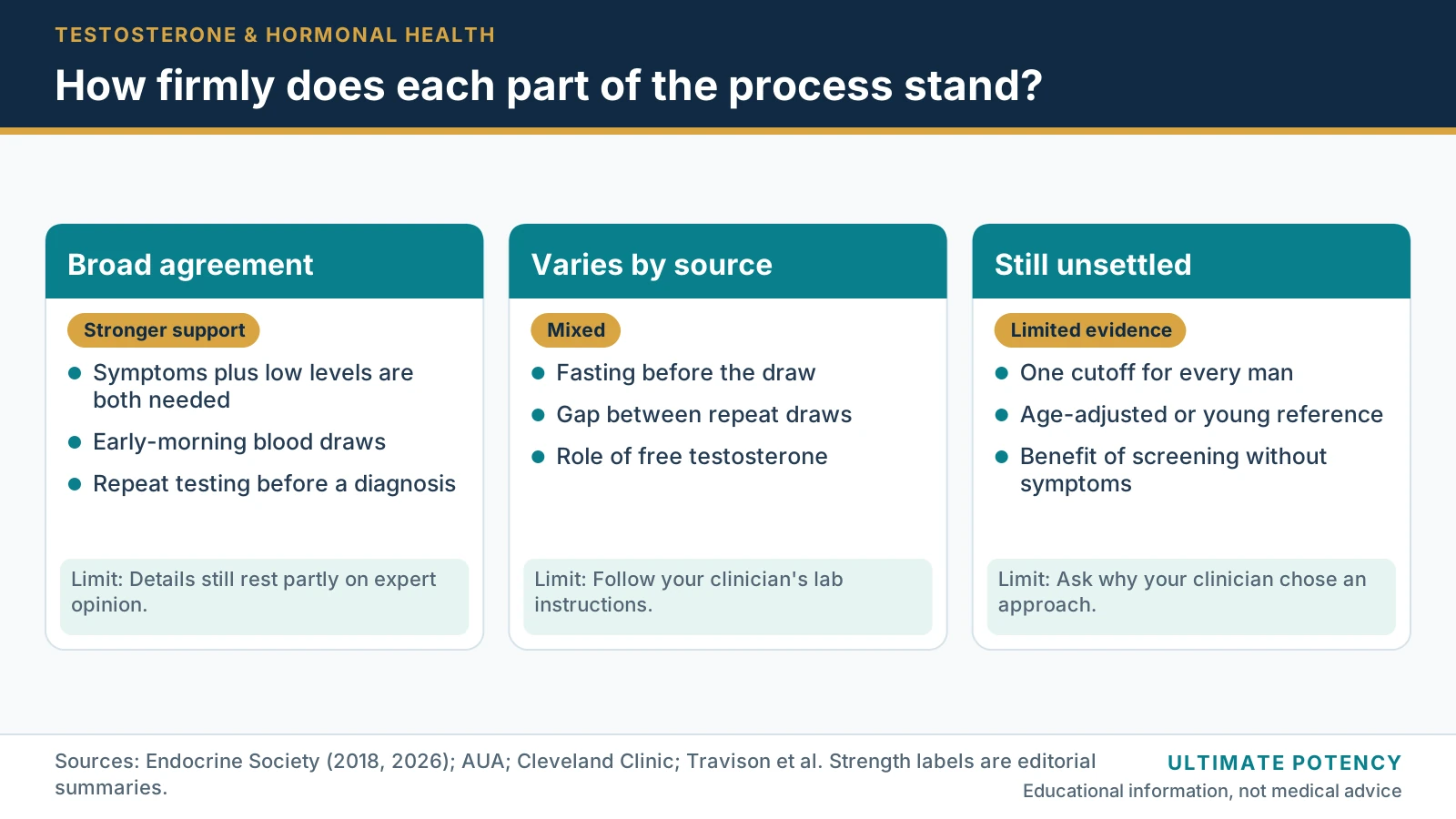
Text version: Broad agreement: symptoms plus low levels are both needed, early-morning blood draws, repeat testing before a diagnosis. Varies by source: fasting before the draw, gap between repeat draws, role of free testosterone. Still unsettled: one cutoff for every man, age-adjusted or young reference range, benefit of screening men without symptoms.
After the Diagnosis: Treatment Gates, Fertility, and Follow-Up
A diagnosis isn’t an endpoint. It determines which paths are open, which safeguards are needed, and what happens next. Because treatment decisions have their own articles, this section stays on the connection between diagnosis and what follows: why labels and trials insist on confirmation, how fertility changes the picture, and why results get revisited over time.
Why Confirmation Comes First
Careful diagnosis isn’t bureaucracy. Testosterone products carry real risks and limits, and the rules for using them are written around the assumption that low testosterone has been properly confirmed.
What Labels and Guidelines Require
Product labeling builds the diagnostic standard into its instructions. The Pfizer testosterone cypionate label, revised in June 2025, tells prescribers to confirm the diagnosis before starting by checking morning results from at least two separate days. It carries the same limitation of use for age-related hypogonadism and warns that testosterone can raise blood pressure, with periodic monitoring advised. The Urology Care Foundation likewise says a total testosterone level should always be checked before any testosterone therapy.
The FDA’s February 28, 2025 announcement added results from the TRAVERSE trial to all testosterone products, kept the limitation of use for age-related hypogonadism, removed cardiovascular-risk language from the Boxed Warning, and added blood pressure information and warnings. A changed warning doesn’t mean every risk has disappeared. On the guideline side, the American College of Physicians limits its 2020 advice to men with age-related low testosterone who have sexual dysfunction and want to improve it, and says to reevaluate within 12 months. Confirming the diagnosis first is part of using these products as intended. The details of benefits and risks are in our article on TRT benefits and risks.
What Large Trials Required Before Enrolling Men
The TRAVERSE trial is the largest study of testosterone therapy’s cardiovascular safety so far, and how it chose participants shows what careful diagnosis looked like in research. According to the published paper, men aged 45 to 80 needed at least one symptom of hypogonadism and two fasting testosterone levels below 300 ng/dL, with samples drawn between 5 a.m. and 11 a.m. and measured at a central laboratory using LC-MS/MS. Of 5,246 men randomized, the primary outcome of cardiovascular death, heart attack, or stroke occurred in 7.0 percent of the testosterone group and 7.3 percent of the placebo group over a mean follow-up of about 33 months.
The Endocrine Society’s 2026 statement summarizes the same trial as showing no meaningful increase in heart attack or stroke over one to four years, but roughly a 50 percent relative increase in pulmonary embolism and more fractures among treated men. Notice what this does and doesn’t tell you about diagnosis. It shows that high-quality research used repeated, timed, laboratory-standardized measurements plus symptoms. It does not show how accurately any particular cutoff identifies who will benefit. Men who don’t meet those criteria, or who differ from the participants, can’t assume the results apply to them. Our article on who should not take testosterone addresses the other side of that question.
Fertility and Follow-Up
Two themes keep coming back after a low result is confirmed: whether a future pregnancy is part of the plan and how results will be revisited. Both belong in the diagnostic conversation rather than being left for later.
Semen Analysis and Family Plans
If you hope to have children, fertility becomes a central part of the evaluation. The Endocrine Society’s full guideline recommends two semen tests several weeks apart when fertility is in question, and the Urology Care Foundation says FSH and semen tests are done before hormone therapy if you want children. The reason is practical: the Pfizer label notes that oligospermia (a low sperm count) may occur after prolonged administration or excessive dosage of testosterone, and the Endocrine Society’s 2026 statement does not address fertility at all, so the details come from other sources.
Consider a hypothetical situation: a man in his thirties has low desire, two early-morning results below his lab’s range, and mentions that he and his partner hope to have a child within a couple of years. The most useful step wouldn’t be choosing a treatment. It would be telling the clinician about the plan early, asking how testing and any treatment might affect sperm production, and asking whether a semen analysis should come first. That’s an illustration, not advice for any real person. Fertility goals change which options make sense, so raise them at the start. Our articles on TRT and fertility and on male fertility cover this in depth.
Monitoring and Reassessing Over Time
Diagnosis is a snapshot, and follow-up gives it context. Testosterone can change when weight, sleep, medicines, or health conditions change, so a clinician may repeat testing after a cause has been addressed, or to check whether a low value persists. If a treatment is started, monitoring becomes part of care. The Endocrine Society’s 2026 statement says screening and monitoring are needed once testosterone therapy begins and stresses that prostate cancer risk assessment before and monitoring during treatment remain essential, while noting that long-term safety, including for prostate cancer, is not established.
The Cleveland Clinic patient page advises regular follow-up, once or twice a year, for people on hormone therapy and suggests asking how often your testosterone should be checked. The ACP guideline similarly says to reevaluate symptoms within 12 months and stop if sexual function hasn’t improved. For you, the practical question is simple: who will review results, when, and what would prompt an earlier call? Our guide to TRT monitoring blood tests lists what monitoring can involve. Even without treatment, it’s reasonable to ask whether and when testing should be repeated, for instance after a weight change, a medicine change, or treatment of sleep apnea, because those changes can shift the picture.
Common Questions
People tend to ask the same handful of questions once they start reading about testosterone testing. The answers below draw on the sources used throughout the article, grouped into questions about tests and results and questions about symptoms, age, and cost. Each answer is short on purpose and points back to the fuller discussion.
Questions About Tests and Results
These questions come up most after someone sees a number on a lab report and isn’t sure how much weight to give it.
Is 300 ng/dL the Number That Defines Low Testosterone?
Not exactly. It’s the figure most often used as a clinical reference point, but no source we read treats it as a biological boundary that applies identically to everyone. AUA materials define low as under 300 ng/dL, the Endocrine Society’s 2026 statement calls it a common clinical threshold, and the 2018 guideline itself avoids a single universal cutoff and asks for “unequivocally and consistently low” values by an accurate assay. A harmonized reference study put the lower edge for healthy, nonobese young men at 264 ng/dL, which shows how the line depends on who is being compared.
Units add to the confusion. Some labs report nanograms per deciliter and others report nanomoles per liter, so a value of about 10 on one scale is not the same as 10 on the other. If a report doesn’t say, ask. A result near the line deserves a conversation about repeat testing, symptoms, and other causes, not a verdict from the number alone. For help reading ranges, see our guide to reference ranges and the article on when to test testosterone levels.
Can a Normal Result Still Leave Questions?
Yes, for several reasons. A normal total testosterone result doesn’t rule out every hormone-related issue, since binding proteins can change how total and free values relate. A single sample can also miss a lower value on another day, and a reference range by definition includes most healthy men, so a result inside it doesn’t prove that testosterone is at the right level for you. Conversely, a normal result often means the symptoms deserve a different explanation, which is useful information in itself.
If symptoms persist after a normal, properly timed result, the helpful next step is usually to widen the search rather than repeat the same test endlessly. Sleep, mood, medicines, thyroid function, weight, and relationship or work stress all deserve a look. For erection changes specifically, the evaluation described by NIDDK covers medicines, sexual and mental health history, an exam, and tests of thyroid and prostate. Our article on low testosterone and erectile dysfunction explains how the two questions relate. A normal result is an answer, even when it isn’t the answer you expected.
Questions About Symptoms, Age, and Costs
The next two questions are about the limits of symptom-based reasoning and about what testing may involve financially.
Can Symptoms Alone Establish Low Testosterone?
No. The Endocrine Society’s 2026 statement says symptoms alone aren’t diagnostic, noting that low energy, libido, and mood are common in aging men and have many causes. The AUA’s guideline summary describes symptoms associated with low levels as very nonspecific and as possible manifestations of other conditions. Even the European Male Aging Study, which found a distinct sexual-symptom pattern, paired symptoms with measured testosterone to propose its criteria.
That doesn’t make your symptoms any less real or worth taking seriously. It means they’re the reason to look, and a properly timed, repeated blood test is how to find out whether testosterone is part of the explanation. If a questionnaire or an online quiz suggested low T, treat it as a prompt for a conversation. If a clinician suggests starting treatment without having confirmed the diagnosis with testing, it’s reasonable to ask how the diagnosis was established, because the labeling and guidelines described earlier call for confirmation first. Taking symptoms seriously and requiring confirmation are not opposing positions. They work together.
What Affects the Cost of Testing?
Costs depend on who orders the test, where it’s processed, and how many tests are involved, and no single price applies to everyone. We haven’t verified any prices from a source we could open, so we describe cost components rather than quoting figures. The table below lists what tends to add up and what to check with your plan or provider before you go.
This table lists the pieces that can add to the cost of an evaluation and what to confirm with your insurer or provider, without quoting prices we could not verify.
| Cost component | What may vary | What to verify |
|---|---|---|
| Office or telehealth visit | Type of clinician, copay, deductible, in-network status | Whether the visit is covered and what you owe |
| Initial blood draw | Which tests are bundled; total only or free testosterone and SHBG as well | Which tests are ordered and how each is billed |
| Repeat testing | Number of repeat draws and timing | Whether repeat draws are covered and how often |
| Follow-up tests | LH, FSH, prolactin, iron studies, semen analysis, imaging | Which are medically indicated and covered |
| Laboratory choice | In-network lab, hospital lab, or direct-to-consumer lab | Whether the lab uses a certified assay and bills your plan |
| Home or online kits | Sample type, what is measured, whether clinician review is included | Whether results come with clinician review and what insurance covers |
Editorial summary. The Hims & Hers page notes that its home tests are rarely covered by insurance and not payable by FSA or HSA, which reflects one company’s policy; check your own plan.
Cost can also shape practical choices, such as which lab to use or whether to combine visits. A short call to your insurer’s member line can clarify coverage before you schedule. If cost is a barrier, say so; a clinician may be able to prioritize the tests most likely to change the plan. And remember the AUA white paper’s point that rigid payer cutoffs shouldn’t replace clinical judgment when a clinician has established the need.
Your Next Steps
You now have the shape of the diagnostic process. This final section turns it into action: how to gather the information that makes an appointment productive, which questions to bring, how to read results alongside a clinician, and how to plan the follow-up. The aim is to leave each visit with clarity about what was found, what remains uncertain, and what happens next.
Preparing for Care
Preparation makes a short appointment more useful. A little organizing beforehand helps a clinician see your pattern clearly and choose the right tests sooner.
Gathering Your Notes and Medication List
Start with a simple timeline. Write down when you first noticed changes, how often they happen, and whether anything shifted around the same time, such as a new medicine, weight change, illness, or stressful period. Note sleep quality, snoring, and mood, since these often matter as much as the hormone itself. List every prescription, over-the-counter product, and supplement, including biotin and any “booster” products, and bring prior lab reports with the lab’s name and the time of day they were drawn, if you have them. If a partner has noticed snoring, irritability, or changes in your energy, those observations can be valuable, and you can relay them in your own words. Keep the notes short and factual: dates, patterns, and examples work better than a long narrative, and a one-page summary on your phone is plenty.
If you have a choice of who to see, our guide to what doctor treats erectile dysfunction explains how primary care, urology, and endocrinology often divide the work, and similar reasoning applies to hormone questions. The table below organizes what to bring and why it helps.
This preparation table pairs each piece of information with why it helps a clinician and what you might say.
| What to note | Why it helps | What to bring up |
|---|---|---|
| Symptom timeline | Shows duration, pattern, and what changed | “This started about when…” with specific dates or events |
| Sexual changes | Desire, erections, and morning erections point to different causes | Whether desire, firmness, or both have changed |
| Sleep and snoring | Sleep apnea and poor sleep overlap with low T | Partner observations about snoring or pauses in breathing |
| Medications and supplements | Opioids, steroid medicines, and others can lower testosterone; biotin can affect some tests | A full list, including over-the-counter products |
| Past results and timing | Time of day and lab method affect how results compare | Prior reports, lab names, and draw times |
| Family plans | Treatment can affect sperm production | Whether a pregnancy is in your plans |
Editorial template informed by the Endocrine Society, Mayo Clinic, and Urology Care Foundation descriptions of the evaluation. Not a self-diagnosis tool.
Questions About How Low Testosterone Is Diagnosed
Good questions turn a visit into a conversation. You might ask: What are you looking for, and what would change the plan? Which tests do I need, and when should they be drawn? Do I need to fast, and is a repeat draw needed? Which laboratory will run it, and does it use a certified method? Could any of my medicines, my sleep, or my weight be contributing? If the results are low, what will you look for next? If they’re normal, what else could explain my symptoms?
It’s also fair to ask how the clinician decides when low testosterone is confirmed, since sources differ on details like timing and spacing. Ask what the plan is if the first result is borderline, and whether fertility needs to be considered before any treatment decision. You are allowed to ask why a test is being ordered and what the answer will change. Writing the questions down and bringing a notebook or phone note keeps the visit focused. The graphic below condenses the preparation steps into a checklist you can save and use.
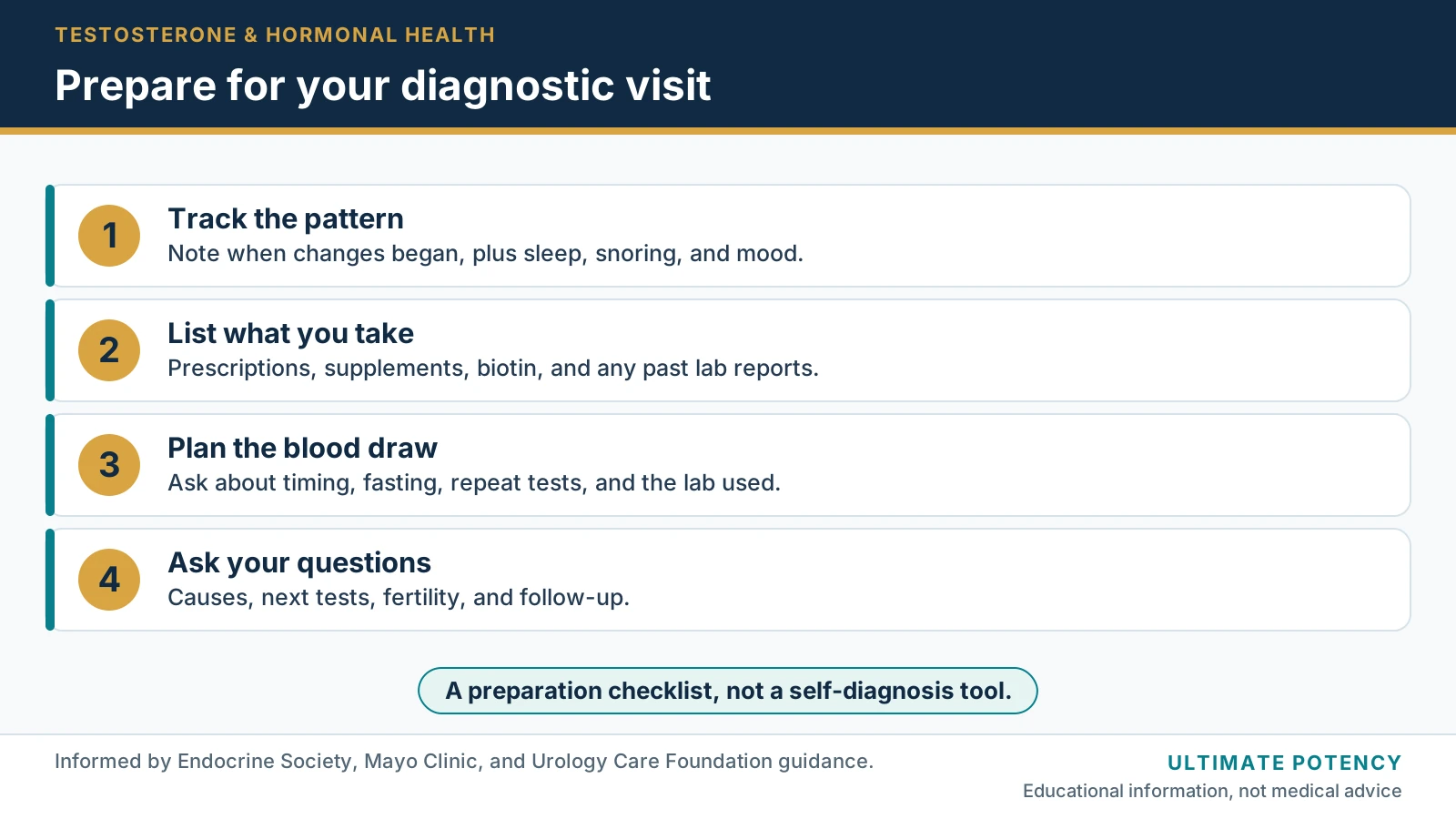
Text version: Step 1: track the pattern of symptoms, sleep, snoring, and mood. Step 2: list every prescription, supplement, and biotin product, and bring past lab reports with the lab name, date, and time. Step 3: plan the blood draw by asking about morning timing, fasting, repeat tests, and the lab. Step 4: ask about causes, next tests, fertility plans, and follow-up.
After the Visit
What happens after the appointment matters as much as what happens in it. Understanding results and agreeing on a follow-up plan are how a diagnosis becomes a plan you can actually follow.
Reading Results Together
When results arrive, ask to go through them together, whether in person, by phone, or through a patient portal. Ask which tests were done, at what time of day, what the lab’s reference range is, and whether the result is considered consistent with your symptoms. If a value is borderline, ask whether repeating it makes sense and under what conditions. A result that surprises you is a reason to ask more questions, not a reason to act alone.
Consider a hypothetical situation: a man receives two early-morning results, drawn on separate days, that are both below the lab’s range, and he has been dealing with lower desire and fatigue. His clinician orders LH, FSH, and prolactin and reviews his medicines and sleep. The point of that follow-up isn’t to hurry toward a treatment. It’s to learn whether the cause lies in the testicles, the pituitary, or something modifiable. This is an illustration, not a prediction. Understanding why testosterone is low usually matters more than the number itself. Our article on primary versus secondary hypogonadism explains how these paths differ.
Building a Follow-Up Plan
A good follow-up plan has three parts: what happens next, who is responsible, and when to check back. Ask when you should expect results, whether a repeat draw is planned, and which symptoms should prompt an earlier call. If lifestyle or medicine adjustments are discussed, ask what changes are being recommended, how long to try them, and when to retest. Don’t change or stop a prescribed medicine without talking to the prescriber.
Keep a short record: dates, results, the lab used, and any changes in how you feel. That record is valuable if you see another clinician or need to compare results over time. If your mood drops significantly, or you have thoughts of harming yourself, you can call or text 988 right away. Otherwise, remember that you don’t have to settle every question in one visit. Diagnosis is a process, and it’s fine for it to take more than one conversation. When you’re ready to look further, our guide to low testosterone symptoms is a good companion to this one.
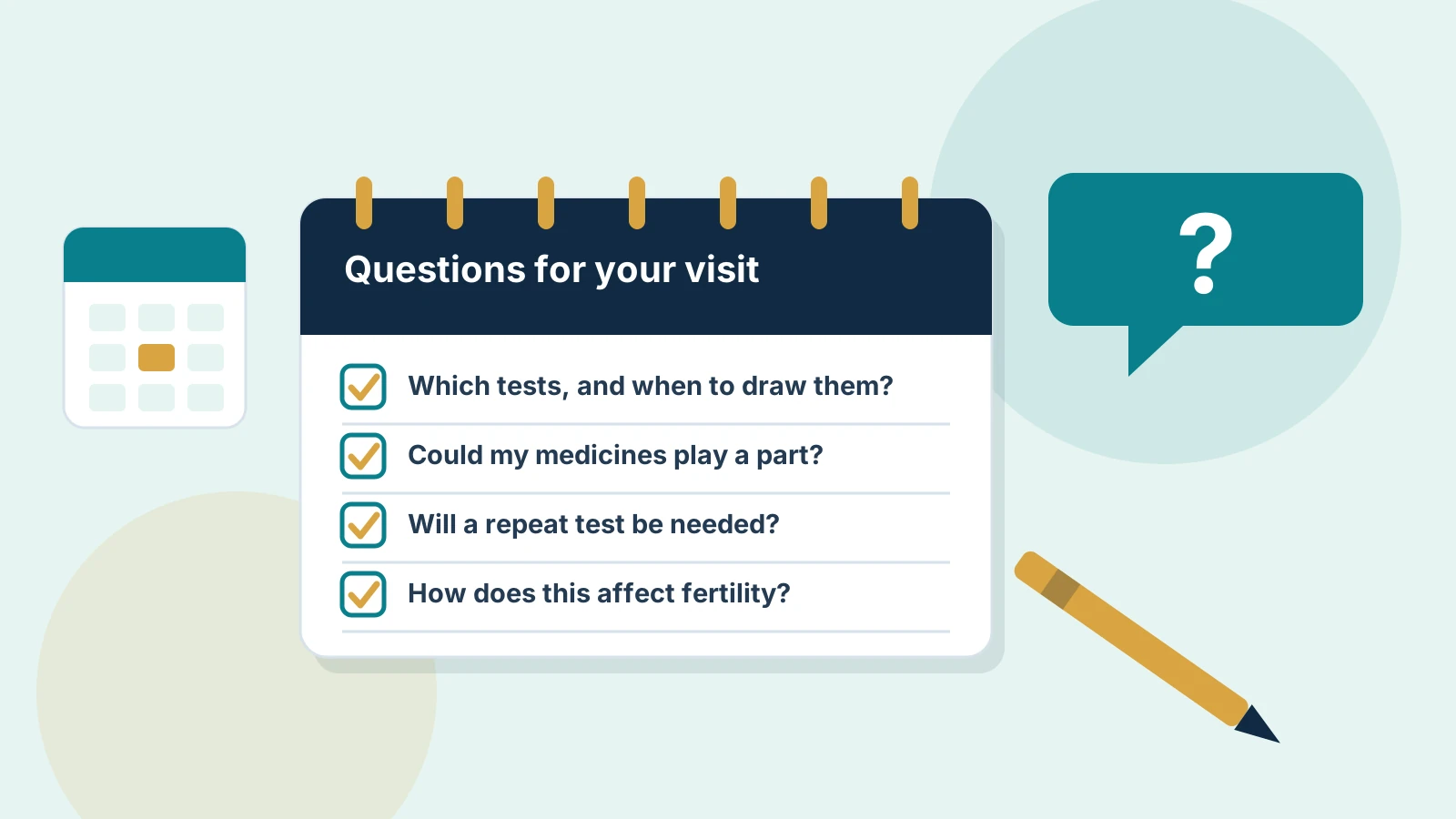
Sources
- Statement on Testosterone Replacement Therapy. Endocrine Society. July 16, 2026. Checked 2026-10-16.
- Testosterone Therapy in Men with Hypogonadism: Clinical Practice Guideline (summary page). Endocrine Society. Posted March 19, 2018. Checked 2026-10-16.
- Testosterone Therapy in Men with Hypogonadism: An Endocrine Society Clinical Practice Guideline (full text, copy hosted by the Alabama Board of Medical Examiners). Endocrine Society (J Clin Endocrinol Metab, 2018). 2018. Checked 2026-10-16.
- Evaluation and Management of Testosterone Deficiency (2024) – public landing page. American Urological Association. Published 2018; reviewed and validity confirmed 2024. Checked 2026-10-16.
- Top 3 Myths vs. Facts When It Comes to Low Testosterone. American Urological Association. June 15, 2021. Checked 2026-10-16.
- The Laboratory Diagnosis of Testosterone Deficiency (white paper). American Urological Association. 2013 copyright; exact date not shown. Checked 2026-10-16.
- Testosterone Levels Test. MedlinePlus (NIH). Last updated June 5, 2025. Checked 2026-10-16.
- Luteinizing Hormone (LH) Levels Test. MedlinePlus (NIH). Last updated December 5, 2023. Checked 2026-10-16.
- Male hypogonadism: Diagnosis and treatment. Mayo Clinic. Page dated September 20, 2024. Checked 2026-10-16.
- Male hypogonadism: Symptoms and causes. Mayo Clinic. Page dated September 20, 2024. Checked 2026-10-16.
- Low Testosterone (Male Hypogonadism). Cleveland Clinic. Last updated February 23, 2026. Checked 2026-10-16.
- Why testosterone levels drop and when to consider treatment. Harvard Health Publishing. March 27, 2026. Checked 2026-10-16.
- 1-Minute Consult: Does My Patient Have Testosterone Deficiency?. Cleveland Clinic Consult QD (Cleveland Clinic Journal of Medicine). May 20, 2024. Checked 2026-10-16.
- Low Testosterone: Symptoms, Diagnosis & Treatment. Urology Care Foundation. No review date shown (footer 2026). Checked 2026-10-16.
- FDA issues class-wide labeling changes for testosterone products. U.S. Food and Drug Administration. February 28, 2025. Checked 2026-10-16.
- Testosterone Cypionate Injection prescribing information. Pfizer. Revised 6/2025. Checked 2026-10-16.
- Hormone Standardization (HoSt) Program: Improving Performance. Centers for Disease Control and Prevention. Last updated May 14, 2026. Checked 2026-10-16.
- Harmonized reference ranges for circulating testosterone levels in men of four cohort studies in the United States and Europe. Travison et al., J Clin Endocrinol Metab (PubMed Central copy). 2017. Checked 2026-10-16.
- Identification of late-onset hypogonadism in middle-aged and elderly men (European Male Aging Study, abstract record). New England Journal of Medicine, 2010 (University of Glasgow repository). 2010. Checked 2026-10-16.
- Cardiovascular Safety of Testosterone-Replacement Therapy (TRAVERSE; copy hosted by University of Wisconsin Department of Urology). New England Journal of Medicine, 2023. 2023. Checked 2026-10-16.
- ACP issues guideline for testosterone treatment in adult men with age-related low testosterone. American College of Physicians. January 7, 2020. Checked 2026-10-16.
- Recommendations on the diagnosis, treatment and monitoring of hypogonadism in men. Lunenfeld et al., The Aging Male, 2015 (PubMed Central copy). 2015. Checked 2026-10-16.
- Obstructive sleep apnea: Symptoms and causes. Mayo Clinic. Page dated December 4, 2025. Checked 2026-10-16.
- Depression. National Institute of Mental Health. Revised 2024. Checked 2026-10-16.
- Diagnosis of Erectile Dysfunction. NIDDK. Last reviewed October 2024. Checked 2026-10-16.
- Treatment for Erectile Dysfunction. NIDDK. Last reviewed October 2024. Checked 2026-10-16.
- Do At-Home Testosterone Tests Work?. Hims & Hers (commercial benchmark). Published November 17, 2025. Checked 2026-10-16.
Ultimate Potency is an educational publication. It does not diagnose, prescribe, or provide medical care. This article does not replace advice from a licensed healthcare professional who knows your history.