Few things feel as unsettling as a hard blow, a crash, or a surgery involving the testicles, followed by weeks of wondering whether something has changed hormonally. If you’ve been searching for answers about low testosterone after testicular injury, you’ve probably found scary headlines and very little clear explanation. This guide is meant to fill that gap in plain language.
Here’s the short version of what it covers. Most testicular injuries are mild and heal, according to the Cleveland Clinic’s testicular trauma overview, but that same page lists low testosterone and infertility among possible complications, because trauma can interfere with hormone and sperm production or block blood flow. How likely that is depends on how severe the injury was, whether one or both testicles were affected, and what your hormone levels were before. We’ll walk through the kinds of injury, symptoms that overlap with many other conditions, blood tests and how to read them over time, what research does and doesn’t show, and treatment safety, including fertility.
One boundary up front. This article can’t tell you whether your own level is low, whether an injury caused it, or whether you need treatment. Those are judgments for a clinician who has your records in front of them. For the broader hormone picture, our guide to low testosterone symptoms is a good companion. If your care team is also checking other hormones, the articles on prolactin and low testosterone and thyroid problems and testosterone may help too.
A final note on tone. An injury to this part of the body can stir up embarrassment, fear, or frustration, and talking about it isn’t easy. None of those feelings say anything about your worth or your masculinity. A testicular injury is a medical event, and medical events deserve calm, practical attention.
Understanding Low Testosterone after Testicular Injury
Before looking at symptoms or lab work, it helps to settle what the phrase actually means and what kinds of injuries people are talking about. This section defines the terms, explains where the testicles fit into the body’s hormone system, and sorts injuries into groups that matter for follow-up.
Key Concepts
Two ideas get blended in many online discussions: an injury to the testicle and a hormone result. This subsection pulls them apart, then explains how the two can connect.
What Low Testosterone after Testicular Injury Means
The phrase describes a blood testosterone level that is lower than expected following damage to one or both testicles. On its own, a low number is only a lab finding. Clinicians generally speak of testosterone deficiency or hypogonadism when a low level comes together with symptoms or signs. The American Urological Association’s testosterone deficiency guideline page defines testosterone deficiency as low testosterone levels combined with symptoms or signs associated with low serum total testosterone, and a person qualifies only when both are present.
That matters after an injury, because it works in two directions. A man can have a low reading soon after trauma and feel fine, and a man can feel tired or low in drive while his numbers are normal. The word “after” also deserves care. Something happening after an injury doesn’t prove the injury caused it, since low testosterone is common for other reasons and may predate the event. Think of the phrase as a question to investigate, not a conclusion.
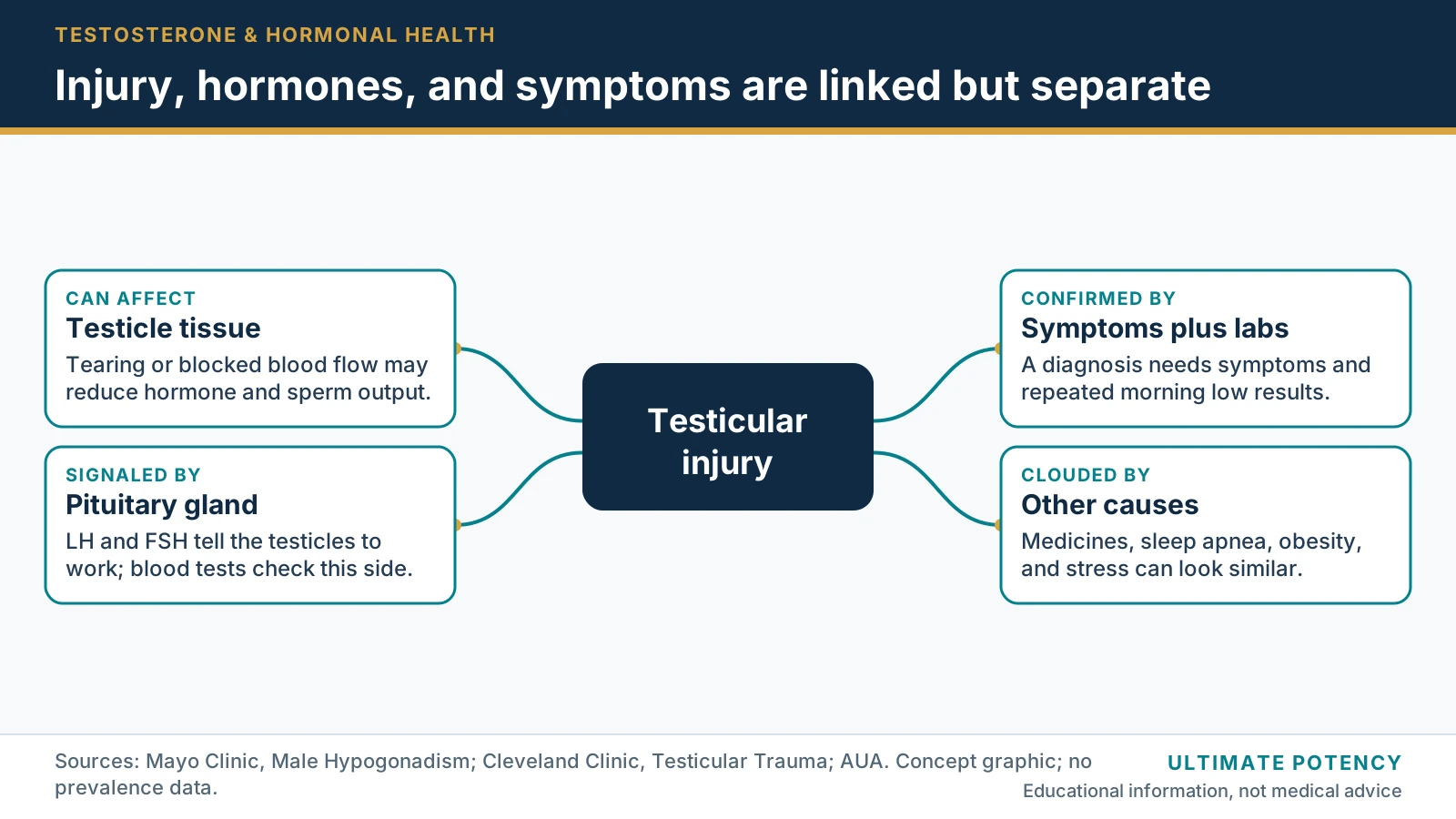
Text version: Testicular injury can affect testicle tissue, which makes testosterone and sperm. The pituitary gland signals the testicles with LH and FSH, and blood tests look at this side too. A diagnosis needs symptoms plus repeated morning low results. Other causes such as medicines, sleep apnea, obesity, and stress can look similar.
How the Testicles Make Hormones and Where Injury Fits
The testicles do two jobs: they make sperm and they make testosterone. The Mayo Clinic’s male hypogonadism page explains that the hormone-making process is directed from above, since the hypothalamus and pituitary gland normally signal the testicles to produce testosterone. When the testicles themselves are the problem, the condition is called primary hypogonadism, and Mayo lists testicular injury among its causes. When the signaling centers are the problem, it’s called secondary hypogonadism.
Injury is a primary, testicle-level cause. Trauma can tear tissue or cut off blood flow, and the Cleveland Clinic notes that it can interfere with hormone and sperm production, so the testicle may make less hormone than before. Our explainer on primary versus secondary hypogonadism goes deeper on the distinction. The practical point is that an injury and a signaling problem can look the same on a basic test, which is one reason later blood work often looks at both sides of the system.
Kinds of Testicular Injury
Not every injury carries the same hormonal risk, so sorting them helps. Doctors group testicular injuries by how they happened and what tissue was damaged, and that grouping shapes both treatment and follow-up.
Blunt Injuries, Bruises, and Ruptures
Blunt injuries are the most common kind. The MSD Manual’s genital trauma page for professionals notes that most testicular injuries come from blunt force, such as assaults, motor vehicle crashes, and sports injuries. Doctors call it a contusion when the testicle is bruised and a rupture when the tunica albuginea, the tough outer covering, is torn. A collection of blood around the testicle is called a hematocele.
The Cleveland Clinic page describes causes that include kicks, punches, thrown objects like baseballs, and motorcycle or bike accidents, and says motorcycle riders and contact-sport players carry higher risk. Mild bruises are generally managed with rest, ice, scrotal support, and over-the-counter pain relievers. Ruptures are different and usually need surgery. The MSD Manual cautions that pain can be out of proportion to the physical findings, or the reverse, which is why a clinician usually orders an ultrasound rather than relying on how an injury looks or feels.
Penetrating Wounds, Torsion, and Surgery
Penetrating injuries, such as stab wounds, gunshot wounds, or animal bites, are less common but more likely to damage the testicle itself. The MSD Manual says penetrating injuries, and findings suggesting rupture on exam or ultrasound, call for surgical exploration and repair. The AUA’s 2020 urotrauma guideline includes statements on ultrasound for blunt scrotal injuries that suggest rupture and on exploration with repair or orchiectomy (surgical removal of a testicle) for penetrating scrotal injuries.
Two other situations belong in this group. Testicular torsion, where the spermatic cord twists and cuts off blood flow, can be triggered by a scrotal injury, according to MedlinePlus. And surgery near the groin or scrotum, including removal of a testicle for any reason, can change hormone output. Each path leads to a different follow-up conversation, which the table below summarizes.
This table sorts common injury types in plain language and pairs each with a question that connects the injury to hormone follow-up.
| Injury type | What it generally means | A hormone-related question to ask |
|---|---|---|
| Contusion (bruise) | Bruising of the testicle without a torn covering | Is a hormone check needed, or only if symptoms appear later? |
| Rupture | The testicle’s outer covering is torn, usually repaired with surgery | What did the repair involve, and should hormones be checked afterward? |
| Hematocele | Blood collected around the testicle | Did imaging show damage to the testicle itself? |
| Penetrating injury | A wound that enters the scrotum or testicle | Was any testicular tissue lost or removed? |
| Torsion after injury | A twisted cord that cut off blood flow | How long was blood flow reduced, and how does the testicle look now? |
| Surgery or orchiectomy | An operation that changed or removed a testicle | Which testicle is left, and what was my level before? |
Sources: Cleveland Clinic, Testicular Trauma (reviewed August 2025); MSD Manual Professional Edition, Genital Trauma (January 2025); MedlinePlus, Testicular Torsion (July 2025). Plain-language summary, not a diagnostic tool.
Getting Urgent Care and Early Follow-Up
Hormone questions only matter once the injury itself has been dealt with. This section covers the signs that call for emergency care, why timing is so critical with a twisted testicle, and what early evaluation usually involves, so the later conversation about testosterone starts from solid ground.
Signs That Need Prompt Attention
Some symptoms after a groin injury shouldn’t wait for a routine appointment. Knowing them is the single most protective step for hormone and fertility outcomes, because saving testicular tissue starts with fast care.
Symptoms That Call for an Emergency Visit
The Cleveland Clinic lists severe scrotal pain, visible bruising, swelling, lower belly pain, nausea or vomiting, fever, blood in the urine, and pain while urinating as symptoms of testicular trauma. Its guidance is direct: if there’s any question about how severe the injury is, go to the nearest emergency department. It also names an injury that penetrates the scrotum, severe swelling with pain and bruising, fever after an injury, and pain that doesn’t stop or gets worse as reasons to be seen promptly.
It’s tempting to tough it out, especially when the pain eases after a few minutes. A fading ache doesn’t rule out a serious injury, and a rupture or twisted cord can stay hidden behind swelling. Going in and hearing “this is only a bruise” is a good outcome, not a wasted trip.
Why Torsion Is a Race Against Time
Testicular torsion is a twist of the spermatic cord, the structure that carries blood to the testicle. MedlinePlus describes it as an emergency: surgery is usually needed to untwist the cord, and if it’s done within 6 hours, most of the testicle can usually be saved. When blood flow is cut off for longer than that, the chance of needing removal rises, and the testicle can lose function even when the twist lasts less than 6 hours. MedlinePlus advises going to an emergency room rather than urgent care, because surgery may be needed right away.
Torsion matters for this topic because the testicle that loses its blood supply can shrink or stop working, which is one route to hormone and fertility trouble. The Mayo Clinic’s torsion page notes that episodes often follow vigorous activity, a minor injury, or sleep. If you have sudden one-sided pain, the clock is the priority.
What Early Evaluation Involves
Once you’re in front of a clinician, the first goal is to understand the physical damage. This subsection explains what that typically looks like and why testosterone usually isn’t the first concern in the first days.
Exams, Ultrasound, and Repair Decisions
According to the Cleveland Clinic, a provider asks how the injury happened and performs a physical exam, and a painless testicular ultrasound may be ordered. A normal ultrasound usually means no serious injury. Concern arises when something is torn or out of position, or when blood flow is reduced. The MSD Manual says patients with blunt testicular injury typically need a scrotal ultrasound, and the AUA’s urotrauma guideline gives specific statements on ultrasound and exploration for suspected rupture.
Repair decisions weigh the injury type. Severe injuries, or those where symptoms don’t improve after 48 hours, may need surgery, per the Cleveland Clinic. Removal of the testicle is rare, and sperm banking may be suggested if a testicle has to come out. For mild contusions, rest of 24 to 48 hours is typical, and a follow-up visit within one or two weeks is usual. These details matter later, because the operative notes and imaging reports become the record you’ll bring to any hormone discussion.
Why Hormone Questions Often Come Later
In the first days, nobody is usually thinking about testosterone, and for good reason. Control of pain, infection, bleeding, and blood supply comes first. A hormone level drawn during acute injury may also be hard to interpret. The research we cover later suggests levels can be lower soon after a severe injury and then improve, so an early number is a snapshot of a bad moment rather than a prediction.
That doesn’t mean the hormone question is unimportant. It means timing it well makes the answer more useful. No single schedule fits everyone, and the right moment for a first check is a clinical decision that depends on how severe the injury was and how you’re recovering. If you notice symptoms in the meantime, or if both testicles were involved, say so at your follow-up visit rather than waiting to be asked. A note listing the date of the injury and any surgery gives your clinician the context needed to choose the right moment.
Symptoms That May Show Up Afterward
Weeks or months after an injury, some men start to notice changes in drive, energy, or mood and wonder if hormones are involved. This section describes what low testosterone symptoms can look like, why they are so easy to misread after a hard stretch of recovery, and how to sort observations into useful questions instead of conclusions.
Changes You Might Notice
The symptoms linked to low testosterone are wide-ranging, and none of them is unique to the condition. Knowing the usual list helps you describe your own experience clearly without trying to diagnose it.
Desire, Erections, and Sexual Function
MedlinePlus says testosterone testing is mainly ordered for men who have gone through puberty and show symptoms such as low sex drive, erectile dysfunction, or infertility. The Mayo Clinic’s hypogonadism page similarly places reduced sex drive among early adult symptoms and erectile dysfunction and infertility among later ones. In plain terms, that means less interest in sex, changes in getting or keeping an erection, and fewer morning erections can all be on the list.
Here’s the catch: those same changes are common after any painful injury or operation, and they have many non-hormonal explanations. The Cleveland Clinic notes that sexual performance issues after testicular trauma are sometimes short-term. Worry about the injury itself can switch off desire or make erections less reliable, even when hormone levels are normal. For that reason, it helps to write down what changed, when it began relative to the injury, and whether it comes and goes. The overlap between hormones and erections is real but not one-to-one.
Energy, Mood, and Body Changes
Beyond sexual changes, Mayo describes low energy and depression among early adult symptoms, and, with longer-standing low levels, less body and facial hair, loss of muscle, breast tissue growth, and bone thinning, with trouble focusing in severe cases. MedlinePlus adds unexplained anemia to its list of reasons a clinician might order testing. Most of these develop slowly, over months or longer, rather than overnight.
That slow pace is useful to know. If you feel wiped out two weeks after an injury or surgery, the likelier explanation is healing, poor sleep, pain, or stress, not a hormone problem. Symptoms that persist well after recovery, or that keep building, are the ones worth raising. When you do, be specific: “I’m tired by mid-afternoon most days and lifting feels harder than before” gives a clinician far more to work with than “I feel off.” A symptom diary kept for a few weeks can show patterns that memory blurs, and it takes the pressure off trying to remember everything during a short visit.
Why Symptoms Are Hard to Interpret
Even with a careful list, symptoms rarely point to one cause. This subsection explains why recovery from an injury can mimic low testosterone and which other conditions clinicians usually keep in view.
Pain, Stress, and Recovery Can Look Alike
Recovering from a testicular injury is stressful in ordinary ways. Pain disrupts sleep, medicines can dull energy and drive, time away from exercise changes mood and body composition, and anxiety about sexual function can become a loop of its own. Each of those can produce tiredness, low motivation, or trouble with erections on its own.
This is why the question “is it the injury, the stress, or the hormones?” rarely has an immediate answer. Consider a hypothetical situation: after a bicycle crash, a man in his thirties has a severe bruise to one testicle and no surgery. A month later he’s less interested in sex and sleeping badly, and he assumes his testosterone has dropped. His clinician might ask about pain, sleep, mood, and medicines first, then decide whether a morning blood test makes sense and when. This is only an illustration of reasoning, not advice about any real case. The overlap between recovery and hormone symptoms is a reason for careful evaluation, not for jumping to a label. Worry can also sustain itself after the physical cause settles, which is why talking about it early helps.
Other Conditions That Share the Picture
A clinician looking at low testosterone symptoms will usually think beyond the injury. The Mayo Clinic lists secondary causes that have nothing to do with the testicles themselves, including pituitary conditions, certain medicines such as opiates, untreated obstructive sleep apnea, and obesity. MedlinePlus adds chronic liver or kidney disease and alcohol use disorder to the list of reasons for low results. The Endocrine Society’s 2026 statement likewise stresses ruling out reversible causes, naming obesity and medicines such as corticosteroids and opioids.
That matters after an injury because pain treatment sometimes includes opioid medicines, and a hormone result drawn while taking them may not reflect the testicles alone. Never stop a prescribed medicine on your own because of something you read; instead, bring the full list to your clinician and ask whether any item could affect hormones. Our article on medications that lower testosterone covers the topic in depth, and the thyroid and prolactin pieces explain two other hormone checks that sometimes accompany a low result.
This decision aid pairs common observations after a testicular injury with a question for your clinician, without implying any observation points to a particular cause.
| If you notice | A useful question | Information to bring |
|---|---|---|
| Lower interest in sex since the injury | Could pain, stress, or a hormone change explain this? | When it started, and whether it varies day to day |
| Erections less firm or less reliable | Should we look at hormones, blood flow, or both? | Any change in morning erections and current medicines |
| Ongoing fatigue or low mood after healing | Which causes should we rule out before testing hormones? | Sleep patterns, pain medicines, alcohol use |
| Loss of muscle or body hair over months | Is this the kind of change that calls for blood work? | Photos or notes that show the time course |
| Plans for a pregnancy with a partner | Should semen analysis come before anything hormonal? | Dates of injury or surgery and any prior fertility history |
Editorial decision aid informed by MedlinePlus (Testosterone Levels Test, June 2025) and the Mayo Clinic (Male Hypogonadism). Not a diagnostic or self-assessment tool.
Testing and Lab Results After an Injury
Blood tests turn a vague worry into data, but only if the right test is done at a sensible time and the result is read in context. This section explains what the common tests measure, how to think about repeat results, and why lab quality and timing can change the story.
What the Blood Tests Measure
A testosterone test is more nuanced than a single number. Here are the basics of what clinicians usually look at and why one reading seldom settles anything.
Total Testosterone, Free Testosterone, and Timing
MedlinePlus explains that total testosterone measures both bound and free hormone and is the most common test, while free testosterone measures only the unattached form that the body can use most readily. Testing is usually done in the morning, between 7 and 10 a.m., when levels are typically highest, and you may need to fast for several hours. The page also says to tell your provider about all medicines you take but not to stop any unless told to.
The same page makes a point worth remembering: a testosterone level test alone can’t diagnose a condition. Results depend on the type of test, age, symptoms, other test results, and other health conditions, and an abnormal result doesn’t always mean treatment is needed. For more on timing, ask the lab or your clinician what instructions apply to your draw. After an injury, two timing questions are particular to you: how long ago was the injury, and are you still taking pain medicines? Both belong on the requisition conversation, not in an afterthought.
LH, FSH, and Locating the Source of a Low Result
When a result comes back low, the next question is where the problem sits. The Endocrine Society’s clinical practice guideline on testosterone therapy recommends measuring luteinizing hormone (LH) and follicle-stimulating hormone (FSH), the pituitary signals that tell the testicles to work, to distinguish primary (testicular) from secondary (pituitary or hypothalamic) hypogonadism.
After a testicular injury, a pattern pointing to the testicles would fit the story, but it doesn’t prove the injury was the cause. A pattern pointing elsewhere would send the investigation toward the pituitary and other contributors, which may or may not have anything to do with the injury. The guideline also suggests further evaluation to find the cause. Our explainers on LH and FSH blood tests in men and primary versus secondary hypogonadism walk through what the patterns mean in general terms. They can’t replace a clinician’s reading of your own results alongside your injury history and exam.
Reading Results Over Time
For injury-related questions, the trend often matters as much as any single value. This subsection looks at early readings, recovery, and the practical reasons a repeat test may be requested.
Early Low Values and Later Recovery
The most relevant human data we found come from a retrospective chart review in the Journal of Urology, summarized on the Houston Methodist research page. It looked at service members with complex battle injuries, including scrotal trauma. Of 192 charts reviewed, 84 met the inclusion criteria. Initial post-injury testosterone was lower with more severe scrotal injury. Among men whose levels recovered to at least 250 ng/dL, recovery took a mean of about 4.5 months. Men who later needed testosterone replacement had lower initial levels and slower recovery.
The authors suggested that many men with scrotal injuries may recover testosterone without treatment, so observation can be reasonable. Those findings come with limits: the group was a military polytrauma population, the design was retrospective, and many charts didn’t have enough measurements. Consider a hypothetical situation: a man has a low reading a few weeks after surgery for a ruptured testicle, then a repeat several months later that looks different. The clinician wouldn’t treat the first number as the final answer. Here again, this is an illustration of logic, not a forecast for anyone’s recovery.
Repeat Testing and Lab Quality
The Endocrine Society’s 2026 statement on testosterone therapy says hypogonadism requires both symptoms and consistently low, accurately measured testosterone. It recommends at least two early-morning fasting tests, mentions a common clinical threshold near 300 ng/dL, and notes that non-standardized assays can give different results for the same sample, recommending assays certified by the CDC’s HoST program. A single low result, especially from a non-certified method, is a reason to repeat the test, not to start treatment.
Practical steps follow from that. Ask whether the lab is certified, whether your sample was drawn at the right time, and whether the same lab will be used for repeats, since switching labs can shift results. Keep copies of every report with its units, because ng/dL and nmol/L are both used. Reference ranges are set by each laboratory, so a number compared with a figure from the internet may be meaningless. See our guide on how low testosterone is diagnosed for the general process.
This table compares the tests most often discussed after a testicular injury, with the main limit of each and a question to raise.
| Test | What it can show | Main limit | Question to ask |
|---|---|---|---|
| Total testosterone (morning) | The overall amount of hormone in the blood | One reading can mislead; assay quality varies | Should this be repeated, and at what interval? |
| Free testosterone | The unattached portion the body can use most readily | Methods differ; not always ordered | Is this test needed in my situation? |
| LH and FSH | Whether pituitary signals point to a testicular or pituitary source | Doesn’t identify the exact cause | What do these results suggest about where the problem is? |
| Semen analysis | Sperm count and quality, relevant to fertility goals | Separate from hormone levels | Do I need this if I plan to have children? |
| Scrotal ultrasound | Structure of the testicle and its blood flow | Doesn’t measure hormones | Did imaging show lasting changes I should track? |
Sources: MedlinePlus, Testosterone Levels Test (June 2025); Endocrine Society, Testosterone Therapy in Men With Hypogonadism (2018) and statement on TRT (July 2026). Plain-language summary; specific tests are a clinician’s decision.
Comparing Relevant Factors
Reading about injury and hormones, it’s easy to come away with either too much alarm or too much reassurance. This section sets the research side by side, shows how far it can be stretched, and then looks at the personal factors that may make one man’s recovery different from another’s.
Evidence and Limitations
The published evidence on this exact question is thin. Understanding what each study did, and what it can’t say, is the best protection against both overconfident claims and unnecessary fear.
What the Research Has Looked At
We found a handful of relevant sources, and each answers a slightly different question. Some track hormone recovery, some look at surgery versus watchful waiting, and one is a single patient’s story. The table lays them side by side so the differences are visible.
This evidence matrix summarizes each source we opened, what it reported, and the main reason it can’t be stretched to everyone.
| Source | Design and group | Reported finding | Main limit |
|---|---|---|---|
| Williams and colleagues, 2015 | Retrospective chart review of 84 service members with polytrauma and scrotal injury | Initial testosterone was lower with more severe injury; recovery to at least 250 ng/dL took about 4.5 months on average | Military polytrauma group; not typical of sports or accident injuries |
| Kukadia and colleagues, 1996 | 15 men who had immediate surgery; 8 returned for testing | Hormone levels normal in all 8; 5 of 9 injured testes were atrophic | Very small and old; many men were lost to follow-up |
| Chang, 2025 conference abstract | Systematic review of 10 studies and 280 patients | Atrophy was reported more often with conservative care; long-term testosterone was comparable between approaches | Search covered studies only through 2015; abstract, not a full paper |
| Garcher, 2019 case report | One 26-year-old man with bilateral rupture after a motorcycle crash | Severe hypogonadism that improved with testosterone | A single case; shows what is possible, not what is typical |
| Patterson and colleagues, 2025 | Scoping review of pediatric scrotal trauma, 253 patients | No hormone outcomes reported; atrophy found in 30 patients | Children only; low-quality evidence per the authors |
Sources: Journal of Urology 2015 (Houston Methodist record); Journal of Urology 1996 (University of Minnesota record); ICS 2025 conference abstract; Translation 2019 case report; Irish Journal of Medical Science 2025. Summaries are editorial; check the original papers for detail.
The pattern is clear. The Williams review, summarized on the Houston Methodist research page, is the only source here that tracked testosterone over time in a group of injured men. The 1996 study of men who had immediate surgery found normal hormone levels in the eight men it retested, but also atrophy in five of nine injured testes and subfertility in six men. The 2025 systematic review abstract reported comparable long-term testosterone with surgical and conservative care. The 2019 case report describes bilateral rupture followed by severe hypogonadism that improved with testosterone, and the authors’ literature review suggested blunt trauma is a very rare cause of acquired hypogonadism. The 2025 pediatric scoping review did not report hormone outcomes at all.
How the Evidence Applies
Put together, these sources support a few careful statements. Severe scrotal injury can lower testosterone, at least for a while. Recovery over months is documented in at least one group of men. Preserving testicular tissue seems to matter for atrophy, and surgery and conservative care appear to end up with similar testosterone in the pooled data we saw. The same sources do not support some things that headlines imply: they don’t give a percentage of men who develop lasting low testosterone, they don’t show that a minor bruise leads to hormone problems, and they don’t say how long to wait before testing.
Absence of evidence is not the same as evidence of safety, and it is not evidence of harm either. What it means in practice is humility: your clinician is working from small studies, general principles, and your own numbers. If someone offers a confident prediction about your future testosterone based on the injury alone, it’s fair to ask what that prediction rests on. The graphic below summarizes how much weight each kind of statement can bear.
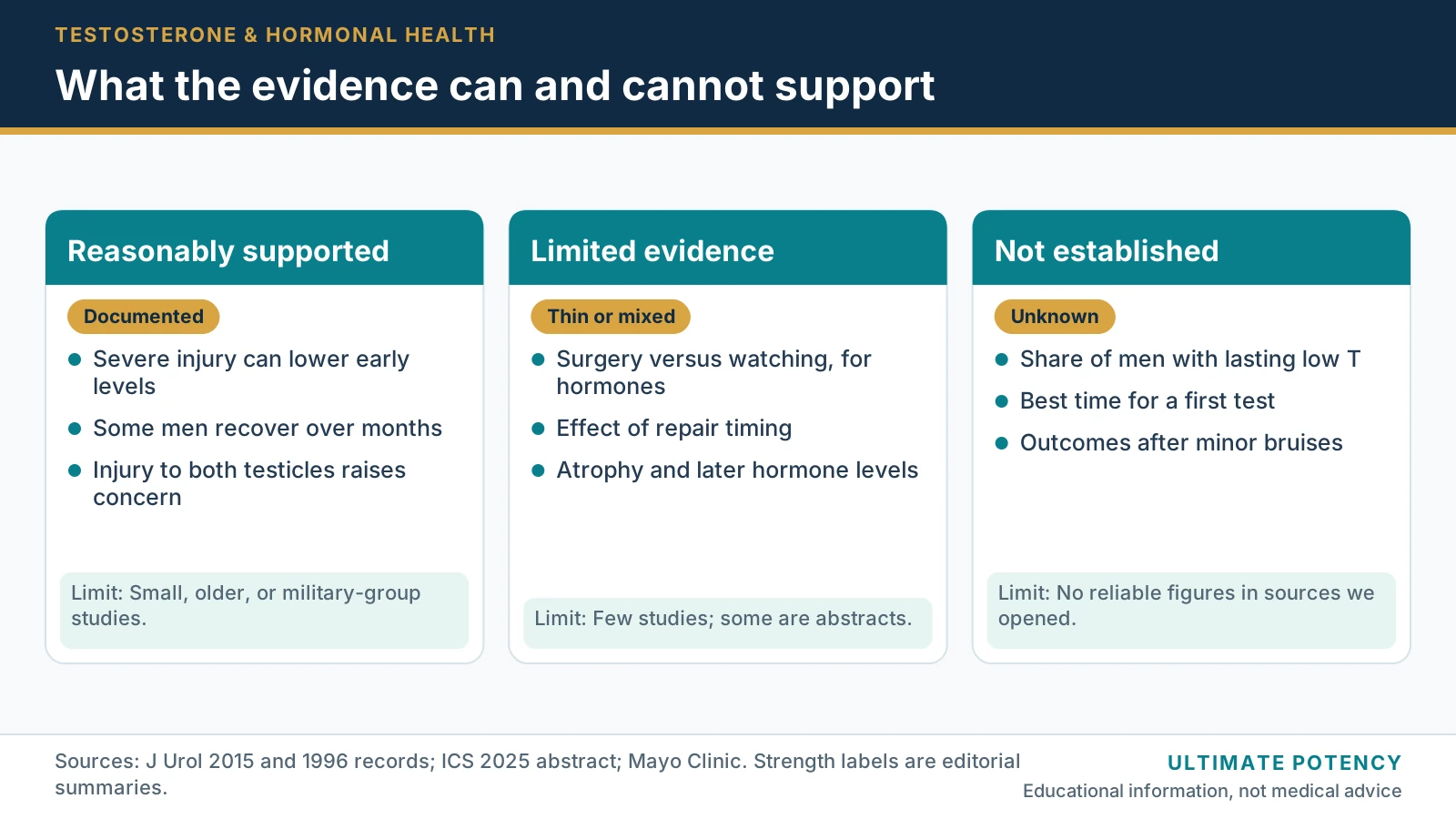
Text version: Reasonably supported: severe injury can lower early levels, some men recover over months, and injury to both testicles raises concern. Limited evidence: surgery versus watching for hormones, effect of repair timing, atrophy and later hormone levels. Not established: share of men with lasting low T, best time for a first test, outcomes after minor bruises.
Factors That Shape Hormone Outcomes
Because the research can’t predict an individual, clinicians weigh several factors together. These two subsections describe the ones that come up most often and why each is hard to measure.
Severity and the Number of Testicles Affected
Severity is the clearest factor. In the Williams review, initial testosterone was lower when the scrotal injury was more severe, and the men who needed replacement had lower starting levels and slower recovery. A bruise, a repaired rupture, and a lost testicle are not equivalent events, even if all three get called “a testicular injury.”
The number of testicles involved is the second major factor. The Mayo Clinic explains that injury to both testicles can cause hypogonadism, while if one is injured or removed, the other usually compensates. That is why a man with one damaged testicle and one healthy one often has an uncomplicated hormone picture, while bilateral damage is the setting in which trouble is most expected. The 2019 case report shows the far end of that range, with severe hypogonadism after bilateral rupture. “Usually compensates” is not a promise, though. The remaining testicle has to be healthy and its function can change for unrelated reasons, so one-sided injury is still a reason for periodic attention, particularly if symptoms develop or if fertility is a goal.
Starting Point, Timing, and Other Health Factors
One big unknown for many men is where they started. If no baseline testosterone was ever measured, a low result after an injury can’t be traced to the injury with certainty. Low testosterone has many causes, some of them listed earlier, and a man with obesity, sleep apnea, or a medication effect may have been low before the blow. Records from earlier checkups can help, so it’s worth asking whether any prior results exist.
Timing of repair may matter for the testicle itself. The 1996 study’s authors suggested that early repair may help preserve hormonal function and fertility, and the 2025 systematic review abstract found surgery achieved higher salvage rates than conservative care, typically for torn coverings or large hematomas. In the pediatric review, one study cited reported a much higher removal rate when surgery was delayed 72 hours compared with acute exploration. Children aren’t adults, so treat that as a signal rather than a rule. The takeaway is simple: prompt evaluation after a serious injury may protect the testicle, which is the best hormone insurance available. Overall health, weight, sleep, and medicines also shape both hormone levels and symptoms, so those get reviewed alongside the injury history.
Treatment Conversations and Safety
If a low result is confirmed and symptoms fit, treatment becomes a real discussion. This section explains when observation can make sense, how clinicians think about testosterone therapy, and the fertility and safety issues that anyone considering it should understand first.
Watching, Waiting, and Treating
Treatment isn’t automatic when a number comes back low. The decision depends on symptoms, the cause, timing, and your plans, and sometimes the right first step is to keep watching.
When Observation Can Make Sense
Among the men in the Williams review, many with scrotal injuries recovered their testosterone without intervention, and the authors concluded that observation can be reasonable for many patients. That fits with the way the AUA frames testosterone deficiency: low levels and symptoms or signs together. If a level is low soon after a severe injury but you feel reasonably well, repeat testing over time can show whether it is climbing.
Observation isn’t passive neglect. It usually means a plan: a follow-up date, a repeat blood test, a symptom check, and a clear signal for when to call sooner. It also means attention to anything fixable in the meantime, such as sleep, medicines that may affect hormones, or alcohol use. Waiting often makes the most sense when symptoms are mild, when recovery is still early, or when a clinician expects the injury to settle. It usually makes less sense when symptoms are significant, when both testicles were damaged, or when levels are very low and not improving. Those judgments belong to your care team, which is why a shared timeline helps so much.
When Clinicians Discuss Testosterone Therapy
The Endocrine Society’s 2026 statement says therapy at a dose similar to natural production has clear benefits for men with appropriately diagnosed hypogonadism caused by testicular, pituitary, or hypothalamic disease. The same statement stresses diagnosis first, with reversible causes ruled out. FDA labeling is consistent: the agency’s 2025 class-wide labeling announcement describes testosterone as approved solely for men who lack or have low testosterone levels together with an associated medical condition.
In the one case report we reviewed, a man with bilateral rupture and severe hypogonadism improved with replacement. That shows therapy can help in severe, well-documented cases, not that it is the usual path. This article stays focused on the injury question, so the treatment details belong in your own clinical conversation. Ask your clinician what result and symptoms would justify therapy in your case and what would not.
Fertility and Safety Considerations
Any decision about testosterone after a testicular injury has to account for fertility, and then for the safety information that comes with the drug. Both are easy to overlook when the focus is on feeling better.
Fertility Plans and Testosterone Therapy
The Endocrine Society guideline recommends against starting testosterone therapy in men planning fertility in the near term. For a man whose injury already raises questions about sperm, that matters twice. The Cleveland Clinic lists infertility among complications of testicular trauma and says sperm banking may be suggested if a testicle must be removed, and the 1996 study found subfertility in six of eight retested men. Fertility and hormone levels are related but separate, so a normal testosterone level doesn’t guarantee normal sperm, and a low one doesn’t always mean low sperm.
Consider a hypothetical situation: a man had surgery to repair a ruptured testicle, and a repeat blood test several months later still looks low. He and his partner hope to have a child in the next year or two. Before anything is prescribed, his clinician might talk about semen analysis, how hormone therapy could affect sperm, and what alternatives or timing might fit that goal. This is an illustration of the conversation, not a recommendation. If children are even a possibility, say so at the first visit. Our guide to TRT and fertility explains the broader topic.
Monitoring, Label Warnings, and Product Claims
Safety information has shifted recently. The FDA’s February 28, 2025 announcement removed the boxed warning language about increased cardiovascular risk from all testosterone product labels, following the TRAVERSE trial, and added blood pressure information to labels. The Endocrine Society’s 2026 statement reports that in TRAVERSE, which included more than 5,200 men, there was no meaningful increase in heart attack or stroke over 1 to 4 years. It also reports roughly a 50% relative increase in pulmonary embolism, which is a blood clot in the lungs, along with more bone fractures, and says long-term safety including prostate cancer risk has not been established.
A changed warning doesn’t mean every risk has disappeared, and the statement calls for risk assessment before treatment and close monitoring during it. Product claims deserve the same skepticism. “Natural” or “testosterone booster” on a label is marketing, not a safety guarantee, and over-the-counter products can’t substitute for a diagnosis. If you take any supplement, put it on the medication list you bring to your visit.
Common Questions
Readers who land on this topic tend to arrive with the same handful of worries. The answers below are grouped by theme and stay close to what the sources we opened actually support, including where they stop.
Injury and Hormone Questions
The first group deals with the fear behind most searches: that a single event may have changed hormone health for good. The honest answers are more nuanced than either yes or no.
Can One Blow Cause Lasting Low Testosterone?
It can in principle, but it’s not the usual result. The Cleveland Clinic says many testicular injuries are mild and that most people recover, often fairly quickly, while still listing low testosterone among possible complications. The hormone risk rises with how much testicular tissue is damaged or deprived of blood, which is why a bruise, a rupture, a penetrating wound, and a torsion are so different from one another.
What the research adds is a sense of range. In the one group of injured men followed over time, levels were lower after more severe injury and often recovered over months, while some men went on to need replacement. At the far end, the 2019 case report describes severe hypogonadism after both testicles were ruptured. A useful rule of thumb is that severity and the number of testicles involved matter far more than the mere fact that an injury happened. Nothing we found gives a reliable percentage for lasting low testosterone, and a source that quotes a precise figure without a study behind it deserves a closer look.
Will Having One Testicle Mean Low Testosterone?
Not necessarily. The Mayo Clinic notes that if one testicle is injured or removed, the other usually compensates, and injury to both is what typically leads to hypogonadism. Many men with a single working testicle keep normal hormone production. That is reassuring, but it comes with caveats worth knowing.
First, ”usually” leaves room for exceptions, particularly if the remaining testicle has its own problem or if low testosterone was already present for another reason. Second, the remaining testicle now carries the whole load for sperm production, so fertility planning gets more important, not less. The Cleveland Clinic page mentions sperm banking when removal is needed. Third, symptoms still count: if you notice lasting changes in drive, energy, or erections, you shouldn’t dismiss them because “I still have one.” Ask whether a baseline blood test makes sense now, even without symptoms, so any future change has something to be compared with. The Endocrine Society advises against screening men without symptoms across the whole population, but a clinician can still decide that a baseline is reasonable in your individual situation.
Testing and Treatment Questions
The second group covers timing of tests and what happens if a result is low. These are the questions that most often come up at the appointment itself.
How Soon After an Injury Should Testosterone Be Checked?
We didn’t find a source that sets a standard waiting period, and that gap is worth being open about. What the sources do support is a framework. The Endocrine Society ties testing to symptoms and says diagnosis rests on consistently low results from at least two early-morning fasting tests. MedlinePlus says testing is typically ordered when symptoms are present, and that morning draws are best. The Williams review shows hormones can be lower early on after severe injury and often improve, so a very early value may not predict where you’ll land.
In practice, that points to a conversation rather than a calendar date. If both testicles were hurt, if you had surgery, or if you’re having symptoms, bring it up at follow-up and ask when a first check would be most informative. If you feel well and the injury was mild, ask whether testing is needed at all. Being tested sooner isn’t automatically better, and being tested later isn’t automatically a mistake. The point is that someone is deliberately keeping the question on their radar.
Is Testosterone Therapy the Usual Answer?
No. Therapy is one possible response for men who meet the diagnostic criteria, not a default after an injury. The AUA defines testosterone deficiency as low levels together with symptoms or signs, and the Endocrine Society says diagnosis comes first, with reversible causes ruled out. In the Williams review, observation was reasonable for many men because levels recovered on their own.
Where therapy does come up, it is a long-term commitment with monitoring, label warnings about blood pressure, and effects on fertility. A fair way to approach the discussion is to ask what the expected benefit is for your specific symptoms, what the alternatives are, how progress will be measured, and what the plan is if it doesn’t help. If you hear a recommendation to start therapy based on one result, it’s reasonable to ask about repeat testing and about the cause. That isn’t being difficult. It’s the same standard the major guidelines set for the diagnosis, and a good clinician will recognize it.
Your Next Steps
You don’t need to have all the answers before a visit. You only need enough information to make the appointment efficient and to feel like a partner in the plan. This section covers what to gather, what to ask, and what to expect afterward.
Preparing for Care
A little preparation turns a rushed appointment into a productive one. The two subsections here cover the paperwork and the questions, and the second ends with a one-page checklist you can bring along.
Gathering Records and Notes
Start with the paper trail. Request copies of the emergency or urgent care notes, any ultrasound report, the operative report if you had surgery, and discharge instructions. These documents tell your clinician what was injured, how severe it was, and what was repaired or removed, which is the foundation for everything else. Add any earlier testosterone results you can find, even from years ago, because a baseline helps separate “after the injury” from “because of the injury.”
Then write down your own observations. Note the date of the injury, when each symptom started, how it has changed, and anything that makes it better or worse. List every medicine, including over-the-counter products, supplements, and any pain medicine you were given, since some can influence hormones. Add plans that affect decisions, such as hopes for children. If a partner is part of your life and you’re comfortable, they may remember details you don’t. Don’t stop any medicine before the visit unless the prescriber tells you to. Bring the list as it is, even if it feels unremarkable.
Questions About Low Testosterone after Testicular Injury
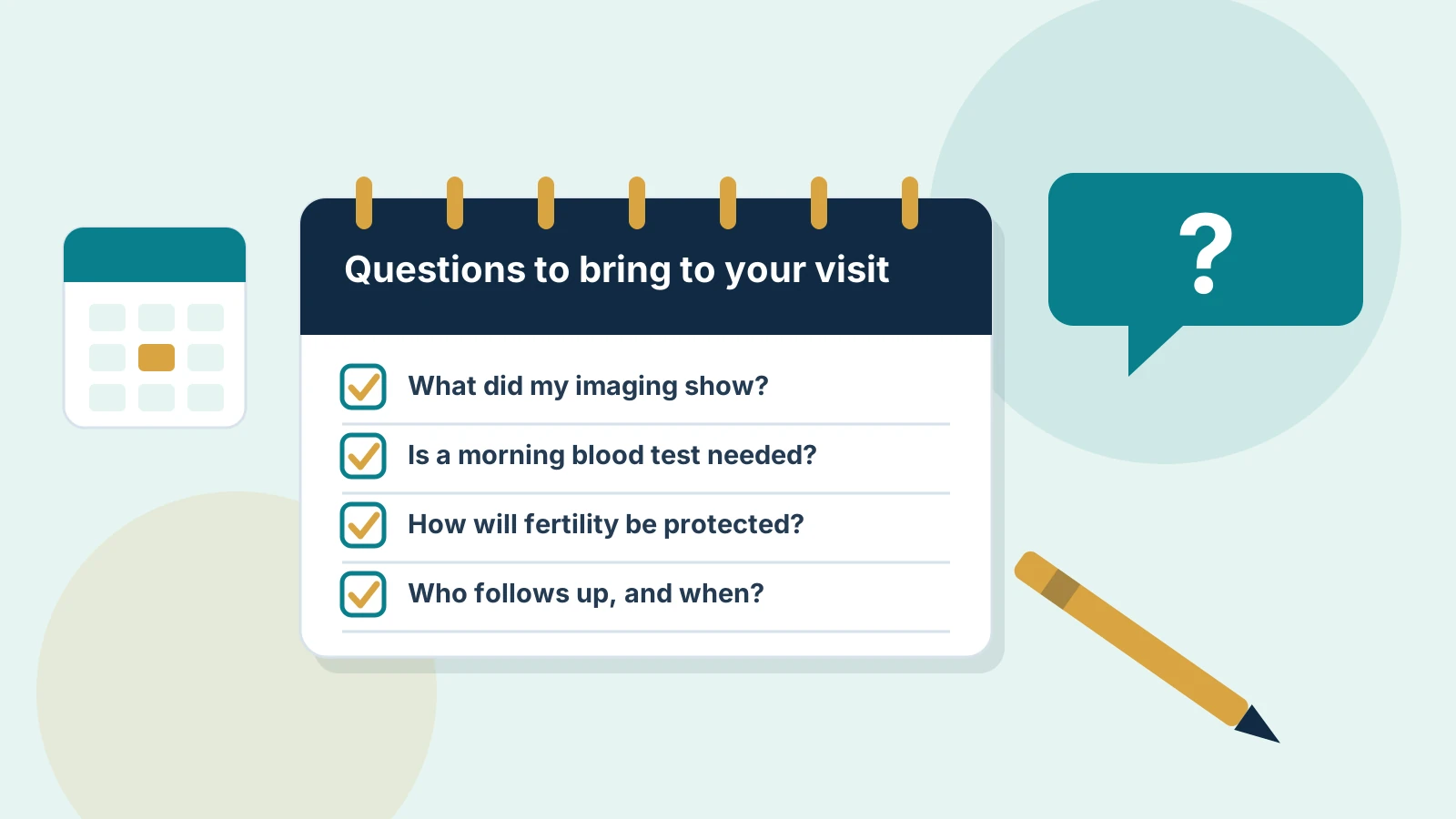
Good questions make a short visit go further, and the best ones are open-ended. Ask what the injury looked like on imaging and whether the testicle appears healthy now. Ask whether a morning blood test is appropriate yet, and which tests would be included. Ask how your clinician will tell whether symptoms come from the injury, from recovery, or from something unrelated like sleep, stress, or a medicine.
Add questions about the road ahead. If a result comes back low, what would be the next step before any treatment? Would a repeat test help? How would fertility be protected or assessed? Who will follow up, and when? You can also ask which warning signs should bring you back sooner. If you’re not sure how to phrase things, simply say, “I want to understand whether my injury could be affecting my hormones, and what we should do about it.” That sentence alone gets the ball rolling. Our guide to how low testosterone is diagnosed can help you follow the answers. The checklist below condenses the preparation into a few steps.
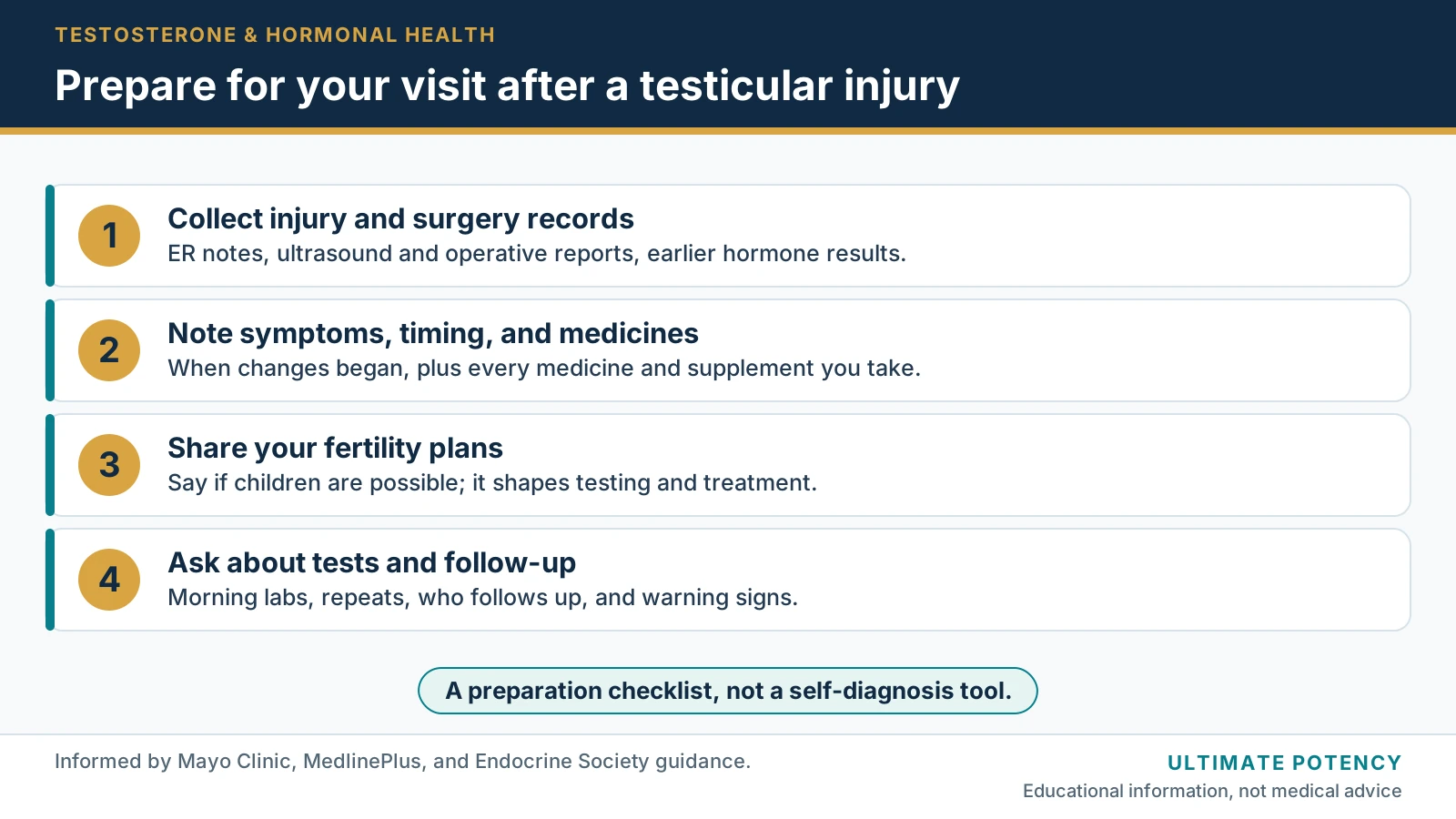
Text version: Step 1: collect injury and surgery records. Step 2: note symptoms, timing, and every medicine and supplement. Step 3: share your fertility plans. Step 4: ask about tests, repeats, who follows up, and warning signs.
After the Visit
What happens after the appointment matters as much as the appointment itself. This subsection looks at turning the discussion into a plan you understand and at taking care of yourself while you wait for answers.
Understanding the Plan and Follow-Up
Before you leave, try to restate the plan in your own words: what tests are ordered, when, and why; what will be watched in the meantime; and what would change the plan. If something isn’t clear, ask for it in writing or through the patient portal. It’s common to forget half of a conversation once you leave the building, so a quick note afterward can save confusion later.
Pay attention to the practical details. Find out whether blood tests need to be done in the morning and whether you should fast, which medicines to take as usual, and how results will reach you. Ask when you should expect to hear back and what to do if you don’t. If a repeat test is planned, mark the date, because follow-up is where many plans quietly fall apart. If treatment is discussed, ask for the reasoning, the monitoring schedule, and the fertility implications to be spelled out. And if new symptoms appear, such as severe pain, swelling, or a sudden change in the testicle, don’t wait for the scheduled visit; those need prompt care.
Looking After Your Well-Being
Waiting for results can be the hardest part. It’s normal to feel anxious, to replay the injury, or to avoid intimacy because of worry about how your body will respond. Those reactions are understandable, and they are not a sign of weakness or of anything being wrong with you as a person. A hormone level, a scar, or a missing testicle doesn’t define your masculinity, your attractiveness, or your value in a relationship.
A few steady habits can take the pressure off while you wait. Keep regular sleep and activity as your recovery allows, check with your clinician about when exercise is safe, limit alcohol, and keep up with any other health care you were already receiving. If a partner is involved, a simple honest conversation, such as “I’m waiting on some tests and I’m a bit stressed,” usually helps more than silence. If worry or low mood is affecting your daily life, tell your clinician; support from a counselor or therapist is a legitimate part of recovery. And remember the bigger picture: many testicular injuries heal well, and a thorough evaluation is how you find out which group you’re in.
Sources
- Testicular Trauma. Cleveland Clinic. Last reviewed August 21, 2025. Checked 2026-10-16.
- Genital Trauma (Professional Edition). MSD Manual. Reviewed January 2025. Checked 2026-10-16.
- Urotrauma Guideline 2020: AUA Guideline (abstract). American Urological Association / PubMed. 2020 (J Urol 2021). Checked 2026-10-16.
- Testosterone recovery after polytrauma and scrotal injury in patients from Operation Enduring Freedom and Operation Iraqi Freedom (record page). Journal of Urology via Houston Methodist Scholars. 2015. Checked 2026-10-16.
- Testicular trauma: Potential impact on reproductive function (record page). Journal of Urology via University of Minnesota Experts. 1996. Checked 2026-10-16.
- Surgical vs. Conservative Management in Testicular Trauma: A Systematic Review of Clinical Outcomes (conference abstract). International Continence Society 2025. 2025 abstract; search through 2015. Checked 2026-10-16.
- A scoping review of historical and contemporary management strategies for paediatric scrotal trauma. Irish Journal of Medical Science. 2025. Checked 2026-10-16.
- Functional Castration from Blunt-force Trauma to Motorcycle Gas Tank from a Car-versus-motorcycle MVA. Translation: The University of Toledo Journal of Medical Sciences. 2019. Checked 2026-10-16.
- Male hypogonadism: Symptoms and causes. Mayo Clinic. Published September 20, 2024. Checked 2026-10-16.
- Testosterone Levels Test. MedlinePlus (NIH). Updated June 5, 2025. Checked 2026-10-16.
- Testosterone Therapy in Men With Hypogonadism: An Endocrine Society Clinical Practice Guideline. Endocrine Society. March 2018. Checked 2026-10-16.
- Statement on Testosterone Replacement Therapy. Endocrine Society. July 16, 2026. Checked 2026-10-16.
- Evaluation and Management of Testosterone Deficiency (guideline page). American Urological Association. Published 2018, validity confirmed 2024. Checked 2026-10-16.
- FDA issues class-wide labeling changes for testosterone products. U.S. Food and Drug Administration. Sponsors informed February 28, 2025. Checked 2026-10-16.
- Testicular torsion. MedlinePlus (NIH). Reviewed July 1, 2025. Checked 2026-10-16.
- Testicular torsion: Symptoms and causes. Mayo Clinic. Published February 24, 2022. Checked 2026-10-16.
Ultimate Potency is an educational publication. It does not diagnose, prescribe, or provide medical care. This article does not replace advice from a licensed healthcare professional who knows your history.