
If you’re thinking about switching from sildenafil to tadalafil, you’ve probably already tried one erectile dysfunction (ED) medicine and are wondering whether the other might fit your life better. Maybe the timing felt rigid, a side effect got in the way, or the results weren’t what you hoped for. Those are all fair reasons to raise the question, and none of them means you did anything wrong.
This guide explains what actually changes in a switch: how long each medicine is labeled to act, how food and schedules differ, which warnings stay exactly the same, and what research can and can’t say about whether tadalafil is a better match. It draws on the current U.S. prescribing labels, MedlinePlus, NIDDK, Mayo Clinic, and published studies. For a full side-by-side of the two medicines, see our sildenafil vs tadalafil comparison; this article focuses on the change itself.
Two points are worth stating up front. First, the evidence supports “many men prefer tadalafil” more strongly than it supports “tadalafil works better,” and the preference data has real limits. Second, moving from one tablet to the other is a prescriber’s decision, because heart health, blood pressure, prostate symptoms, and other medicines all shape what is safe. We checked the labels on October 16, 2026. Labels get revised, so confirm specifics with your pharmacist.
Understanding Switching From Sildenafil to Tadalafil
A switch sounds simple, since both medicines treat the same condition, but the details matter. This section defines what a switch is, explains why the question comes up so often, and sets realistic expectations about what changing medicines can and can’t do for you.
Key Concepts
Two ideas anchor everything else in this guide: what a switch actually involves, and why it differs from simply taking a different pill. Getting these straight first makes the later sections on timing, evidence, and safety easier to follow.
What Switching From Sildenafil to Tadalafil Means
Switching from sildenafil to tadalafil means that a prescriber replaces one PDE5 inhibitor with another, and you stop the first. A PDE5 inhibitor is an oral medicine that improves blood flow to the penis, which can help with getting and keeping an erection, as NIDDK explains. Sildenafil is sold as Viagra, and tadalafil is sold as Cialis. Generic versions of both exist, according to Mayo Clinic.
The word “switch” implies a clean handover, not an addition. You aren’t adding a second medicine to the first, and you aren’t trying both on the same day. The new medicine comes with its own instructions about timing, food, and frequency, and your results with sildenafil don’t automatically predict how tadalafil will behave. A switch is a new treatment trial, not a refill with a different label. That is why it helps to think of it as a planned experiment with a start date, a way of judging the outcome, and a follow-up visit.
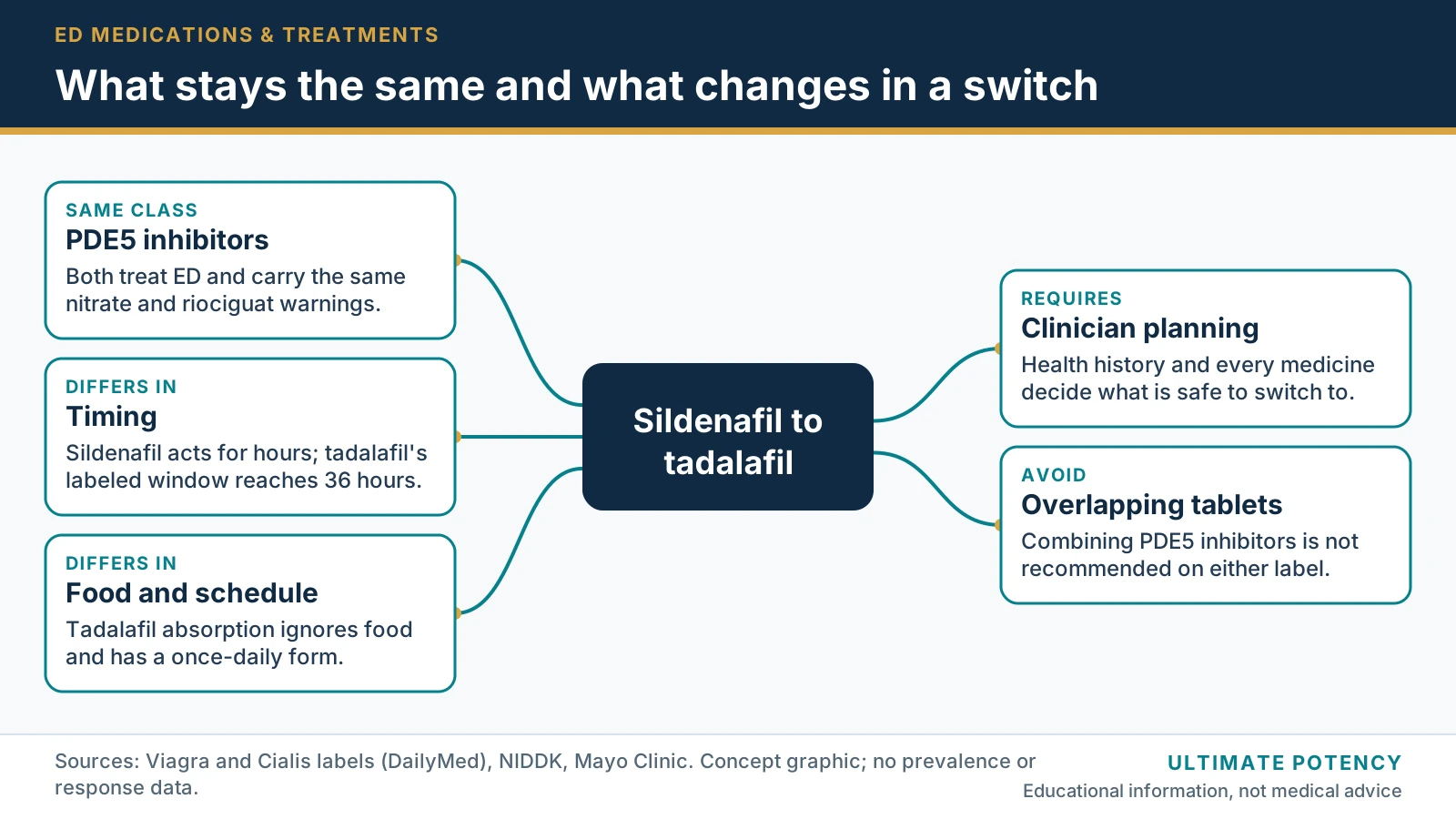
Text version: Switching from sildenafil to tadalafil connects five ideas. Same class: both are PDE5 inhibitors with the same nitrate and riociguat warnings. Differs in timing: sildenafil acts for hours, tadalafil’s labeled window reaches 36 hours. Differs in food and schedule: tadalafil absorption ignores food and has a daily form. Requires clinician planning. Avoid overlapping tablets.
Why People Raise the Question
The reasons vary, and most are ordinary. Some men like the idea of a medicine that isn’t tied to a specific evening. Others notice headaches, flushing, or an upset stomach and wonder whether the other option would feel different. Some got an uneven response and want to know whether a different drug is worth trying before moving on to other treatments. Cost, insurance changes, and a pharmacy switching generics can also prompt the question.
Online reading adds another layer. Telehealth and pharmacy pages often present tadalafil as the “longer-lasting” option, which can make sildenafil sound like a lesser choice. It isn’t. Sildenafil is a well-studied medicine that works well for many men.
It also helps to separate a medication reason from a life reason. A medication reason is something the drug itself is doing, such as a side effect. A life reason is about fit, such as a work schedule or a wish for spontaneity. Both are valid, and naming which one applies makes the conversation with a clinician much more productive.
The Medicines Behind the Switch
Before weighing a change, it helps to see how much the two medicines share and where they part ways. The similarities explain why the safety rules carry over, and the differences explain why a switch can feel noticeably different.
Same Class, Different Profiles
Sildenafil and tadalafil belong to the same class, and that shared class is why their core safety warnings match. Both labels list nitrates and riociguat as contraindications, meaning situations where the medicine must not be used. The Viagra label and the Cialis label also share warnings about erections lasting more than four hours, sudden vision loss, and sudden hearing loss.
The profiles differ in how the body handles each drug. The Viagra label reports a terminal half-life of about 4 hours, while the Cialis label reports a mean terminal half-life of 17.5 hours in healthy subjects. The half-life is the time it takes for the amount of medicine in your blood to fall by half. That single difference helps explain tadalafil’s longer labeled window and its daily option.
Same class does not mean interchangeable. Different chemistry leads to different timing, food effects, and side-effect patterns, which Mayo Clinic notes can guide the choice.
What a Switch Cannot Promise
A switch can change timing, schedule, and the pattern of side effects. It can’t promise a better erection, and it can’t fix a cause that sits outside the medicine. Harvard Health reports that at least one ED drug works in about 70 percent of men, but results vary, and men with nerve or blood-vessel damage from conditions such as diabetes or cardiovascular disease often respond less strongly. That means roughly three in ten may need more than a pill.
A switch also can’t create desire. Libido, relationship stress, and performance worry shape sexual experiences in ways no tablet addresses directly. If those pieces are in play, a new medicine may feel disappointing for reasons unrelated to the drug.
It’s reasonable to hope for improvement, and the next sections explain where improvement is most plausible. Just keep the goal realistic: a clearer, better-fitting treatment plan, not a perfect result on the first try. A disappointing first attempt with tadalafil wouldn’t be a verdict on your body.
How the Two Medicines Differ Day to Day
Daily life is where most men notice the difference between these two drugs. This section covers timing, how long each medicine is labeled to act, how meals and alcohol enter the picture, and how the schedules work, with a table of label facts to anchor the comparison.
Timing and Duration
Timing is the first practical difference, and it is also the easiest to misread. Two ideas matter here: when each medicine is meant to be taken relative to sexual activity, and what its “duration” does and doesn’t tell you.
Onset and Planning Ahead
Onset of action means how long a medicine takes to start working. For sildenafil, the Viagra label says it may be taken anywhere from 30 minutes to 4 hours before sexual activity, and MedlinePlus says the best time is about 1 hour before. For as-needed tadalafil, MedlinePlus says it is generally taken at least 30 minutes before activity, and the Cialis label describes dosing “prior to anticipated sexual activity.”
Harvard Health’s table lists sildenafil onset at 30 to 60 minutes and tadalafil at 30 to 45 minutes. On paper, those windows look similar. In practice, the Cialis label reports a median time to peak blood level of about 2 hours, with a range from 30 minutes to 6 hours, so some men prefer to leave extra room.
Neither medicine is meant to work the moment it is swallowed. If you’re moving to tadalafil, ask how far ahead your prescriber suggests planning, and note how your own body responds. Our guide to how long Cialis lasts goes deeper on timing for tadalafil in particular.
Duration Is Not a Continuous Erection
When people hear that tadalafil is labeled for up to 36 hours, some imagine a day and a half of erection. That isn’t what the number means. The Cialis label says as-needed tadalafil improved erectile function compared with placebo “up to 36 hours following dosing.” That describes a window during which the medicine can help, if you’re aroused and stimulated, rather than a continuous erection.
Sildenafil works the same way over a shorter span. Mayo Clinic says its effects often last 4 to 5 hours. Neither medicine produces a constant erection, and both still depend on sexual interest and stimulation.
This matters for a switch because the longer window changes the planning, not the mechanism. A man who moves to tadalafil may feel less rushed, but he should also know the warning that stays the same: an erection lasting more than 4 hours is a medical emergency, no matter which medicine was taken. Treat any prolonged or painful erection as urgent, and don’t wait for it to pass.
Food, Alcohol, and Schedules
Meals, drinks, and the shape of your week can all affect how a medicine fits. This part looks at what the labels say about food and alcohol, and at the daily option that exists for tadalafil but not for sildenafil.
Meals and Absorption
Food can slow sildenafil more than tadalafil. The Viagra label says that with a high-fat meal, the rate of absorption is reduced, and MedlinePlus adds that a high-fat meal makes sildenafil take longer to start working. Mayo Clinic says sildenafil works best on an empty stomach about an hour before sex. Tadalafil is different: the Cialis label states that the rate and extent of absorption “are not influenced by food.”
For some men, that is the practical heart of the switch. If a dinner out regularly got in the way of sildenafil, tadalafil may feel more forgiving. The label statement is a starting point rather than a promise, so it’s worth asking how meals should factor into your own routine.
Alcohol is a separate matter. The Cialis label warns about substantial alcohol use, with 5 units or more given as an example, and MedlinePlus notes that heavy drinking can increase dizziness and headache. Because alcohol and these medicines can both lower blood pressure or cause dizziness, ask your prescriber what is reasonable for you rather than assuming the rules are the same.
As-Needed and Daily Forms
Sildenafil is used as needed, with the Viagra label setting a maximum of once per day. Tadalafil offers two routes. As-needed use is taken before anticipated activity. Once-daily use is taken at about the same time every day, without regard to the timing of sexual activity, and the Cialis label also describes a once-daily approach for benign prostatic hyperplasia (BPH), a non-cancerous enlargement of the prostate. Our guide to daily vs as-needed tadalafil covers that choice in detail.
A switch from sildenafil can therefore lead to one of two new routines, and that is worth deciding with your prescriber before the first prescription.
This table lines up the label details that differ most between the two medicines, so you can see what a switch would change in practice.
| Feature | Sildenafil (Viagra) | Tadalafil (Cialis) | Why it matters |
|---|---|---|---|
| Timing for as-needed use | May be taken 30 minutes to 4 hours before sexual activity | Taken prior to anticipated sexual activity | Planning windows differ |
| Duration | Often 4 to 5 hours (Mayo Clinic); half-life about 4 hours | Improved function up to 36 hours after dosing; half-life 17.5 hours | A window, not a continuous erection |
| Food effect | High-fat meal slows absorption | Absorption not influenced by food | Meals may matter more for sildenafil |
| Daily form | Not labeled; maximum once per day | Once-daily option at about the same time each day | Changes the routine |
| Labeled uses | ED | ED, BPH signs and symptoms, or both | Urinary symptoms may enter the choice |
Sources: DailyMed labels for Viagra (revised 11/2023) and Cialis (revised 3/2026); Mayo Clinic; Harvard Health. Limitation: label values come from separate studies, not head-to-head testing, and do not predict your own response.
Why a Clinician Might Discuss a Switch
Not every reason for a switch is equal, and clinicians weigh them differently. This section separates the practical reasons, such as timing and side effects, from the clinical ones, such as an unclear response or urinary symptoms, and ends with a decision aid you can adapt.
Practical Reasons
Practical reasons are about how a medicine fits into your days rather than about how well it works. They’re often the most honest reasons for wanting a change, and they’re easy to describe to a prescriber.
Wanting More Flexibility in Timing
Many men who ask about switching are really asking about pressure. Sildenafil is typically timed around a planned occasion, and the label’s range of 30 minutes to 4 hours before activity leaves room, but the effects often last about 4 to 5 hours according to Mayo Clinic. If your evening plans change, or if you worry about “making the window,” that can add tension to a moment that should feel relaxed.
Tadalafil’s labeled benefit of up to 36 hours can ease that feeling, and the daily form takes timing out of the equation altogether. Some men find that this helps them take the pressure off and stop watching the clock. Others feel the opposite and prefer a medicine they take only when they expect to need it.
Neither preference is wrong. The useful move is to describe your real routine to your prescriber: how often you expect sexual activity, how spontaneous you’d like it to be, and what worries you about the current approach. A clear picture helps your prescriber choose between an as-needed plan and a daily one, instead of guessing.
Side Effects That Bother You
Headache, flushing, indigestion, and a stuffy nose appear on both medicines’ lists, and many men find them tolerable. For others, a recurring side effect turns treatment into something to dread. MedlinePlus lists headache, heartburn, nausea, and flushing among the common effects of sildenafil, and headache, indigestion, back pain, muscle pain, and flushing for tadalafil. Because the lists overlap, a switch can swap one set of annoyances for another rather than remove them.
Consider a hypothetical situation: a man takes sildenafil before date nights, but a pounding headache and a flushed face leave him dreading it, so he starts skipping doses and avoiding the subject with his partner. He is unsure whether to quit entirely. A reasonable next step would be to write down when the symptoms start and how long they last, then ask his prescriber whether a different medicine, a different approach, or a review of his other medicines makes sense. He wouldn’t change anything on his own.
Side effects are a legitimate reason to call your prescriber, and they’re worth reporting even when they seem minor.
Clinical Reasons
Clinical reasons involve what the medicine is or isn’t doing in your body, or what else is going on in your health. They call for a more careful look before any change is made.
Limited Response After a Fair Trial
A medicine that “didn’t work” deserves a closer look before it’s replaced. A clinical review in Medicine Today says most men respond after one or two doses, though some may need six to eight before an optimal response occurs. It also says the most common cause of initial PDE5 inhibitor failure is inadequate patient education or a failure to optimize the dose. That fits the American Urological Association (AUA) guideline, which says instructions should be provided to maximize benefit and that the dose should be titrated, meaning adjusted step by step, for optimal efficacy.
So the first questions are often about use: Was the tablet taken with a heavy meal? Was there enough time and stimulation? Was the dose adjusted with a clinician’s guidance? Our guide on Viagra not working walks through that review.
If those pieces check out, the same review calls a trial of a different PDE5 inhibitor reasonable before more invasive treatments, while acknowledging that the evidence is limited. Underlying causes, including low testosterone, diabetes, or blood-vessel disease, may also need attention.
Urinary Symptoms and Prostate Enlargement
Tadalafil is the only one of the two whose label includes benign prostatic hyperplasia (BPH). The Cialis label lists three indications: ED, the signs and symptoms of BPH, and both together. Sildenafil’s label lists ED only. For a man who also deals with a weak stream or frequent urination, that makes tadalafil an interesting topic to raise.
The picture is more complicated if you already take an alpha-blocker, a type of medicine often used for BPH or blood pressure. The Cialis label says tadalafil is not recommended in combination with alpha-blockers for BPH, and for ED, patients should be stable on alpha-blocker therapy before starting at the lowest recommended dose. The Viagra label advises caution with alpha-blockers or anti-hypertensives.
Urinary symptoms can tip the scales, but only a clinician can weigh them with your blood pressure and medicine list. Use the table below to organize what to mention.
This table links common reasons for considering a switch to a useful question and to what you might bring, as an organizing aid rather than a diagnosis.
| If you notice | A useful question to ask | Information to bring |
|---|---|---|
| Headaches or flushing after sildenafil | Could a different medicine or plan make sense for me? | When symptoms start and how long they last |
| Meals or drinks seem to change how it works | How should food and alcohol factor into a new medicine? | Typical meal timing and how much you drink |
| Feeling rushed by the timing | Would a different schedule fit my routine? | How often and when you expect to be intimate |
| Weak stream or frequent urination | Could prostate symptoms change the choice? | Urinary symptoms and any prostate or blood pressure medicine |
| Results seem inconsistent | Did we confirm how I used the first medicine? | Dates, timing, food, stimulation, and stress level |
| You take heart or blood pressure medicine | Is either option safe alongside my other medicines? | A complete list, including nitrates |
Source: editorial decision aid informed by the Viagra and Cialis labels, MedlinePlus, and AUA guidance. It does not diagnose or recommend a medicine.
Comparing Relevant Factors
Choosing between two close relatives is partly a question of evidence. This section reviews what head-to-head studies and switching studies found, why preference data deserves careful reading, and how to translate all of it to your own situation.
Efficacy and Preference
Two different questions get mixed together online: does one medicine work better, and do men prefer one? They have different answers. This part takes each in turn using published studies.
What Direct Comparisons Show
A 2017 systematic review and meta-analysis by Gong and colleagues, published in International Urology and Nephrology, pooled 16 trials with 5,189 men. On the erectile function domain of a standard questionnaire, the pooled difference was essentially zero (weighted mean difference 0.03, 95 percent confidence interval −0.32 to 0.39), meaning no significant difference in that measure. Tadalafil did show better scores on some confidence, relationship, and treatment-satisfaction questionnaires.
Overall adverse events were similar. Tadalafil had more reports of myalgia (muscle aches) and back pain, while flushing was less frequent with tadalafil. Headache, indigestion, and nasal congestion did not differ significantly.
The authors added an important caution: the studies had quality flaws, blinding methods weren’t described in detail, and several outcomes showed high heterogeneity, which means the trials disagreed with one another. They called their results something to interpret with caution and asked for a large, high-quality, double-blind trial. In plain terms, the pooled data say the two medicines are roughly comparable on effectiveness, not that either is a clear winner.
What Switching Studies Show
Studies that follow men who actually switch are closer to your question, though they have their own limits. An open-label study of 160 Korean men with ED and prior sildenafil use, reported by a Nature Reviews Urology commentary, switched them to tadalafil for 8 weeks and then let them choose. About 74 percent (115 men) chose tadalafil and about 26 percent (41 men) chose sildenafil. Concern about time in relation to sex fell significantly, but scores for spontaneity and self-confidence did not change.
A narrative review of preference studies describes similar patterns. One study of 147 men who switched from sildenafil reported that 90.5 percent preferred tadalafil, and a large observational study of 2,425 men reported that 70 percent of sildenafil-to-tadalafil switchers preferred tadalafil.
Notice that a meaningful minority chose sildenafil even when offered both. In the Korean study, roughly one in four did. Preferences clearly vary, which is why your priorities matter more than averages.
Evidence and Limitations
Evidence is only useful when you know how far it stretches. This part explains why preference studies need a careful reading and then turns the findings into practical expectations.
Why Preference Studies Need Care
The same review that reports high preference for tadalafil also lists reasons for caution. Many preference trials have methodological flaws, such as inadequate blinding and unstandardized ways of asking about preference, which allow bias. Most were run soon after new drugs launched, when novelty and media attention could sway choices. Preference was often captured with a single question, and prescription-renewal data sometimes contradict trial findings. Partner preference has been studied in only one trial. The authors even note that there is no evidence-based guidance for clinicians or patients on choosing between these medicines.
Preference also isn’t the same as better erections. A man may prefer a medicine because it lets sex feel more spontaneous, which is a real benefit, while his erection quality is similar. And open-label designs, where everyone knows which medicine they’re taking, can nudge answers.
This evidence matrix lists the main sources used in this article, what each found, and the limit you should keep in mind.
| Source | Design | What it found | Limitation |
|---|---|---|---|
| Gong et al., 2017 | Meta-analysis of 16 trials, 5,189 men | No significant pooled difference in erectile function; preference favored tadalafil | Quality flaws and high heterogeneity; authors urge caution |
| Ahn et al., 2007 (commentary) | Open-label switch study, 160 Korean men | About 74% chose tadalafil after 8 weeks; about 26% chose sildenafil | Open-label, one population, no control group |
| Giannitsas et al., 2008 | Narrative review of preference studies | Most published trials showed preference for tadalafil | Possible bias, novelty effects, single-question measures |
| McMahon and McMahon, 2020 | Clinical review | Switching is reasonable but evidence is limited; check use and dose first | Expert review; full text was not available to us |
| Harvard Health, 2025 | Patient education article | At least one ED drug works in about 70% of men | Overall figure; not specific to switching |
Sources: Gong et al. 2017 (PMC5603624); Nature Reviews Urology commentary on Ahn et al. 2007; Giannitsas et al. 2008 (PMC2770422); McMahon and McMahon 2020, Medicine Today; Harvard Health, modified January 9, 2025.
How the Evidence Applies
Putting the studies together, a few conclusions hold up. Pooled trials suggest similar effectiveness. Switching studies suggest that many men, though not all, end up preferring tadalafil, often for reasons tied to timing and spontaneity. Neither body of evidence tells you how you will respond, and neither shows that a switch will rescue a response that has other causes.
That leaves you with a sensible framing. A switch is a reasonable option to discuss when your main concerns are timing, food, or side effects, and it can be a fair next trial after a proper first one. It is not a sure upgrade.
If you’re comparing sources, check the date, the population, and the design. A telehealth page saying tadalafil “works better” is not the same as a pooled analysis saying the two are about equal on one measure. Ask your prescriber which parts of the evidence matter for your situation.
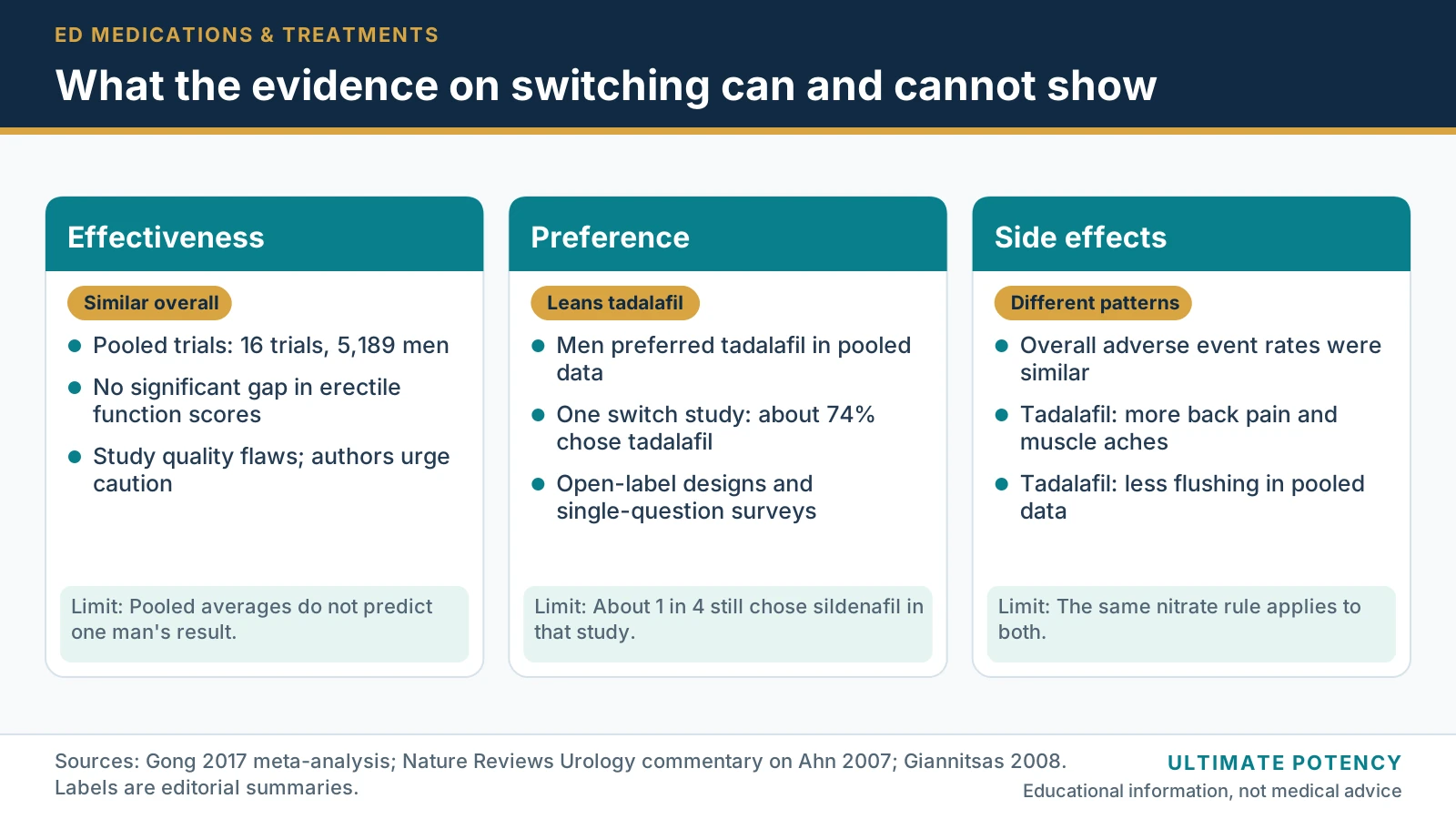
Text version: Effectiveness: similar overall in pooled trials of 5,189 men, with quality flaws. Preference: leans toward tadalafil, with about 74 percent choosing it in one 160-man switch study and about one in four staying with sildenafil. Side effects: overall rates similar, with more back pain and muscle aches but less flushing with tadalafil. The nitrate rule applies to both.
Safety Before, During, and After a Switch
Changing medicines is a moment when safety details deserve extra attention. This section covers the rules that stay the same no matter which tablet you take, then the side effects and warning signs that call for a clinician or emergency care.
Rules That Do Not Change
A switch changes the brand name on the bottle, but the most serious warnings come along with you. Two of them are worth knowing before you make any plan.
Nitrates and Riociguat
Both labels list nitrates as a contraindication, which means these medicines must not be used together. The Cialis label says it is contraindicated in patients using any form of organic nitrate, and the Viagra label says the same about nitrates. Nitrates are medicines often prescribed for chest pain, such as nitroglycerin and isosorbide products. MedlinePlus adds that you should tell your doctor if you use street drugs containing nitrates, known as “poppers.”
Both labels also say not to use the medicine with riociguat, a medicine for certain types of pulmonary hypertension.
Switching to a longer-acting medicine matters here. The Cialis label says that if a nitrate is medically necessary in a life-threatening situation, at least 48 hours should elapse after the last dose of tadalafil before nitrate administration is considered. We did not capture an equivalent interval for sildenafil, so ask your pharmacist how the timing applies to you. Tell every clinician and emergency team what you take and when. Our guide on ED medication and nitrates covers this in more depth.
Why the Two Medicines Should Not Overlap
It can be tempting to start tadalafil before the sildenafil is gone, or to keep a few sildenafil tablets “just in case.” Both labels argue against that. The Viagra label says combining it with other PDE5 inhibitors or other ED treatments has not been studied and that such combinations are not recommended. The Cialis label tells patients not to take it with other PDE5 inhibitors.
One reason for caution is that PDE5 inhibitors can cause transient drops in blood pressure, as the Cialis label notes, and the Viagra label says combinations with other PDE5 inhibitors haven’t been studied.
A switch should therefore be a handover, not a trial of both. If you’re wondering what could happen if the two were taken close together, our article on taking Viagra and Cialis together addresses that question directly.
Don’t add the second medicine to the first because the first seemed weak. Raise the disappointment with your prescriber first. They can tell you which tablet to stop, when the new one should begin, and what to do with leftovers.
Side Effects and Warning Signs
Most side effects of these medicines are mild, but a few signs are urgent. Knowing the difference ahead of time makes it easier to act quickly and calmly.
Differences in Side-Effect Patterns
Label tables give a rough picture, with an important caution: they come from separate trials with different designs, so they can’t be compared head to head. In the Viagra label’s flexible-dose trials, headache was reported by 16 percent of men versus 4 percent on placebo, flushing by 10 percent versus 1 percent, indigestion by 7 percent versus 2 percent, and abnormal vision by 3 percent versus 0 percent. In the Cialis label’s as-needed trials, headache was reported by 11 to 15 percent depending on the strength tested, versus 5 percent on placebo, with indigestion at 8 to 10 percent, back pain at 5 to 6 percent, and myalgia at 3 to 4 percent.
The pooled head-to-head analysis described earlier gives a cleaner comparison: similar overall side-effect rates, more back pain and muscle aches with tadalafil, and less flushing.
What does that mean for a switch? It suggests the side-effect experience might change, not vanish. A man bothered by flushing might notice less of it, while a man who already has back pain might find it more noticeable. Ask your prescriber to explain what to watch for and when to call, and keep brief notes during the first few attempts.
Symptoms That Need Prompt Care
These warnings apply to both medicines. The Viagra and Cialis labels say that an erection lasting more than 4 hours needs emergency treatment, that sudden vision loss in one or both eyes is a reason to stop the medicine and seek care, and that sudden hearing decrease or loss also calls for prompt medical attention. NIDDK lists the same urgent signs.
MedlinePlus adds that if vision or hearing loss occurs, you shouldn’t take further doses of similar medicines until you speak with your doctor. That includes switching to the other medicine as a response to a problem.
A longer-acting medicine can make timing questions more important. If something worrying happens, tell the emergency team exactly which medicine you took and when. Keep the packaging or a note on your phone. It’s also fine to call your prescriber’s office or a pharmacist about milder symptoms that persist, such as headaches that don’t settle or ongoing indigestion.
Planning the Change With a Clinician
Because a switch involves safety, schedule, and follow-up, it works best as a short plan rather than a spur-of-the-moment swap. This section explains the prescriber’s role, how to set up a fair trial, and what to know about costs and legitimate ways to get care.
How a Supervised Switch Works
A supervised switch doesn’t have to be complicated. It simply means someone who knows your history decides the details and checks in afterward.
Why the Handover Belongs to Your Prescriber
The labels describe each medicine’s own instructions, but they don’t offer a standard recipe for moving from one to the other. That gap is the reason the handover belongs to a clinician. Your prescriber decides which medicine and which schedule (as-needed or daily) fit you, when to stop the old one, how to avoid overlap, and how the new one interacts with everything else you take.
They’ll also review your health. Mayo Clinic lists several situations to discuss before taking any ED medicine, including very low or uncontrolled high blood pressure, severe liver disease, kidney disease treated with dialysis, a heart attack, stroke, or serious heart rhythm disorder in the past six months, and an inherited retinal eye disease.
NIDDK is direct on the topic: don’t stop taking any medicine on your own, and talk with your health care professional first. That advice covers sildenafil too.
The safest question isn’t “which pill is stronger?” but “what is the plan for the handover?” Asking it that way invites a concrete, step-by-step answer.
Setting a Fair Trial and Follow-Up
A fair trial gives a new medicine a real chance and gives you a way to judge it. That means agreeing on what you’ll try, how many times, and what you’ll record. The Medicine Today review notes that some men need six to eight doses before an optimal response occurs, and Harvard Health says a drug may be judged ineffective after a predetermined period. Your prescriber can tell you what period makes sense.
Consider a hypothetical situation: a man switches to tadalafil, and his first attempt feels flat. He’s tempted to go straight back to his old sildenafil or add a leftover tablet. Instead, he jots down the time he took it, what he ate, how stressed he felt, and how things went, and he keeps to the plan his prescriber set. At the follow-up, the notes show a rushed, anxious first attempt, so they discuss it rather than guess.
Write down the follow-up date before you leave. A switch without a check-in leaves you guessing.
Costs and Access
Cost is a practical part of any switch, and it isn’t the same for everyone. This part lists what usually goes into the cost and how to get care through legitimate channels.
What a Listed Price May Leave Out
We can’t give reliable prices here, because costs vary by pharmacy, insurance plan, quantity, and date, and we haven’t verified a dated, conditioned U.S. price. What we can do is list the pieces that tend to make up the total. Generic versions of both sildenafil and tadalafil exist, per Mayo Clinic, so brand name versus generic is one factor.
The schedule matters too. A daily tadalafil routine uses a tablet each day, while as-needed use depends on how often you expect to use it, so total monthly cost can look quite different even when the per-tablet price seems similar. Ask your pharmacist to explain how the quantity would work.
This table lists the pieces that make up the cost of changing medicines and what to verify for each one, without quoting prices that vary.
| Cost component | What may vary | What to verify |
|---|---|---|
| Visit or telehealth fee | In-person, telehealth, and follow-up visits may be billed differently | Whether the switch and follow-up are covered |
| Medication | Brand versus generic; as-needed versus daily quantities | The price per month for the quantity you would actually use |
| Insurance | Whether the plan covers ED medicines, and any limits | Coverage rules and any prior authorization steps |
| Pharmacy and shipping | Different pharmacies may charge different amounts; delivery may add fees | Total cost with fees, and that the pharmacy is licensed |
| Leftover medicine | Unused tablets of the old medicine | What to do with them, and whether to dispose of them safely |
Source: editorial summary; Mayo Clinic notes that generic sildenafil and tadalafil are available. No prices are given because none could be verified with a date and conditions.
Using Legitimate Care Channels
Both medicines are prescription products with detailed prescribing information, so a switch should go through a licensed clinician, whether in person or through a legitimate telehealth service. NIDDK advises: “Do not order an ED medicine online before talking with a health care professional.” A good visit covers your history, your medicine list, and a follow-up plan rather than just a quick order.
Be cautious about sellers who skip questions, promise identical results, or offer lookalike products. A product that sounds like Cialis or Viagra isn’t necessarily the real thing.
If you’re not sure where to start, our guide on how to get ED treatment explains the options, costs, and questions to ask. A primary care clinician, urologist, or telehealth provider can all be reasonable starting points, depending on your health and access. Whatever channel you choose, bring a full medicine list and confirm the plan for follow-up before the first fill.
Common Questions About Switching
Readers tend to arrive with the same handful of practical questions. The answers below are short on drama and long on detail, and they point back to the labels and public health sources rather than to rules of thumb passed around online.
Timing and Routine Questions
These questions are about what to expect from a switch and what to do with the medicine you already have. They come up more often than almost anything else.
Will Tadalafil Work if Sildenafil Did Not?
Sometimes, but no source we reviewed can promise it. The answer depends on why sildenafil fell short. If the issue was how it was taken, for example with a heavy meal or without enough time, tadalafil’s food-independent absorption might help, and so might simply repeating the first medicine with better instructions. If the cause sits elsewhere, such as blood-vessel disease, diabetes, nerve damage, or low testosterone, a different tablet may not change much.
The Medicine Today review says a trial of a different PDE5 inhibitor is reasonable, but it also notes limited evidence. It cites one study in which only 12 percent of sildenafil non-responders responded to vardenafil, a third medicine in the class, which shows that switching doesn’t rescue everyone. It also describes one study where men who failed as-needed tadalafil did better on a daily schedule, though that figure comes to us secondhand.
The honest answer is “maybe, and here is how we’ll find out.” A prescriber can also look for contributors that a switch wouldn’t touch. The AUA guideline, for example, recommends measuring morning serum total testosterone in men with ED.
Can I Use Leftover Sildenafil While I Wait?
Please don’t treat leftover tablets as a bridge. Waiting for an appointment or a pharmacy fill can feel frustrating, and a few sildenafil tablets in the drawer look like a harmless fallback. But the safe version of this plan is the one your prescriber approves, because they know which medicine you should be taking, in what way, and when the last dose should be before the new one starts.
Both labels argue against overlap: the Viagra label says combinations with other PDE5 inhibitors or ED treatments aren’t recommended, and the Cialis label says not to take tadalafil with other PDE5 inhibitors. If you’ve already started the new medicine and are tempted to reach for the old one when things feel uncertain, call your prescriber or pharmacist first.
Taking a PDE5 inhibitor out of habit or curiosity rather than need is a separate topic, which we cover in our article on taking Viagra without ED. For this question, the practical advice is simple: ask what to do with leftovers when you get the new prescription.
Safety and Treatment Questions
Safety questions are where small details count most, so these answers lean on the labels and on MedlinePlus and NIDDK guidance.
What Should I Tell My Pharmacist and Clinician?
Tell them everything you take, including prescriptions, over-the-counter products, vitamins, herbal supplements, and recreational substances. NIDDK advises telling your health care professional about all the medicines you are taking, including supplements and other alternative medicines, because interactions can lead to serious problems.
Some items are especially important. Nitrates and riociguat head the list. MedlinePlus also points to alpha-blockers, certain antifungal medicines, HIV protease inhibitors, some blood pressure medicines, and St. John’s wort as things to mention for tadalafil, and it lists cimetidine and St. John’s wort for sildenafil. Both pages ask you to talk with your doctor about grapefruit.
Health conditions matter as well: heart disease, low or uncontrolled high blood pressure, liver or kidney disease, a past stroke or heart attack, and eye conditions. Say what you’ve been taking and why you want to change. The reason for the switch shapes the plan.
Bring the real bottles or photos of the labels if you can, since names and strengths are easy to misremember.
What If the Switch Does Not Help?
A switch that doesn’t help is information, not a failure. The next step is a review: how was the new medicine taken, were there enough attempts, and did food, alcohol, stress, or worry get in the way? Your prescriber may also look for other contributors, such as testosterone, diabetes, blood-vessel health, mood, or other medicines.
The Medicine Today review describes a stepwise approach that starts with re-education and dose optimization, then addresses risk factors and lifestyle, considers sex therapy or couples counseling when psychological factors are involved, considers testosterone treatment in men with low levels, and moves to a specialist and second-line options when needed. Those options include injections, combination therapy, vacuum devices, and, for severe cases, implants.
You can also expect the conversation to include how you feel. Disappointment is common, and it’s fine to say so. Many reasons for a weak response are identifiable, and treatment often takes more than one try. If you notice chest pain or other alarming symptoms along the way, get care promptly.
Your Next Steps
Information becomes useful when it turns into a plan. This final section helps you prepare for a visit, bring the right questions, and leave with clear next steps for the switch and the follow-up.
Preparing for Care
A little preparation makes a short appointment go much further. Two simple things do most of the work: a complete medicine list and a handful of written questions.
Bring a Complete Medicine List
Start with the medicines you take now, including sildenafil: the name, the strength, how often you’ve used it, and how you take it. Then add everything else, such as prescriptions, over-the-counter products, vitamins, supplements, and anything bought online. If you use a nitrate for chest pain, or you’ve used “poppers,” say so plainly. Your clinician has heard it before and needs the information for your safety.
Add a short history of your experience with sildenafil. When did you start, how many times have you used it, what did you eat or drink beforehand, and what did you notice? Dates and brief notes beat memory every time. If you’ve had side effects, note when they began and how long they lasted.
Bring a list of your health conditions and recent changes, such as new medicines, surgeries, or hospital visits. Having it all on paper, or in your phone, takes the guesswork out of the visit and lets your prescriber spend the time on decisions rather than on reconstructing your history.
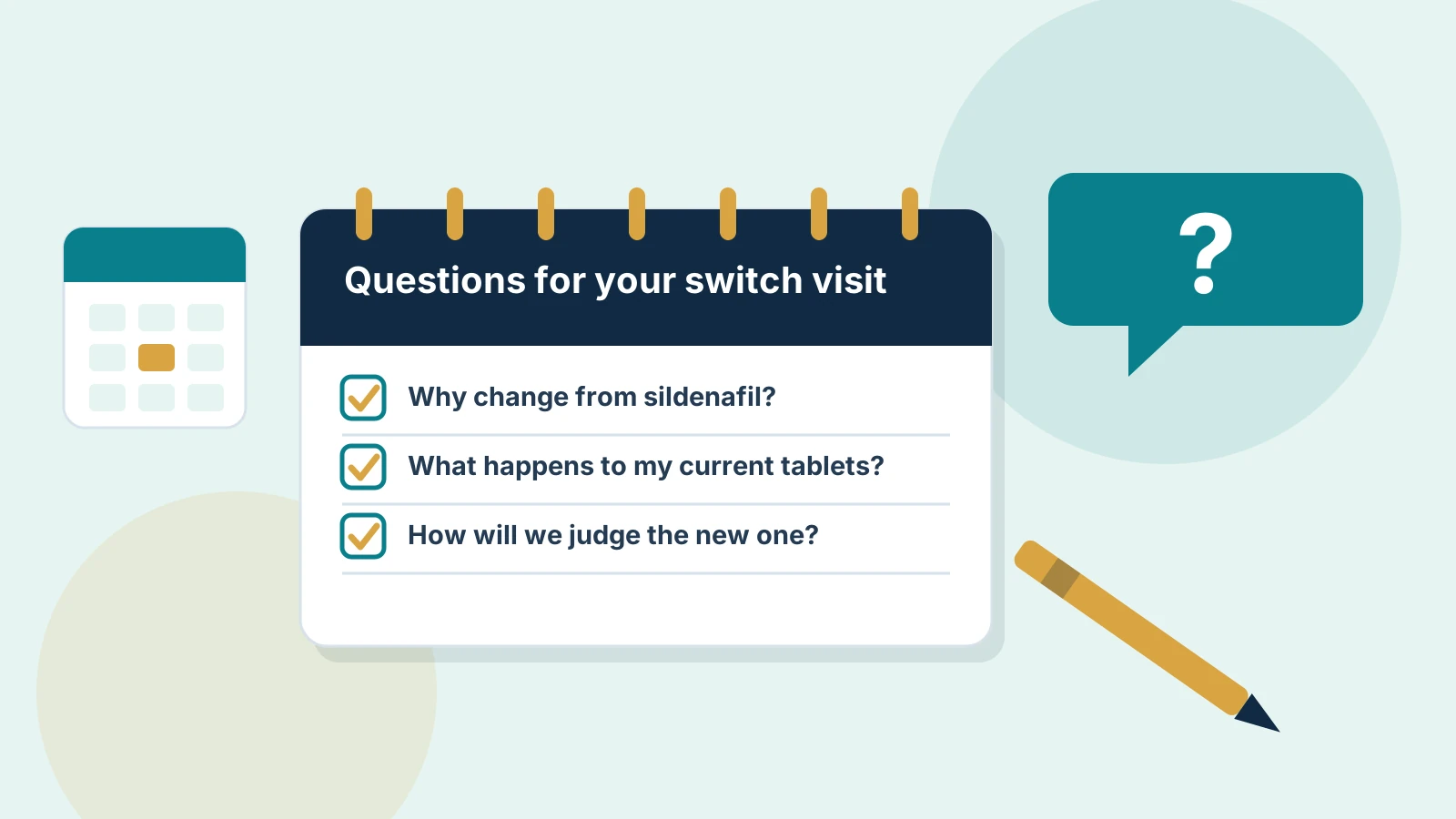
Questions About Switching From Sildenafil to Tadalafil
Written questions keep a conversation focused, especially if the topic feels awkward. Start with your reason: “I’d like to ask about changing from sildenafil because of timing” opens the door more easily than a vague “I’m not sure it’s working.” Then ask what a handover would look like, including when to stop the old medicine and when to start the new one.
Useful questions include these. Is tadalafil appropriate with my heart and blood pressure history and my other medicines? Should it be as-needed or daily for me? How should I think about meals and alcohol? What side effects should I watch for? How many attempts make a fair trial, and when should I call? What should I do with the sildenafil I have left?
Don’t worry about asking too much. A good clinician would rather answer ten questions than have you guess. The checklist below condenses the preparation into steps you can screenshot or print.
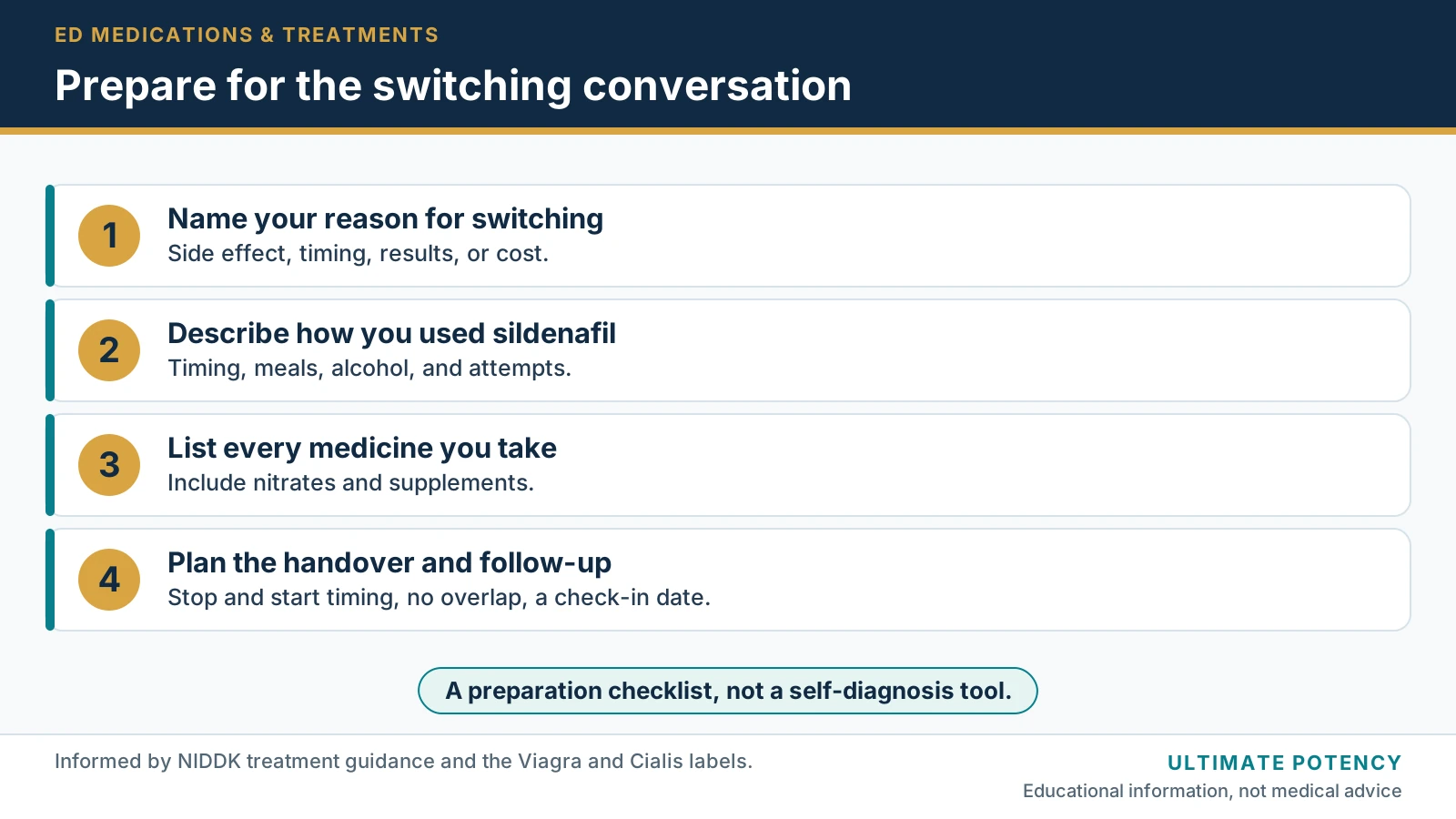
Text version: Step 1: name your reason for switching, such as a side effect, timing, results, or cost. Step 2: describe how you used sildenafil, including timing, meals, alcohol, and attempts. Step 3: list every medicine you take, including nitrates and supplements. Step 4: plan the handover and follow-up, including stop and start timing, no overlap, and a check-in date.
Making an Informed Decision
A good decision usually comes from weighing benefits, risks, and fit together rather than from a single deciding fact. This part helps you think that through and agree on what happens next.
Comparing Benefits, Risks, and Practical Fit
Think of the decision in three parts. Benefits might include a more flexible window, fewer meal restrictions, a daily option, and possibly help with urinary symptoms. Risks include side effects, interactions, and the possibility that nothing changes. Practical fit covers cost, how often you expect to use it, and how comfortable you are with the routine.
None of these factors settles the question alone. Pooled studies suggest the two medicines are about equally effective, preference studies lean toward tadalafil, and safety rules are largely shared. The right choice is the one that fits your health, your routine, and your priorities, as judged with your prescriber.
It can help to rank your priorities before the visit. Is it spontaneity, fewer side effects, cost, or simply wanting to try something different after a so-so result? Your ranking gives your clinician something concrete to work with. And remember that a decision isn’t permanent: if the new medicine doesn’t suit you, you and your prescriber can revisit the plan. For the wider comparison, see our guide to sildenafil vs tadalafil.
Agreeing on a Follow-Up Plan
End the visit with a plan you can repeat back. Know which medicine you’re taking and which one you’ve stopped, how to take the new one, what side effects to expect, and which symptoms mean a call or an emergency visit. Ask how many attempts count as a fair trial and when you should check in.
Write the follow-up date down, along with what you’ll bring: your notes on timing, food, side effects, and how you felt. If your concerns include stress, anxiety, or relationship strain, say so at the follow-up too, since those are part of the picture and can be addressed.
Switching medicines can feel like a big step, but it’s really a small, manageable one when it’s planned. With a clear reason, a complete medicine list, and a follow-up, you’ll be well placed to judge whether the change helps. Whatever the outcome, you’re gathering information that gets you closer to a treatment plan that fits.
Sources
- Treatment for Erectile Dysfunction. NIDDK. Last reviewed October 2024. Checked 2026-10-16.
- VIAGRA (sildenafil citrate) tablets, prescribing information. DailyMed (Viatris Specialty LLC label). Label revised 11/2023. Checked 2026-10-16.
- CIALIS (tadalafil) tablets, prescribing information. DailyMed (Eli Lilly and Company label). Label revised 3/2026. Checked 2026-10-16.
- Sildenafil: MedlinePlus Drug Information. MedlinePlus (NLM). Last revised 08/15/2023. Checked 2026-10-16.
- Tadalafil: MedlinePlus Drug Information. MedlinePlus (NLM). Last revised 04/15/2023. Checked 2026-10-16.
- Erectile dysfunction: Viagra and other oral medications. Mayo Clinic. Dated January 21, 2026. Checked 2026-10-16.
- Can ED drugs really help your sex life?. Harvard Health Publishing. Modified January 9, 2025. Checked 2026-10-16.
- Erectile Dysfunction: AUA Guideline (2018). American Urological Association. 2018 (amendment status not confirmed). Checked 2026-10-16.
- Direct comparison of tadalafil with sildenafil for the treatment of erectile dysfunction: a systematic review and meta-analysis (Gong et al.). International Urology and Nephrology, via PubMed Central. 2017. Checked 2026-10-16.
- Preference for and adherence to oral phosphodiesterase-5 inhibitors in the treatment of erectile dysfunction (Giannitsas et al.). Patient Preference and Adherence, via PubMed Central. 2008. Checked 2026-10-16.
- Commentary on an open-label study of Korean men switching from sildenafil citrate to tadalafil (Ahn et al., Asian J Androl 2007). Nature Reviews Urology. 2008 commentary. Checked 2026-10-16.
- Erectile dysfunction. Part 2: Management of ED unresponsive to PDE5 inhibitors (McMahon and McMahon). Medicine Today. April 2020. Checked 2026-10-16.
Ultimate Potency is an educational publication. It does not diagnose, prescribe, or provide medical care. This article does not replace advice from a licensed healthcare professional who knows your history.