If you’ve been searching for alcohol and testosterone, you’ve probably met two confident claims that point in opposite directions. One says a few beers will tank your hormones. The other says a drink or two can boost them. The research is more nuanced than either, and the nuance is where the useful information lives. Testosterone is the main male sex hormone, and alcohol can touch the systems that control it. How much you drink, how often, and what else is going on in your health all shape what that means for you.
This guide walks through what studies have and haven’t shown, how a testosterone blood test works, how to read a result without jumping to conclusions, and which questions are worth bringing to an appointment. It can’t tell you what your own numbers mean, because only a clinician who knows your history can do that. For the broader hormone overview, see our guide to low testosterone symptoms, and for how testing and diagnosis fit together, the guide to how low testosterone is diagnosed goes deeper.
A quick note on tone. Talking honestly about drinking can feel loaded, and nothing here is meant to judge you. Alcohol habits, sex drive, and hormone levels say nothing about your worth. They’re health information, and information is easier to use when it’s calm and specific.
Understanding Alcohol and Testosterone
Before looking at studies or lab reports, it helps to agree on what the words mean. People use “low T,” “hormone levels,” and “heavy drinking” loosely, and that looseness explains a lot of the confusion online. This section defines the basic ideas, explains briefly how the body regulates testosterone, and shows why headlines about drinking and hormones so often seem to contradict one another.
Key Concepts
This subsection separates the pieces that tend to get blended together: a hormone, a lab number, a drinking pattern, and a diagnosis. Each one is a different thing, and keeping them apart makes the research much easier to follow.
What Alcohol and Testosterone Means
When people ask about alcohol and testosterone, they’re usually asking one of three things. Does drinking change the amount of testosterone in my blood? If it does, does that matter for how I feel? And would cutting back change anything? Those are separate questions with separate evidence behind them. The first is about measurement, the second is about symptoms and health, and the third is about what happens over time.
Testosterone itself is a hormone made mostly in the testicles, and it supports sexual desire, muscle and bone, red blood cell production, and energy. The word “low” gets used two ways. In casual talk, low T means a lab number that looks low. In clinical use, hypogonadism (a condition in which the body doesn’t make enough testosterone) generally means a consistently low level together with symptoms. MedlinePlus states plainly that a testosterone test alone can’t diagnose a health condition.
This table separates the terms that most often get blended together when people read about drinking and hormones.
| Term | Plain meaning | Common misunderstanding |
|---|---|---|
| Testosterone | The main male sex hormone, made mostly in the testicles | That it only affects sex drive |
| Low T on a lab report | A measured level below the lab’s expected range | That a low number alone means a medical problem or a need for treatment |
| Hypogonadism | Low testosterone together with symptoms, after a proper evaluation | That any tired man with a low-looking result has it |
| Standard drink | A U.S. unit equal to 14 grams of pure alcohol | That every glass or bottle equals one drink |
| Heavy or long-term drinking | Regular drinking well beyond low-risk patterns; definitions vary by study | That all research uses the same cutoff |
Sources: MedlinePlus, Testosterone Levels Test; NIAAA, What Is a Standard Drink?; Endocrine Society, 2026 statement on testosterone replacement therapy. Plain-language summaries, not clinical definitions.
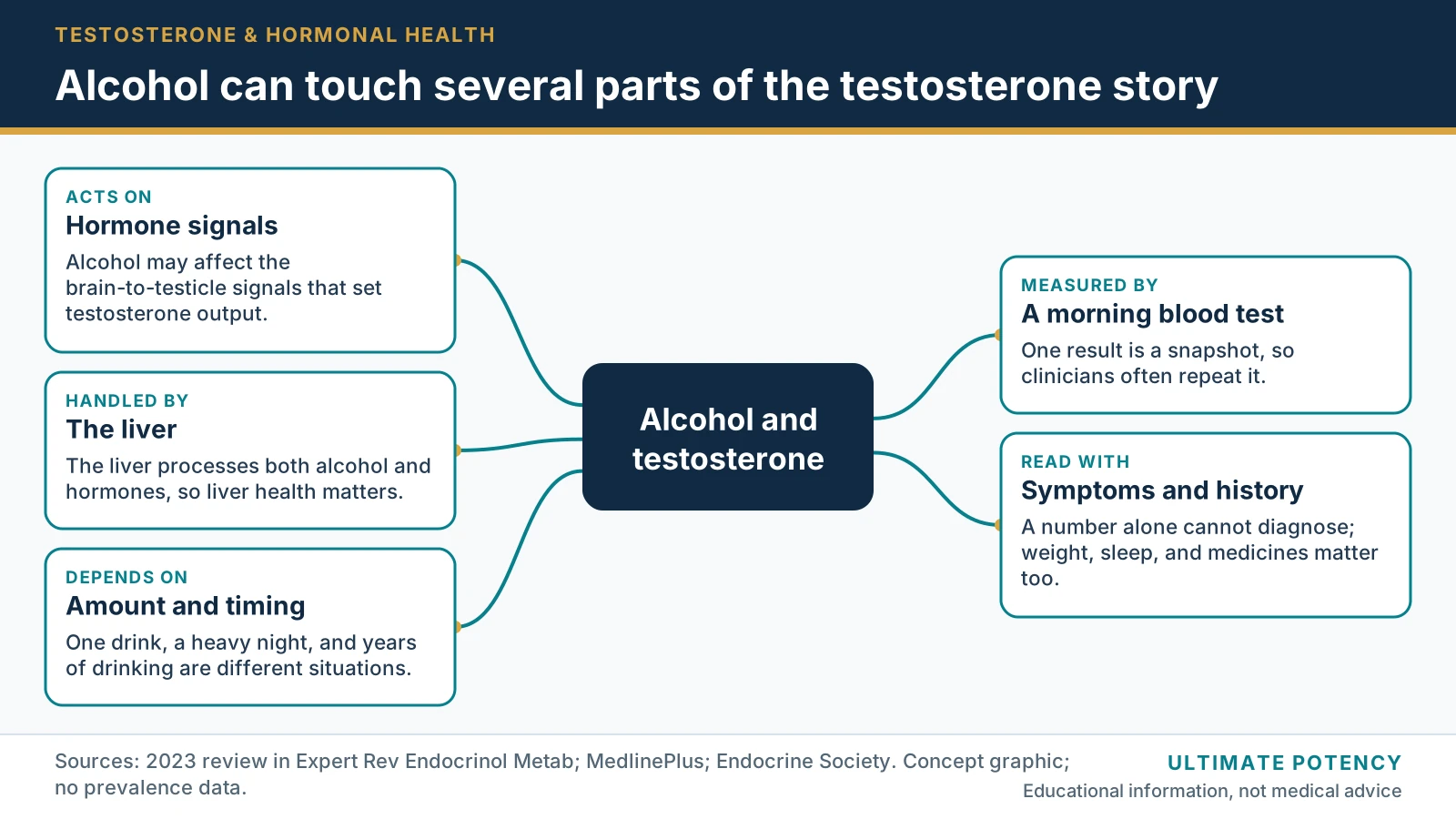
Text version: Alcohol and testosterone connect through five ideas: hormone signals from the brain to the testicles, the liver that processes alcohol and hormones, the amount and timing of drinking, a morning blood test that gives a snapshot, and symptoms and history that a clinician reads alongside the number.
How the Body Makes Testosterone
Testosterone production runs on a chain of signals. The brain’s hypothalamus releases a messenger that tells the pituitary gland, a small gland at the base of the brain, to release hormones called LH and FSH. LH (luteinizing hormone) then signals the testicles to make testosterone. When testosterone climbs high enough, feedback signals tell the brain to ease off, much like a thermostat. Doctors call this the hypothalamic-pituitary-gonadal axis, or simply the hormone axis.
This matters for alcohol because a 2023 review of alcohol’s effects on testosterone synthesis in men describes alcohol acting at several points along that chain rather than at one single spot. The liver also handles both alcohol and hormones, which gives it a role in the story. You don’t need to memorize the pathway. The practical point is that a change in a blood level can come from the brain’s signals, the testicles, the liver, or the way hormones travel in the blood, and a single number can’t say which one is involved.
Why Online Answers Conflict
Search results on this topic can feel like they were written about different planets. This subsection explains the two most common reasons: the time frame being discussed, and the way “drinking” gets defined from one source to the next.
Short-Term Versus Long-Term Drinking
A lot of the contradiction comes from mixing up what happens within hours of a drink and what happens after months or years of regular drinking. The 2023 review in Expert Review of Endocrinology & Metabolism summarizes it this way: acute intake of low-to-moderate amounts of alcohol is associated with a rise in testosterone, while larger volumes lower it, and heavy or chronic excessive drinking impairs testosterone production. Those are three different situations, and an article that reports only one of them will sound very different from an article that reports another.
Think of it like caffeine. One coffee at 9 a.m. and a pattern of five energy drinks a day wouldn’t be expected to have the same effect on your sleep, and nobody would call the two claims contradictory. The same logic applies here. Timing and quantity change the answer, so when you read a claim about alcohol and hormones, the first question to ask is whether it’s describing one night, one week, or years of habit.
Why Dose and Definitions Matter
Even within a single time frame, “drinking” can mean very different amounts. The National Institute on Alcohol Abuse and Alcoholism (NIAAA) defines a U.S. standard drink as 14 grams of pure alcohol, and notes that bottle or glass size doesn’t tell you the content. A 12-ounce beer at 5% alcohol by volume is one standard drink, while a 12-ounce beer at 10% is two. Craft beers, generous wine pours, and mixed drinks can easily hold more than one standard drink.
This is a quiet source of confusion in research too. The abstract of the 2023 review doesn’t define “low-to-moderate” or “large volume” in numbers, and different studies draw their own lines. So when an article says moderate drinking is fine for hormones, it’s worth asking: moderate by whose definition, in which men, and measured how? Without that, a headline can sound more precise than the evidence actually is.
What the Research Shows
Now that the terms are clear, we can look at what studies have reported. The evidence here is real but uneven. Some of it comes from pooled results from many studies, some from reviews that summarize physiology, and some from observational comparisons between drinkers and nondrinkers. This section takes heavy drinking first, then lighter drinking, and keeps track of what each type of evidence can and can’t tell you.
Heavy and Long-Term Drinking
Heavy and long-term drinking has the most consistent signal in the research, but “consistent” doesn’t mean “complete.” This subsection covers what a large pooled analysis reported and how alcohol use disorder and liver health fit into the picture.
What Pooled Studies Found
The strongest single piece of evidence for heavy drinking is a meta-analysis (a study that statistically combines results from many earlier studies) by Santi and colleagues, published in the journal Andrology. According to the published record, it pooled 21 studies, covering 30 trials and 10,199 participants, comparing men who drink with men who do not or who received a nonalcoholic comparison. Men with chronic alcohol consumption had lower total testosterone, lower free testosterone (the portion not bound to carrier proteins), and lower SHBG (sex hormone-binding globulin, a protein that carries testosterone in the blood), along with higher estradiol. LH showed no clear change.
That’s a meaningful finding, and the authors note the exact mechanisms aren’t fully worked out. What a pooled average can’t tell you is how any one man’s level will respond, or whether a given difference would produce symptoms. The summary available to us was the abstract, so details like the size of the differences in clinical terms are better judged from the full paper.
Alcohol Use Disorder and Liver Health
At the far end of the drinking spectrum, alcohol use disorder (a medical condition in which a person has trouble controlling or stopping drinking despite harm) shows up on lists of conditions associated with low testosterone. MedlinePlus names it alongside chronic liver or kidney disease, pituitary disorders, testicle problems, and Klinefelter syndrome as possible links to low testosterone in males.
The liver deserves a mention because it processes both alcohol and hormones, and long-term heavy drinking can injure it. That doesn’t mean every man with a low result has a liver problem, and it doesn’t mean every heavy drinker will have a low result. It means that when a clinician hears about heavy drinking, liver health and hormone health are often looked at together. If you’re worried about either, say so directly. Honest information about your drinking helps the evaluation, and it isn’t used to judge you. A discussion of alcohol use disorder is a medical conversation, and effective help exists.
Light and Moderate Drinking
The picture gets muddier at lower amounts of drinking. This subsection explains why some studies show testosterone going up, what that does and doesn’t mean, and why the finding shouldn’t be read as health advice.
Why Some Studies Show a Rise
The 2023 review reports that acute low-to-moderate intake is associated with a rise in testosterone, and it attributes the rise to liver enzyme activity during alcohol processing. A 2024 systematic review and meta-analysis by Moosazadeh and colleagues in the International Journal of Preventive Medicine, as shown in its journal record, pooled 17 observational studies. Overall, it found no statistically significant difference in testosterone, LH, or FSH between drinkers and nondrinkers. In subgroup breakdowns by intake level, testosterone was higher in the low and moderate intake groups than in people with no alcohol exposure.
So where does that leave us? Some research on lighter drinking finds no difference, and some finds slightly higher levels. Neither result shows that drinking improves hormone health. The measured level may shift for reasons that have little to do with how well the body is actually producing testosterone, and observational studies can’t separate drinking from everything else that differs between drinkers and nondrinkers.
This evidence matrix shows what each finding reported and, just as important, what limits how far it can be stretched.
| Claim | Evidence type | What was reported | Main limitation |
|---|---|---|---|
| Heavy or chronic drinking lowers testosterone | Meta-analysis of 21 studies (10,199 participants) | Lower total and free testosterone and SHBG with chronic drinking | Group averages; mechanisms not fully clarified |
| A small amount of alcohol raises testosterone for a while | Narrative review of physiology | Acute low-to-moderate intake linked to a rise | Doses not defined in the abstract; described as an acute effect |
| Drinkers and nondrinkers differ overall | Meta-analysis of 17 observational studies | No significant overall difference; higher levels in low and moderate groups | Observational; other differences between groups can’t be removed |
| Alcohol use disorder is linked to low testosterone | Clinical reference (MedlinePlus) | Listed among conditions associated with low levels | A list of associations, not a measure of how often it occurs |
Sources: Expert Review of Endocrinology & Metabolism (2023) review; Santi et al., Andrology (2024); Moosazadeh et al., International Journal of Preventive Medicine (2024); MedlinePlus. Summaries are based on abstracts and records, not full texts.
Why a Small Rise Is Not a Reason to Drink
It would be easy to read the lighter-drinking findings and conclude that a drink or two is good for your hormones. That conclusion goes further than the evidence. A short-term bump in a blood level isn’t the same as better health, better sleep, stronger erections, or more energy, and none of the studies above measured those outcomes as reasons to recommend drinking.
Public guidance is also moving toward caution. As reported by AARP, the 2025-2030 Dietary Guidelines for Americans dropped the numeric daily limits that appeared in earlier editions and now advise people to consume less alcohol for better health. If you already drink lightly, the hormone research gives you no reason to panic. If you don’t drink, it gives you no reason to start. No amount of drinking is a treatment for low testosterone, and anyone who sells it that way is overselling a thin finding.
Symptoms and Overlap
Many men look into alcohol and hormones because something feels different: less interest in sex, lower energy, a flatter mood, or erections that aren’t what they were. Those experiences are real and worth taking seriously. They’re also some of the least specific signals in medicine. This section looks at what you might notice, why drinking and low testosterone can look alike on the surface, and why a symptom list can’t point to one cause.
Changes You Might Notice
Symptoms linked to low testosterone and symptoms linked to heavy drinking overlap more than most people expect. This subsection walks through the sexual changes first, then the whole-body changes, and gives you a way to turn your observations into questions.
Desire, Erections, and Drinking
Mayo Clinic lists lower sex drive, low energy, and depression among the early adult signs of low testosterone, and erectile dysfunction (ED, trouble getting or keeping an erection firm enough for sex) among later ones. The NIDDK overview of ED causes lists drinking too much alcohol as a lifestyle behavior that may contribute to ED, and it lists low testosterone as a hormone issue that can contribute too. So both can show up in the same person, which is exactly why it’s hard to sort out from the inside.
The NIDDK treatment page adds a useful point: too much alcohol may mask other mental health, emotional, or physical factors that cause ED. In other words, heavy drinking can make a problem worse and also hide what’s underneath it.
This decision aid turns common observations into questions you can bring to a clinician; it is not a way to work out a cause on your own.
| If you notice | Other things that can look similar | A useful question to ask |
|---|---|---|
| Less interest in sex over several months | Stress, mood changes, relationship strain, medicines, heavy drinking | Could my drinking, mood, or medicines be part of this, and should hormones be checked? |
| Erections that are less reliable | Blood vessel health, diabetes, medicines, anxiety, drinking | Is it worth looking at several causes together, including alcohol? |
| Ongoing tiredness | Poor sleep, sleep apnea, depression, thyroid problems, overwork | Which tests make sense before we assume a hormone problem? |
| Low mood or irritability | Depression, anxiety, stress, alcohol use | Should we look at mood and drinking alongside hormones? |
| Drinking more than you’d like | Stress, habit, social routines, alcohol use disorder | What support is available for cutting back, and how would that affect other health checks? |
Sources: NIDDK, Symptoms & Causes of Erectile Dysfunction and Treatment pages (reviewed October 2024); Mayo Clinic, Male hypogonadism (updated September 2024); MedlinePlus. Questions are editorial suggestions, not a diagnostic tool.
Energy, Sleep, and Mood
Fatigue is one of the least specific symptoms there is. It can come from poor sleep, depression, anxiety, thyroid problems, anemia, and many other causes, and low testosterone is only one of them. Mood works the same way. Irritability or a flat mood can accompany low testosterone, and it can also accompany stress, depression, and heavy alcohol use.
Sleep is worth singling out because it sits in the middle of this web. Mayo Clinic lists obstructive sleep apnea (a condition in which breathing repeatedly pauses during sleep) among the secondary causes of male hypogonadism, and many people notice that drinking changes how they sleep. We haven’t verified a specific sleep mechanism for this article, so treat that as something to track rather than a proven link. Writing down how you sleep and how much you drink in the same notebook lets a clinician see patterns you might not see yourself.
Why Symptoms Cannot Point to a Cause
If symptoms overlap so heavily, can they at least narrow things down? Not reliably. This subsection explains why alcohol is best understood as one possible contributor rather than the answer, and why settling on a single explanation too early can backfire.
Alcohol as One Possible Contributor
The Endocrine Society’s July 2026 statement on testosterone replacement therapy is blunt on this point: symptoms alone are not diagnostic of hypogonadism. It calls for diagnosis based on both symptoms and consistently low, accurately measured testosterone. The American Urological Association’s testosterone deficiency guideline page likewise describes the symptoms as very non-specific and says they can reflect other conditions, such as chronic fatigue, chronic stress, or a depressed state.
For alcohol, that means two things. First, drinking can plausibly contribute to how you feel without being the whole explanation. Second, not drinking doesn’t rule out a hormone problem, and drinking doesn’t prove one. The Endocrine Society statement advises ruling out reversible contributors first, and it names obesity and certain medicines, such as corticosteroids and opioids, as examples. Alcohol belongs on the same list of things a clinician wants to know about, even though that statement does not single it out.
The Risk of Blaming the Wrong Thing
Settling on alcohol as the sole culprit has a cost. If a man assumes his drinking explains everything, he might skip a check on blood pressure, sleep, mood, or blood sugar that could have mattered. The reverse mistake is just as common: assuming a hormone is to blame and ignoring a drinking pattern that is plainly affecting his life.
Consider a hypothetical situation: a man in his forties notices that his drive has dipped over the last year. He has a couple of drinks most evenings, which crept up during a stressful stretch at work, and he sleeps poorly. He wonders whether alcohol has “ruined his testosterone.” A thoughtful appointment wouldn’t start with that answer. It would look at his drinking in standard drinks, his sleep, his mood, his medicines, and his general health, and it might include a morning blood test. Any one of those could matter, and more than one may. This example is illustrative only and isn’t advice for any real person.
Testing and Lab Results
A blood test is the only way to measure testosterone, and it’s also easy to misread. The number depends on when the sample was drawn, how the lab measured it, and what else is happening in your body. This section explains how testing works, why drinking history is useful information for the person ordering it, and how clinicians put results in context.
What a Blood Test Can Show
A testosterone test is a snapshot, and snapshots can be blurry. This subsection covers the practical details of timing and repeat testing, then turns to the part of the visit where your honesty about alcohol makes the biggest difference.
Timing, Morning Draws, and Repeat Tests
MedlinePlus explains that blood is usually drawn in the morning, between 7 and 10, when levels are typically highest, and that fasting may be needed only in certain cases. Mayo Clinic gives a similar morning window and notes that samples are sometimes drawn on more than one day. The Endocrine Society statement goes further: diagnosis should rest on at least two early-morning fasting tests, and a figure near 300 ng/dL is often used as a clinical threshold. Instructions vary, so follow what your clinic or lab tells you.
The Society also stresses that assay quality matters, since non-standardized methods can give different results on the same sample. In practice, this means one low-looking result isn’t a verdict. A repeat test under standard conditions is a normal part of the process, not a sign that something is wrong. For more on timing, see our guide to morning testosterone blood tests.
Telling Your Clinician About Drinking
The person ordering your test can only interpret it using what you tell them. Because research describes both short-term and long-term effects of alcohol on testosterone, drinking history is relevant information. Useful details include how many standard drinks you have in a typical week, whether that has changed, whether you tend to have heavy nights, and roughly when you last drank before the blood draw. Many people find it easier to answer this kind of question with a few weeks of simple notes than from memory.
It’s also worth asking whether you should avoid alcohol before the test, rather than guessing. MedlinePlus advises telling your provider about everything you take and not stopping any medicine unless your provider says so, and the same spirit applies to drinking: be open, then follow the plan you agree on. If you drink heavily, ask about the safest way to cut back before changing anything yourself, because stopping suddenly can be risky. A good clinician has heard it all before, and the goal is accuracy rather than judgment.
Reading Results in Context
A result only means something next to your symptoms, history, and other findings. This subsection explains how drinking fits into that context and which additional tests a clinician may consider if a first result looks low.
When Drinking Is Part of the Picture
When a first result looks low and a man drinks regularly, a clinician has several things to weigh. Was the sample drawn at the right time? Does a repeat test agree? Are there other reversible contributors, such as weight, certain medicines, or sleep problems? And is the drinking pattern heavy enough to be a plausible contributor on its own? The Endocrine Society’s advice to rule out reversible contributors first fits here, and it explains why a sensible plan often begins with a repeat test and a review of daily habits rather than with a prescription.
Consider a hypothetical situation: a man gets a morning result that sits just under his lab’s reference range. He reports about fifteen standard drinks a week, most of them on weekends. His clinician suggests a repeat morning test, a review of his medicines and weight, and a conversation about his drinking, and the clinician doesn’t treat the first number as a diagnosis. That plan isn’t dramatic, but it’s how a careful evaluation usually works. This example is generic and not advice about what any individual should do. Reference ranges also differ between labs, which is another reason to read a result with the lab that produced it.
Other Tests a Clinician May Add
If testosterone looks low, Mayo Clinic notes that further tests may look for the cause, including pituitary hormone tests, semen analysis, and imaging of the pituitary. Which ones apply depends entirely on your situation, and a normal first-line result may need none of them. The alcohol studies discussed earlier measured several markers, including free testosterone, SHBG, LH, and estradiol, which hints at why a clinician may look beyond the total testosterone number.
Free testosterone (the portion available to tissues) and SHBG (the carrier protein) change how total testosterone should be read, which is why a clinician may look at both. LH can help show whether the signal from the brain is changing along with the testicles’ output. You don’t need to order any of these yourself, and you shouldn’t buy panels to interpret on your own. The useful move is to ask your clinician which additional tests, if any, would change the plan, and what each one is meant to show.
Comparing Relevant Factors
Once you’ve seen the studies and the testing basics, the next job is weighing what it all adds up to. Evidence comes in different strengths, and alcohol rarely acts alone. This section looks at how to judge what the research can support, then places drinking alongside the other factors that clinicians commonly review when testosterone looks low.
Evidence and Limitations
Not every finding deserves the same trust. This subsection explains the difference between an association and a cause, then pulls the evidence into a simple map of where it’s stronger and where it’s thin.
Association Versus Cause
An association means two things tend to show up together. A cause means one produces the other. Most of the alcohol and testosterone data you’ll find are associations, because researchers can’t ethically assign men to years of heavy drinking and watch what happens. Observational studies compare people who already drink with people who don’t, and the groups often differ in weight, sleep, smoking, medicines, and general health. Any of those differences could shift testosterone by itself.
The Santi meta-analysis tried to address this. According to its published record, the authors report that the differences persisted after adjusting for factors such as age, body mass index, estradiol, and LH, and they note that the exact mechanisms behind the findings are not fully clarified. That strengthens the heavy-drinking signal without turning it into proof for any individual. A fair summary is that the evidence points in a consistent direction for heavy, long-term drinking, while the cause-and-effect story at lighter levels remains unsettled. Careful readers hold both of those ideas at once.
How the Evidence Applies
Putting this together, the evidence sorts into three rough tiers. The most consistent finding is that heavy or chronic drinking is associated with lower testosterone. The picture for light or moderate drinking is mixed, with some studies reporting no difference and some reporting higher levels. And several questions that readers care about most, such as how much testosterone recovers after cutting back, aren’t well established in the sources we reviewed. The tiers are our editorial summary, not a formal grading system.
How should you use that? If you drink heavily, the research is one more reason to talk with a clinician about both your drinking and your hormones. If you drink lightly, nothing here suggests you need to rearrange your life around your testosterone. And if you’re hoping a drink or a cutback will move a specific lab value, remember that the research describes group averages, not predictions for you. Your own result, repeated and interpreted by a clinician, is the better guide.
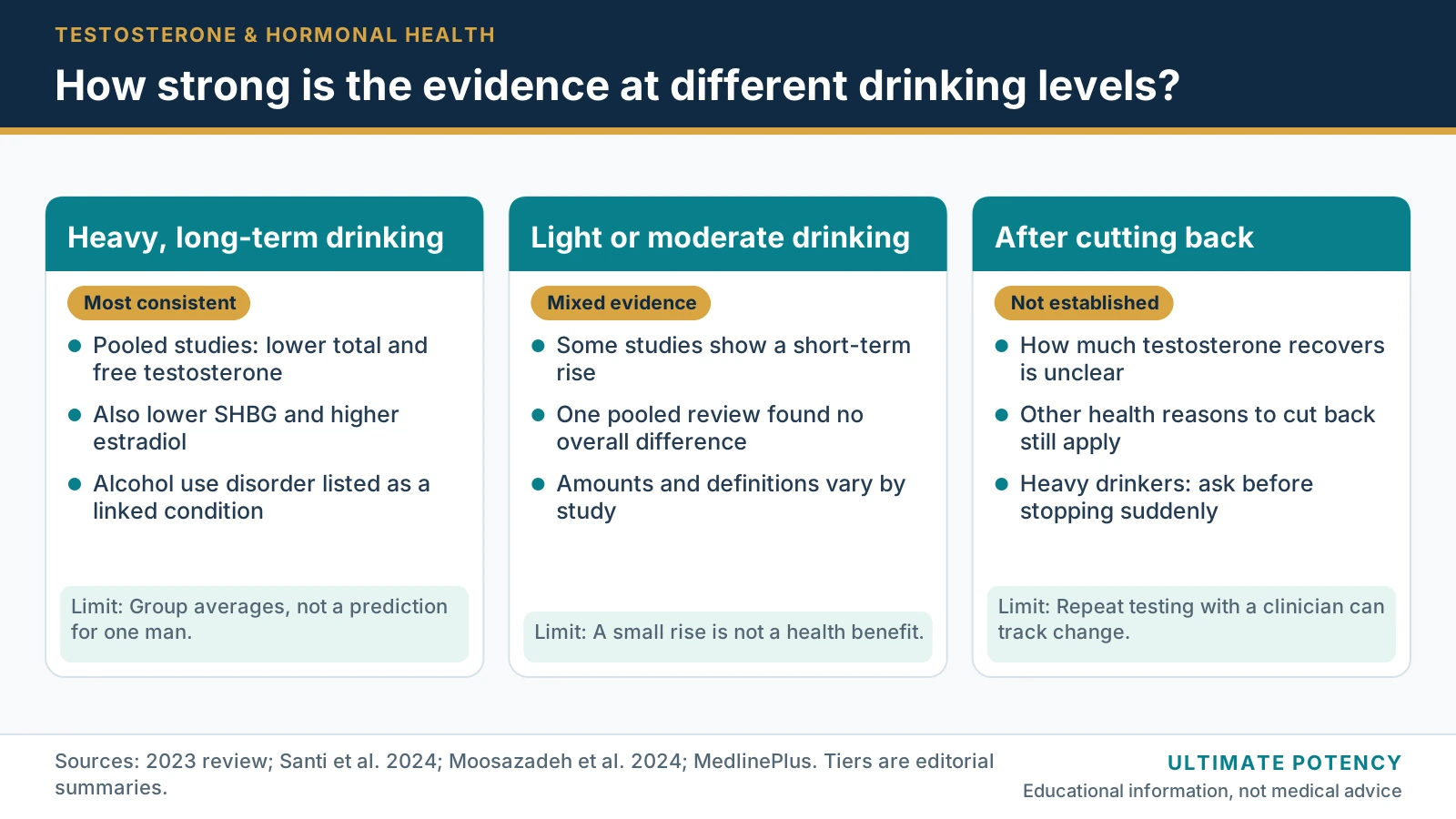
Text version: Heavy, long-term drinking: most consistent evidence of lower testosterone in pooled studies, but group averages only. Light or moderate drinking: mixed results, with some short-term rises and a small rise not being a health benefit. After cutting back: recovery is not established, other health reasons still apply, and heavy drinkers should ask a clinician before stopping suddenly.
Alcohol Alongside Other Contributors
Alcohol seldom travels alone. This subsection looks at the other factors that often sit beside it, then at how to think about changing your habits when several things might be involved at once.
Weight, Sleep, and Medicines
Mayo Clinic lists obesity, obstructive sleep apnea, and certain medicines among the secondary causes of male hypogonadism, and the Endocrine Society statement names obesity and medicines such as corticosteroids and opioids as reversible contributors to rule out first. For hypogonadism linked to obesity, with no other cause found, the statement describes weight loss as typically the first-line approach. These factors can also overlap with drinking, since alcohol adds calories and may be part of a lifestyle that affects sleep and weight. Our guides to obesity and low testosterone and medications that lower testosterone look at those pieces in depth.
Stress belongs on the list too. It affects sleep, appetite, drinking habits, and mood, all at once, which is why our article on stress and testosterone pairs naturally with this one. The point isn’t to blame any single factor. It’s to recognize that several of them tend to move together.
This comparison table shows how alcohol sits next to other factors that can overlap with a low testosterone result.
| Factor | How it can relate to testosterone | A question to ask |
|---|---|---|
| Heavy or long-term drinking | Associated with lower testosterone in pooled research | How does my drinking pattern fit with my result? |
| Liver disease | Chronic liver disease is listed among conditions linked to low levels | Does my liver health need checking? |
| Excess weight | Obesity is a listed secondary cause; weight loss is often a first step when it is the only cause found | Could weight be contributing, and what is a realistic plan? |
| Sleep problems, including sleep apnea | Obstructive sleep apnea is a listed secondary cause | Should my sleep be evaluated? |
| Certain medicines | Opioids and corticosteroids are named as examples | Could any of my medicines be involved? |
Sources: Mayo Clinic, Male hypogonadism (updated September 2024); Endocrine Society, 2026 statement; MedlinePlus, Testosterone Levels Test (updated June 2025). Overlap does not prove that any factor caused a given result.
Weighing Drinking Changes Against Other Steps
When several factors may be involved, a common worry is where to start. There’s no universal order, and your clinician can help you choose, but a few principles hold up. Changes that are safe, reversible, and good for your health in general are reasonable to discuss early. Cutting back on alcohol often fits that description, with the major caveat about withdrawal in the next section. Weight, sleep, and medicine reviews can happen in parallel.
Consider a hypothetical situation: a man in his fifties has a low-normal morning result and several possible contributors. He drinks most nights, carries extra weight, and takes a medicine that his clinician says can affect hormones. Rather than choosing one fix, he and his clinician agree to review the medicine, set a realistic drinking goal with support, and repeat the test in a few months. No single step is expected to carry the whole result. This example is only an illustration and isn’t a plan for anyone.
Cutting Back, Safety, and Treatment Conversations
Questions about alcohol and testosterone usually end up in the same place: what should I do about it? This section covers what may change if you drink less, why stopping suddenly can be dangerous for heavy drinkers, and how testosterone therapy and ED medicines enter the conversation. Throughout, the goal is to prepare you for decisions you make with a clinician, not to replace that conversation.
Changing Your Drinking
Reducing alcohol is the most common reaction to reading about hormones. It can be a good idea for many reasons, but the how and the why deserve some care. This subsection covers expectations first and safety second.
What Might Change and What Is Not Established
Hopes about cutting back often outrun the evidence. The 2023 review’s authors suggest that understanding the link might help identify ways to reduce alcohol’s testosterone-lowering effects, which is a research aspiration rather than a proven plan. A Medical News Today explainer, reviewed by a physician, states that scientists are unsure how much testosterone recovers after quitting alcohol. We treat that as a benchmark, not a primary source, but it matches what we found elsewhere: the recovery question lacks firm answers.
So a fair expectation is this: how much your own testosterone would change is not established, and it may depend on how heavily and how long you drank and on other factors like weight and sleep. Still, there are reasons to cut back that don’t depend on hormones. The NIDDK lists limiting or stopping alcohol use among lifestyle changes for ED. If you decide to change your drinking, you could ask your clinician whether a repeat test after a set period would help you see what, if anything, shifted.
When Stopping Suddenly Is Risky
MedlinePlus explains that withdrawal usually starts within about 8 hours of the last drink, though it can begin days later, and that symptoms typically peak between 24 and 72 hours. The more often you drink, the more likely withdrawal becomes. Moderate-to-severe withdrawal usually needs care in a hospital or facility. If you think you might be drinking at a level that makes stopping risky, tell a clinician before you cut back so they can plan with you.
If cutting down feels hard, that’s common and nothing to be ashamed of. The Substance Abuse and Mental Health Services Administration (SAMHSA) runs a free, confidential national helpline at 1-800-662-HELP (4357), open 24 hours a day, every day, with treatment referrals and information in English and Spanish. It isn’t a substitute for medical care, but it can be a starting point.
Testosterone Therapy and Other Medicines
Some readers arrive here because a result came back low and treatment is on the table. This subsection covers what therapy involves, why alcohol and your medicine list matter to that decision, and which warning signs need prompt attention.
Testosterone Therapy Basics
Testosterone therapy isn’t a casual add-on to a diagnosis. The Endocrine Society statement says risk assessment before starting and careful monitoring during treatment are essential, and that long-term safety, including prostate cancer risk, is not yet established. Mayo Clinic describes checkups and blood tests several times during the first year and yearly afterward, and lists possible effects such as too many red blood cells, acne, breast enlargement, sleep problems, prostate growth, and reduced sperm production.
That last point matters if you want to have children. Testosterone therapy can reduce sperm production, so fertility goals should come up before treatment starts. Our guide to TRT and fertility covers this in detail. Mayo also notes that oral forms are generally avoided because of liver risks, which is one more reason to be upfront about your drinking and liver health. Never start hormones on your own or buy them without a prescription.
Alcohol, ED Medicines, and Urgent Symptoms
If low testosterone and erection changes appear together, your clinician may discuss ED medicines called PDE5 inhibitors, such as sildenafil and tadalafil. The NIDDK treatment page says to tell your health care professional about all your medicines, including prescription, over-the-counter, and supplements. Alcohol belongs on that list. Our guide on sildenafil and alcohol goes through that interaction question separately, and the same conversation applies to other ED medicines.
Some safety points are firm. According to a sildenafil citrate tablets label, nitrate medicines in any form are contraindicated with it, and the label advises against combining it with other ED treatments. An erection lasting more than four hours needs immediate medical help, and so does sudden vision or hearing loss. Don’t wait to see whether it passes, and don’t combine ED medicines on your own. If you have questions about your own prescriptions, ask the prescriber or pharmacist.
Common Questions
Readers tend to arrive with a handful of very specific questions, and the answers are often more careful than a search snippet allows. This section takes four of the most common ones in two groups: questions about how drinking and hormones interact over time, and questions about drink types and supplements. Each answer is based on the sources discussed earlier and says plainly where the evidence runs out.
Drinking and Hormone Questions
The first group deals with timing: what a single night does, and what changing your habits might do. These are the questions people ask just before a blood test or just after a worrying result.
Does One Night of Drinking Change Testosterone?
It can, at least temporarily, but the direction depends on the amount. The 2023 review describes a short-term rise after low-to-moderate intake and a fall with larger volumes. Neither effect is described as a lasting change from a single occasion, and the abstract doesn’t give exact amounts, so you can’t use it to predict your own level the morning after a night out.
For practical purposes, this means one evening of drinking shouldn’t be read as damaging your hormones for good, and it shouldn’t be read as boosting them either. If a blood test is coming up, tell the person ordering it when you last had a drink and ask whether they’d like you to avoid alcohol beforehand. That small step makes the result easier to interpret, especially if a repeat test is needed. And if you’ve had heavy nights recently and a result looks off, mention it. A clinician would rather know than guess, and a repeat test after a quieter stretch may give a clearer picture.
Will Quitting Alcohol Raise My Testosterone?
Honestly, we can’t promise that, and nobody else should either. The research we reviewed shows an association between heavy, long-term drinking and lower testosterone, but how much recovery follows after stopping is not established. A physician-reviewed explainer from Medical News Today says scientists are unsure about the extent of recovery, and the studies described in the records we reviewed mostly compare groups of drinkers with nondrinkers. We did not find a before-and-after study of men who quit in those records.
That doesn’t make cutting back pointless. Drinking less can matter for liver health, sleep, mood, and erections, and the NIDDK lists limiting or stopping alcohol among lifestyle changes for ED. It just means the hormone result shouldn’t be the only yardstick. If you drink heavily, talk with a clinician first, since stopping suddenly can be dangerous. If you’d like to see whether anything changed, ask about repeating morning testosterone testing after a set time, and keep your expectations open. Our guide on how low testosterone is diagnosed explains what a thorough follow-up can include.
Drinks and Products Questions
The second group covers what’s in the glass and what’s in the supplement aisle. Both are areas where marketing tends to get ahead of the evidence, so a calm read of the facts helps.
Does the Type of Drink Matter?
The sources we reviewed organize the question by how much alcohol you take in, not by what you drink it from. The Medical News Today explainer says no specific type of alcohol increases testosterone. The NIAAA’s standard-drink definition points the same way: a beer, a glass of wine, and a shot of spirits each carry about 14 grams of pure alcohol in the standard sizes, and the amount of alcohol is what you’re counting.
So there’s no good evidence in our sources that switching from one kind of drink to another protects your hormones. What matters more is the total amount, how often, and the strength. A high-alcohol craft beer or a large pour of wine can contain more than one standard drink, so it’s easy to undercount. If you want to know where you stand, keeping a simple tally in standard drinks for a couple of weeks gives you a much more reliable number than your memory. Take that tally to your appointment, since it’s more useful to a clinician than saying “a few.”
Can a Supplement Make Up for Drinking?
Supplements marketed as testosterone boosters promise a lot, but we found nothing in the primary sources reviewed for this article showing that any supplement offsets the effects of heavy drinking. Research on one ingredient doesn’t prove that a finished product works, and “natural” is not a safety guarantee. Some supplements can also affect the liver or interact with medicines, which matters even more if you already drink.
The safer path is to deal with the actual questions first: your drinking pattern, your sleep, your weight, your medicines, and a properly timed blood test. The Endocrine Society statement is a reminder that diagnosis, not a product, is the foundation for any hormone decision. If you’re already taking something, add it to the list you bring to your visit and don’t stop a prescribed medicine on your own.
Your Next Steps
Information is most useful when it turns into a plan you can act on. This closing section helps you prepare for a visit, gives you questions to bring, and explains how to make sense of what happens afterward, including when to seek care sooner. The point is a clearer, calmer conversation, not a self-diagnosis.
Preparing for Care
A short visit goes much further when you arrive with organized notes. This subsection covers the information worth gathering and the questions that tend to produce the most useful answers.
Gathering Notes and a Drinking Record
Two or three weeks of simple notes can change the quality of an appointment. Write down what has changed, when you first noticed it, and whether it’s steady or comes and goes. Include sexual changes such as desire and morning erections, and also energy, mood, sleep, and weight. Then add a plain record of your drinking in standard drinks, with the days and rough amounts. Gather every prescription, over-the-counter product, and supplement you use. If you’ve had a testosterone test before, bring the report, including the date, time of day, and units.
This isn’t about perfection. A rough record is far better than none, and nobody will grade it. If a clinician can see your patterns, they can ask better questions and decide which tests make sense.
This preparation table lists what to note, why it helps, and what it lets you bring up.
| What to note | Why it helps | What you can bring up |
|---|---|---|
| Symptoms and when they started | Shows patterns and timing | “Here is what changed and when.” |
| Drinking in standard drinks | Gives an accurate picture of intake | “This is my typical week; has it changed?” |
| Medicines and supplements | Some can affect hormones or interact | “Could anything I take be involved?” |
| Sleep, weight, and mood | Overlapping factors clinicians review | “Should these be checked as well?” |
| Prior lab reports with dates and times | Allows fair comparison across tests | “How does this fit with my earlier results?” |
Informed by MedlinePlus, Testosterone Levels Test, and NIDDK guidance on ED evaluation. A preparation aid, not a self-diagnosis tool.
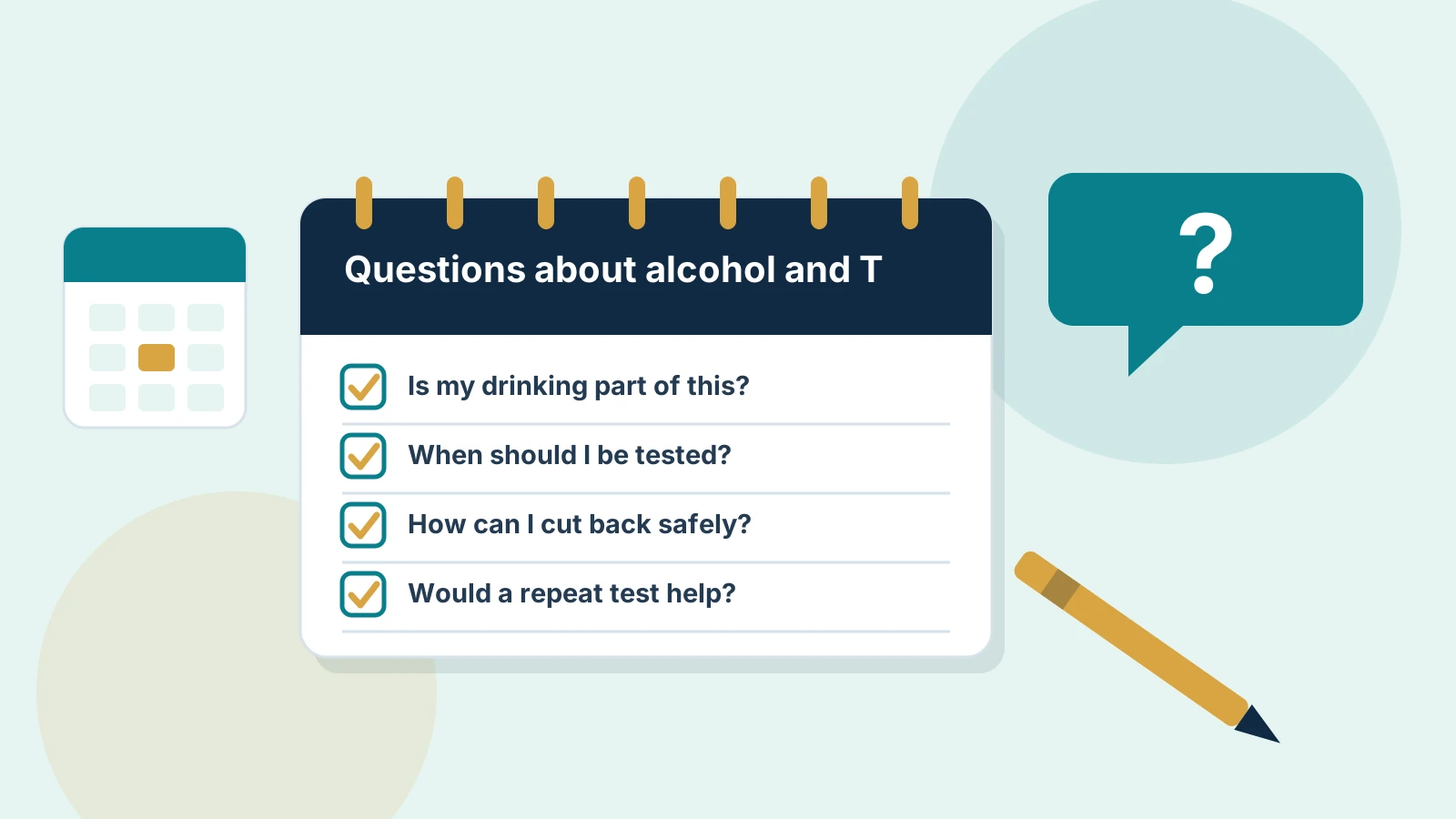
Questions About Alcohol and Testosterone
Good questions keep a visit focused. You might ask: Based on my history, is a testosterone test appropriate now, and when should it be drawn? Could my drinking be affecting my result, and should I avoid alcohol before the blood draw? If the first result is low, will we repeat it, and what else would you check? Are there other contributors, such as weight, sleep, or medicines, that we should look at first?
It’s also fair to ask about safety and support. How can I cut back safely, given how much I drink? Is it risky for me to stop suddenly? If treatment is ever considered, what would monitoring involve, and how would it affect fertility? And what would count as a sign that I should come back sooner? You don’t have to ask them all. Pick the three or four that matter most to you, write them down, and ask the clinician to explain anything you don’t understand in plain language. A visit is a conversation, and you’re allowed to steer it.
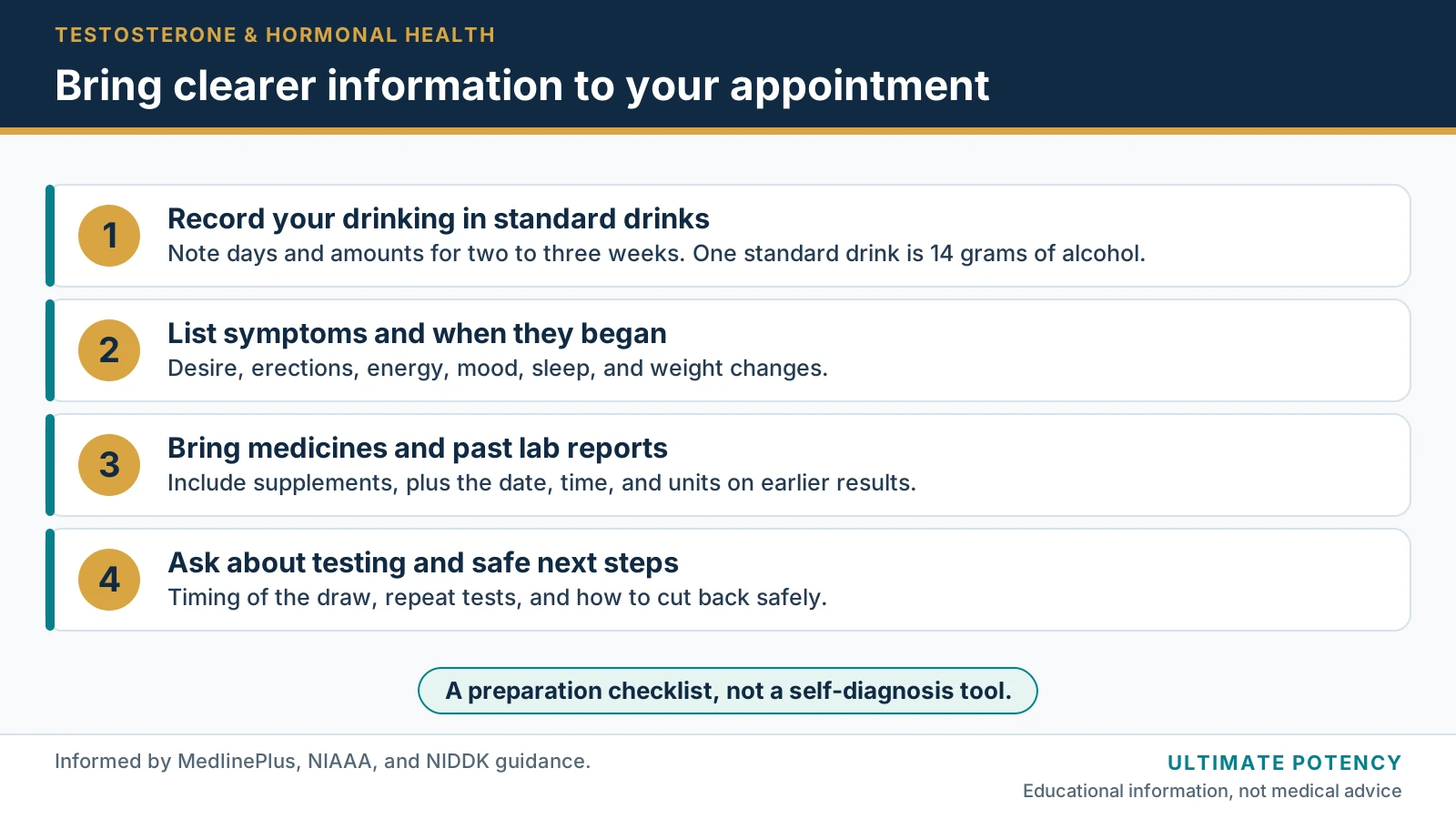
Text version: Step 1: record your drinking in standard drinks for two to three weeks. Step 2: list symptoms and when they began. Step 3: bring medicines, supplements, and past lab reports. Step 4: ask about testing timing, repeat tests, and how to cut back safely.
After the Visit
What happens after the appointment matters as much as the appointment. This subsection covers how to understand the plan you leave with and when to reach out sooner than planned.
Understanding the Plan and Follow-Up
Before you leave, try to be able to say back three things: what the clinician thinks is going on, what happens next, and when you’ll hear about results. If a repeat test is planned, ask when and under what conditions it should be drawn, including whether the timing of your last drink matters. If you’re changing your drinking, ask what support is available and what a realistic timeline looks like.
It helps to write the plan down while it’s fresh. If there’s something you don’t follow, call the office and ask. Follow-up isn’t a sign that something has gone wrong. Hormone questions are often answered across more than one visit, with repeat measurements and adjustments to the plan along the way. Keep your notes going between visits, since new information, like a change in sleep or in medicines, can alter what the next steps should be.
Knowing When to Seek Care Sooner
Some situations shouldn’t wait for a scheduled follow-up. If you drink heavily and develop shakiness, sweating, a racing heart, confusion, or hallucinations after cutting back, treat it as an emergency; MedlinePlus advises going to an emergency room or calling 911 for seizures, fever, severe confusion, hallucinations, or an irregular heartbeat. An erection lasting more than four hours, or sudden vision or hearing loss after taking an ED medicine, needs urgent medical attention.
Call your clinician promptly if symptoms get worse, if a new medicine seems to be causing problems, or if you feel you can’t control your drinking. Low mood that doesn’t lift deserves attention too, and the SAMHSA helpline at 1-800-662-HELP (4357) is open at all hours. Seeking help sooner isn’t overreacting. It’s what the care system is for, and most clinicians would far rather hear from you early than late.
Sources
- Testosterone Levels Test. MedlinePlus (NIH). Last updated June 5, 2025. Checked 2026-10-16.
- The effects of alcohol on testosterone synthesis in men: a review. Expert Review of Endocrinology & Metabolism (via PubMed). 2023 Mar;18(2):155-166. Checked 2026-10-16.
- The chronic alcohol consumption influences the gonadal axis in men: Results from a meta-analysis. Andrology (Santi et al.), repository record. 2024; online September 2023. Checked 2026-10-16.
- Association of the Effect of Alcohol Consumption on LH, FSH, and Testosterone Hormones in Men: A Systematic Review and Meta-Analysis. International Journal of Preventive Medicine (Moosazadeh et al.), DOAJ record. December 2024. Checked 2026-10-16.
- Statement on Testosterone Replacement Therapy. Endocrine Society. July 16, 2026. Checked 2026-10-16.
- Symptoms & Causes of Erectile Dysfunction. NIDDK (NIH). Last reviewed October 2024. Checked 2026-10-16.
- Treatment for Erectile Dysfunction. NIDDK (NIH). Last reviewed October 2024. Checked 2026-10-16.
- Male hypogonadism: Symptoms and causes. Mayo Clinic. Updated September 20, 2024. Checked 2026-10-16.
- Male hypogonadism: Diagnosis and treatment. Mayo Clinic. Updated September 20, 2024. Checked 2026-10-16.
- Evaluation and Management of Testosterone Deficiency. American Urological Association. Published 2018; reviewed and validity confirmed 2024. Checked 2026-10-16.
- What Is A Standard Drink?. NIAAA (NIH). Last updated December 2025. Checked 2026-10-16.
- Alcohol withdrawal. MedlinePlus (NIH). Review date January 1, 2025. Checked 2026-10-16.
- National Helpline. SAMHSA. Page undated. Checked 2026-10-16.
- What the New Dietary Guidelines Say About Alcohol. AARP (news report on the 2025-2030 Dietary Guidelines). January 23, 2026. Checked 2026-10-16.
- Alcohol and testosterone. Medical News Today (benchmark; physician-reviewed). September 26, 2023. Checked 2026-10-16.
- Sildenafil citrate tablets prescribing information. Greenstone / Pfizer labeling. Revised 1/2018. Checked 2026-10-16.
Ultimate Potency is an educational publication. It does not diagnose, prescribe, or provide medical care. This article does not replace advice from a licensed healthcare professional who knows your history.