If your life has felt like a never-ending to-do list, it’s reasonable to wonder whether stress and testosterone are connected. Online, you’ll find two loud answers. One says stress is quietly draining your hormones and a supplement can fix it. The other says the whole idea is a myth. The research sits between those poles, and the details decide what a sensible next step looks like.
This guide focuses on that middle ground. It explains what stress does in the body, what human and animal studies have and haven’t shown, why so many other conditions look the same from the inside, and how a blood test fits in. It also covers realistic ways to ease stress and the questions worth bringing to an appointment. For the wider hormone picture, start with our guide to low testosterone symptoms, and for a closely related topic, read about low testosterone and mood. We can’t tell you what your own numbers mean, because that takes a clinician who knows your history.
One more thing before we dig in. Feeling worn down, irritable, or less interested in sex during a hard season says nothing about your worth, your masculinity, or your relationship. These are health signals, and health signals deserve calm, practical attention. If stress ever feels so heavy that you’re thinking about harming yourself, call or text 988 right away rather than reading on.
Understanding Stress and Testosterone
Before weighing studies or lab reports, it helps to settle the vocabulary. People use “stress,” “cortisol,” “low T,” and “burnout” almost interchangeably, and that blurring causes much of the confusion. This section defines the terms, shows how the body’s stress system and hormone system relate, and explains why the topic is so easy to misread.
Key Concepts
This subsection separates the building blocks: what stress is, what testosterone does, and how clinicians separate a normal hormone fluctuation from a medical condition.
What Stress and Testosterone Means
Stress is the body’s response to a demand or threat. The National Institute of Mental Health describes a stressor as something that can be a one-time or short-term event, or something that happens repeatedly over a long time. Testosterone is the main male sex hormone, made mostly in the testicles, and it supports sex drive, energy, muscle, and sperm production. The American Urological Association (AUA) defines testosterone deficiency as low levels combined with symptoms or signs, so a low number alone doesn’t qualify. When people search for stress and testosterone, they’re really asking two questions: whether stress can change a hormone level, and whether any change is big or lasting enough to matter for how they feel. Keeping those apart is important, because a short-lived hormone swing and a medical condition are very different things, and only the second usually calls for treatment.
This table separates the words that most often get blended when people read about stress and testosterone.
| Term | Plain meaning | Common misunderstanding |
|---|---|---|
| Stress | The body’s reaction to a demand, short-term or repeated | That all stress is harmful or that it always shows up in labs |
| Cortisol | A hormone from the adrenal glands, often called the stress hormone | That a cortisol result measures how stressed you feel |
| Low testosterone (low T) | A blood level lower than expected for the lab and test used | That one low number explains every symptom |
| Testosterone deficiency | Low levels together with symptoms or signs | That any tired, tense man has it |
| Burnout or exhaustion | A state of prolonged strain, often with poor sleep | That it is the same thing as a hormone disorder |
Sources: NIMH, I’m So Stressed Out! fact sheet; AUA, Evaluation and Management of Testosterone Deficiency (validity confirmed 2024); MedlinePlus, Cortisol Test. Plain-language summaries, not clinical definitions.
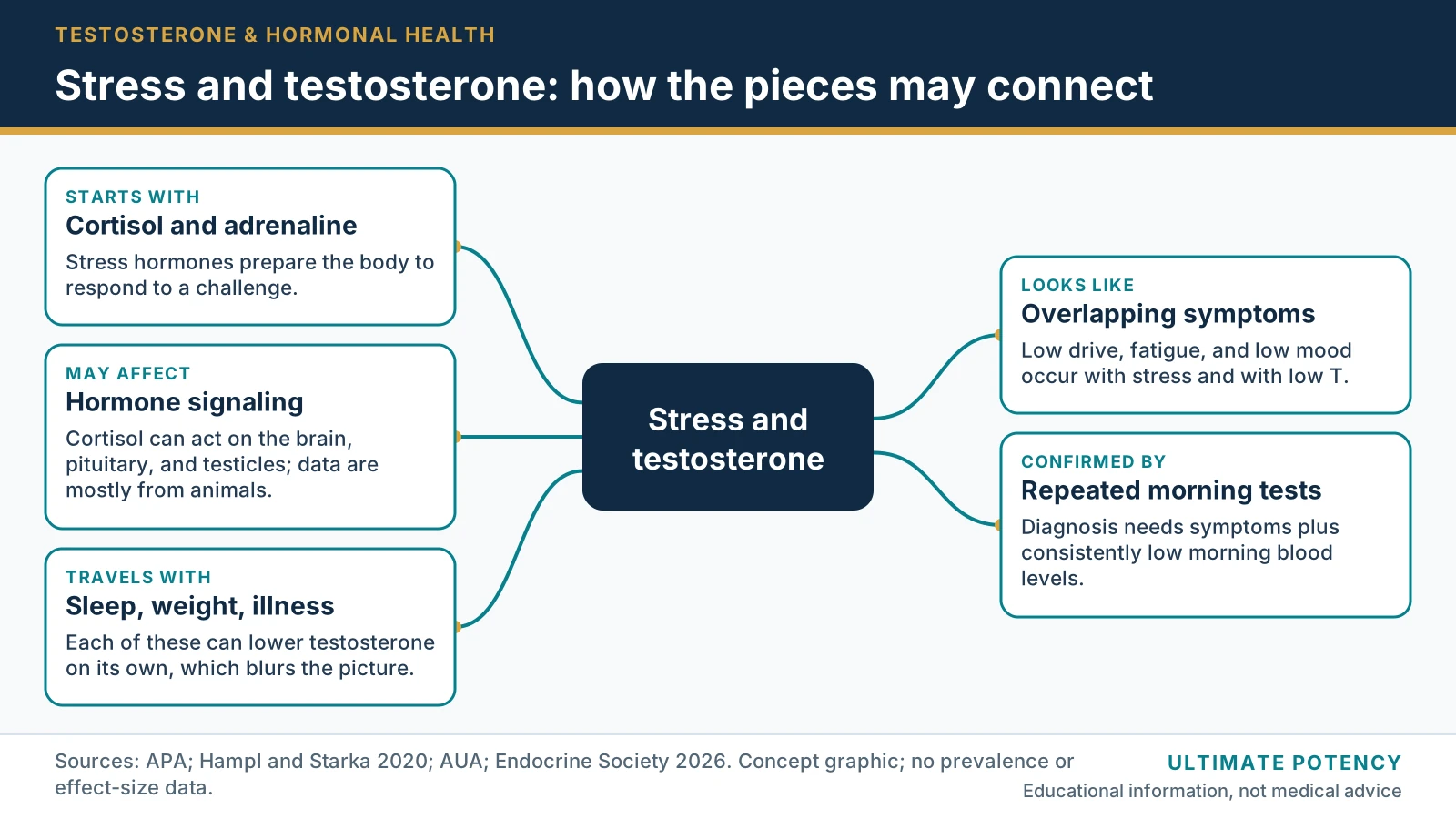
Text version: Stress and testosterone connect through five ideas. Stress starts with cortisol and adrenaline. It may affect hormone signaling, mostly shown in animals. It travels with sleep, weight, and illness. Its symptoms overlap with low testosterone. Low testosterone is confirmed only by symptoms plus repeated morning blood tests.
The Body’s Stress Response Explained
When your brain detects a challenge, the sympathetic nervous system signals the adrenal glands, two small glands above the kidneys, to release adrenaline and cortisol. The American Psychological Association explains that these stress hormones act as messengers that prepare the body to respond. In a short burst, this is useful: your heart speeds up and your focus sharpens. Cortisol follows a daily rhythm, and the MedlinePlus page on the cortisol test notes that levels are normally highest in the morning. Testosterone has a similar pattern, which is why testosterone blood draws are usually done in the morning, between 7 and 10. The two systems also talk to each other. A review in Physiological Research describes glucocorticoids, the family that includes cortisol, acting on the hypothalamus, the pituitary, and the testicular cells that make testosterone. We’ll return to that mechanism in a later section.
Why the Topic Gets Confusing
Stress and testosterone are hard to study and easy to oversell. This subsection explains why the symptoms overlap and why the headline claim is too simple.
Symptoms That Overlap With Stress
The symptoms usually blamed on low T are not specific to it. The AUA guideline says the symptoms associated with testosterone deficiency “are very non-specific and can be manifestations of other conditions,” and it gives chronic fatigue, chronic stress, and a depressed state as examples. Mayo Clinic’s page on male hypogonadism lists lower sex drive, less energy, and depression among adult symptoms. Meanwhile, NIMH lists excessive worry, tension, headaches or body pain, high blood pressure, and loss of sleep as symptoms of stress and anxiety. Put the lists side by side and you’ll see the problem: a tired, tense man with a low drive could have a hormone problem, a stress problem, a sleep problem, or several at once. That’s why a symptom list can start a conversation but can’t settle it.
Why “Stress Lowers T” Is Too Simple
It’s tempting to draw one straight line from stress to a lower hormone level. Real life is messier. The Cleveland Clinic page on low testosterone lists causes such as obstructive sleep apnea, obesity, diabetes, certain medicines, and Cushing syndrome, a condition of excess cortisol, but it does not name everyday stress. Mayo Clinic’s cause list doesn’t either. That doesn’t prove stress is irrelevant. It suggests that clinicians usually look for specific, treatable explanations first. It’s also plausible that long-term stress works indirectly, by disrupting sleep, appetite, activity, and alcohol use, though that is reasoning rather than something these sources measured. And as the next section shows, the direction of the effect can even flip depending on the type of stress, which a slogan like “stress kills testosterone” can’t capture.
What the Research Shows
Human studies on this question are few, small, and varied, and much of the mechanism work comes from animals. This section walks through what each type of study can support and where the claims run out.
Findings in People
Researchers have looked at men under exam pressure, in everyday life, and under extreme physical strain. Their results don’t all point the same way.
Short-Term Stress and Testosterone Changes
Two small studies show how mixed the picture is. In a 2016 study in Psychiatry Investigation, salivary testosterone rose in 30 male medical students at the start of a final exam, while a fall in the 28 women was not statistically significant. A 2005 analysis in Neuroendocrinology Letters followed 72 men and 60 women, averaging about 48 years old, across five visits. In men, lower levels of stress were positively linked to plasma testosterone, with a plateau at higher stress, though the statistical fit was borderline. Both studies were observational and small, used different stress measures, and cannot show cause and effect. The honest takeaway is that brief or moderate stress doesn’t reliably lower testosterone and may nudge it up, so a single stressful week is a weak explanation for a low result.
Prolonged Strain and Exhaustion
Extreme, sustained strain looks different. The Physiological Research review by Hampl and Stárka cites a study of Norwegian military cadets who completed five days of intense training with little sleep and little food. Their testosterone and related androgens fell, while DHEA-S, another adrenal hormone, rose, and cadets who were bullied showed a deeper drop. That is a very particular setting: physically exhausted, underfed, and sleep-deprived. It tells us that a body under severe, combined strain can lower testosterone production, not that an ordinary stressful job will. The authors also note that the link between changes in pituitary signals and androgens was fairly weak, which means the story isn’t fully worked out even in this extreme case. For most readers, the closer your life resembles chronic exhaustion, the more reasonable the question becomes, but it remains a question rather than a conclusion.
Mechanisms and Animal Work
To explain how stress might affect testosterone, researchers turn to lab models. Those models are useful for generating ideas but can’t be applied to people without caution.
How Cortisol May Reach the Hormone Axis
Testosterone production is run by a chain of signals called the hypothalamic-pituitary-gonadal axis. The hypothalamus releases gonadotropin-releasing hormone (GnRH), the pituitary responds with luteinizing hormone (LH), and LH tells the Leydig cells in the testicles to make testosterone. According to the review by Hampl and Stárka, glucocorticoids have receptors at all three levels and can reduce GnRH and LH release, and in rat experiments they lower the enzymes needed to make testosterone. The same authors state that most results come from animal models and tissue cultures, that human evidence is sparse, and that whether glucocorticoids reduce LH receptors in Leydig cells “remains open.” So the idea that cortisol can interfere with the hormone chain has biological support, but how much that matters in a typical man with ordinary stress is not established by this work.
What Noise-Exposure Studies in Rodents Show
Noise is a classic laboratory stressor, so it has been used to test the idea in animals. A 2015 meta-analysis in Endokrynologia Polska by Dzhambov and Dimitrova pooled seven rodent studies and found a large drop in testosterone after chronic exposure to noise of roughly 100 decibels, which is a very loud, sustained level of exposure. The authors also reported high heterogeneity, signs of publication bias, and a smaller estimate after adjusting for missing studies, and they stressed that results from rodents cannot be directly extrapolated to people. Longer exposure was linked to a larger apparent effect, but with only seven small studies the authors themselves called the meta-regression limited. We include the work because it shows both the appeal and the limits of animal research, which is better read as a hypothesis-builder than as proof for men. Here is how the main pieces of evidence compare.
This table lines up the studies discussed above so you can see how far each one can be stretched.
| Evidence type | What it found | Main limit |
|---|---|---|
| Exam-stress study in students | Salivary testosterone rose in men | Small sample, one exam, one site |
| Healthy adults followed over visits | Lower stress linked to higher testosterone in men, with a plateau | Observational, borderline statistics, healthy group |
| Review citing military cadets | Androgens fell after days of severe strain and little sleep or food | Extreme setting, specific group, secondhand summary |
| Rodent noise meta-analysis | Large testosterone drop at very loud, chronic noise | Animals only, high heterogeneity, publication bias |
Sources: Afrisham et al., Psychiatry Investigation 2016; King et al., Neuroendocrinology Letters 2005; Hampl and Stárka, Physiological Research 2020; Dzhambov and Dimitrova, Endokrynologia Polska 2015. Editorial summary; findings are not directly comparable.
How Stress Shows Up in Daily Life
Hormones are only one piece of what stress does. Before you ask what a blood test might show, it helps to look at how stress tends to appear in your thoughts, your body, and your sex life. This section covers those everyday signs and explains when they point toward support for stress itself.
Mind and Mood
Stress is felt first as a change in thinking and mood. These changes matter on their own, and they also muddy the hormone question because they resemble the symptoms people attribute to low T.
Worry, Tension, and Irritability
According to NIMH, common signs of stress and anxiety include excessive worry, uneasiness, and tension. Many men describe it differently: a short fuse, trouble switching off after work, a mind that races at bedtime, or a flat feeling where nothing seems very interesting. Some people notice headaches or body aches, and the NIMH list also includes high blood pressure and loss of sleep. None of these signs points to a hormone problem by itself, and none requires one to be real or worth addressing. Irritability and low motivation are common stress responses, and they are also among the symptoms people associate with low testosterone, which is why the two get tangled. If you’re curious how mood and the hormone relate more directly, our guide to low testosterone and mood goes through the research on that specific link.
When Stress Becomes Something More
Stress is a normal part of life, but it can slide into a health condition. NIMH says signs that stress may be turning into a disorder include interference with daily life, avoiding activities you’d usually do, and symptoms that seem to be always present. It also notes that persistent anxiety can affect sleep and the immune, digestive, cardiovascular, and reproductive systems, and can raise the risk of anxiety disorders or depression. That matters here because Mayo Clinic lists depression among the early adult symptoms of low testosterone, so a man with depression might chase a hormone explanation and overlook treatable mental health care. Anxiety and depression deserve their own evaluation, whatever your testosterone level turns out to be. NIMH names talk therapy and medication as the main treatments for anxiety, often used together. If you ever feel unsafe or think about harming yourself, call or text the 988 Suicide & Crisis Lifeline right away.
Body and Sexual Health
Stress also reaches the body, and the sexual effects are often the reason men look into testosterone in the first place. This subsection covers sleep and energy, then drive, erections, and fertility.
Sleep, Energy, and Drive
Sleep may be the most practical bridge between stress and hormones. In a small 2011 JAMA letter by Leproult and Van Cauter, ten healthy young men had three nights of 10-hour bedtimes and then eight nights of 5-hour bedtimes in a laboratory, and their total sleep fell from about 9 hours to under 5. Their waking-hour testosterone averaged 16.5 nmol/L under restriction versus 18.4 nmol/L when rested, which the authors summarized as a drop of about 10 to 15 percent, and their vigor scores fell. The group was tiny and all young and healthy, so the finding can’t be stretched to everyone. Still, it shows that a few short nights can move a number and a mood at the same time. Consider a hypothetical situation: a man spends three months on a demanding project, sleeps five or six hours a night, skips workouts, and leans on caffeine. He feels flat and notices less interest in sex. A clinician might ask about sleep, snoring, mood, and medications before any hormone is discussed.
Libido, Erections, and Fertility Under Pressure
The American Psychological Association’s page on stress and the body says chronic stress can affect testosterone production, leading to a decline in sex drive, and that it can even cause erectile dysfunction. It adds that chronic stress can harm sperm production and maturation, and it cites a finding that men who reported two or more stressful life events in the past year had a lower percentage of motile sperm. Those are summary statements rather than detailed trial results, so treat them as signals worth discussing, not as measured effects for you. Stress can also affect sex through a simpler route: worry about performance can create a loop of pressure and avoidance. Our cornerstone guide to sexual performance anxiety explains that cycle. If you and a partner are hoping to conceive, mention that goal early, because it shapes which tests and treatments make sense.
Comparing Relevant Factors
Once you accept that several things can affect hormones and mood at the same time, the useful question becomes which ones deserve attention first. This section compares how strong the evidence is for different explanations and covers the overlapping factors that clinicians usually check before they look at stress.
Evidence and Limitations
Not every statement about stress and testosterone rests on equally solid ground. Sorting claims by strength keeps expectations realistic and keeps you from either dismissing or overrating the link.
How the Evidence Applies
The firmest statements are about diagnosis rather than about stress. Symptoms of low testosterone are nonspecific, according to the AUA. A diagnosis needs consistently low, accurately measured levels, as the Endocrine Society statement puts it. And Cleveland Clinic notes that being sick can briefly lower production. On the stress question itself, the evidence is thinner: severe combined strain lowered androgens in one cadet study, small studies of milder stress conflict, and the cortisol mechanism rests mostly on animals. Evidence strength differs by claim, so a sentence like “stress lowers your testosterone” overstates what any single study shows. The graphic below sorts these points into stronger, mixed, and unclear groups. The labels are editorial summaries of the sources discussed, not a ranking of any individual’s options or a way to interpret your own result.
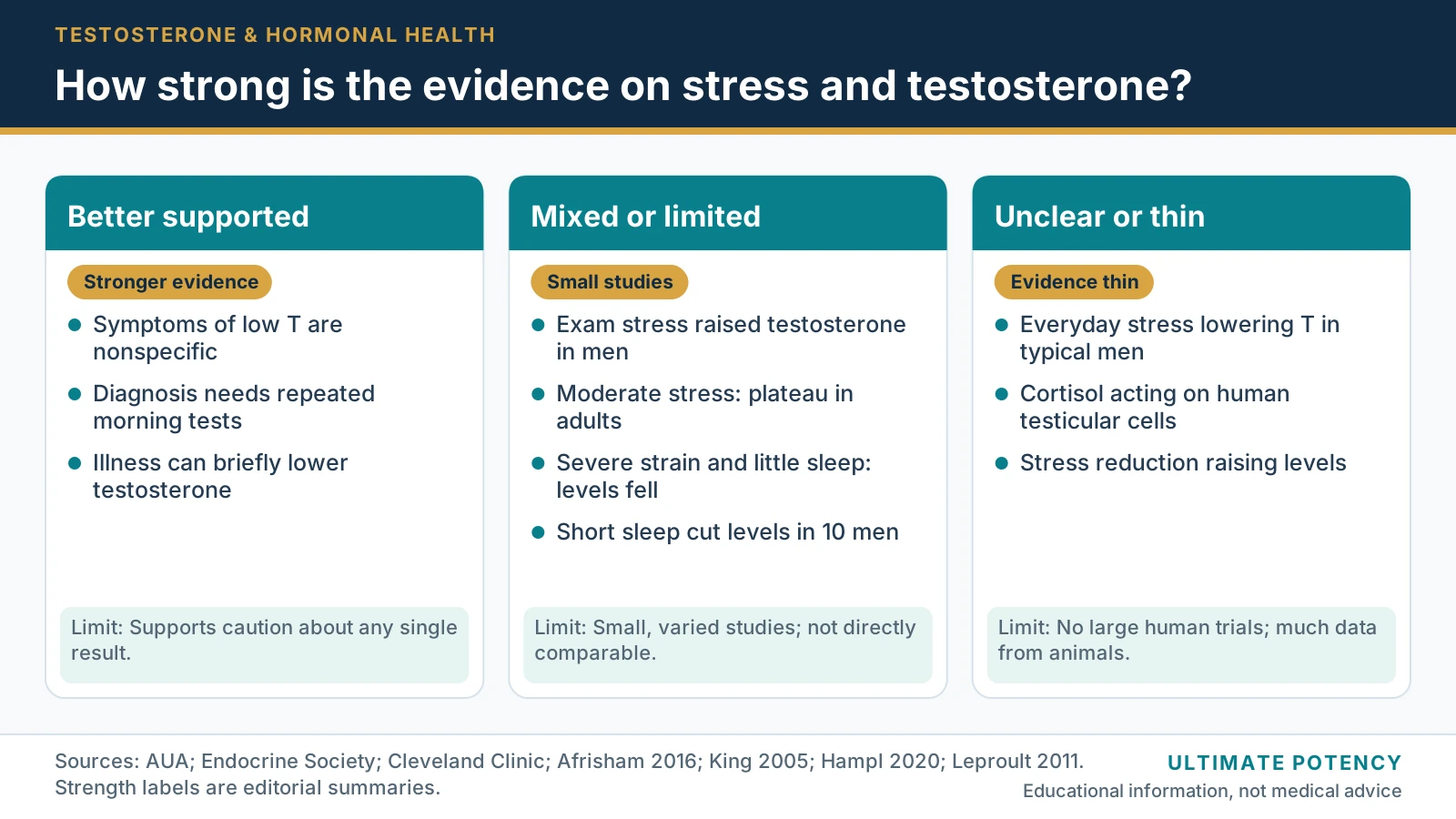
Text version: Better supported: symptoms of low T are nonspecific, diagnosis needs repeated morning tests, and illness can briefly lower testosterone. Mixed or limited: exam stress raised testosterone in men, moderate stress showed a plateau, severe strain with little sleep lowered levels, and short sleep cut levels in ten men. Unclear: everyday stress in typical men, cortisol acting on human testicular cells, and whether reducing stress raises levels.
Where the Evidence Is Thin
Several gaps are worth naming. There are no large trials that assign men to chronic stress and then measure testosterone, which would be neither practical nor ethical. Studies use different stress measures, from exam day to questionnaires to military training, so their results can’t be pooled neatly. Saliva and blood measurements aren’t interchangeable, and the time of day can change a result. Cause and effect can also run backward, since a man who feels unwell because of low hormones may become more stressed. Finally, stress rarely arrives alone: it often travels with poor sleep, extra alcohol, and less exercise, so it’s hard to know which piece is doing the work. The fair summary is “plausible, inconsistent, and unproven for everyday stress.” None of that makes the research useless. It means honest answers often begin with “it depends,” which is a good reason to bring a clinician into the picture.
Overlapping Contributors
Many of the factors that can lower testosterone also feed on stress. That overlap is one reason cause and effect are hard to untangle, and one reason treating a single contributor can help in several ways at once.
Sleep, Weight, and Illness
Cleveland Clinic advises getting enough sleep and treating sleep apnea if you have it, and it says most men with low-testosterone symptoms usually have an underlying issue from obesity or diabetes. It also states that being sick can briefly stop testosterone production and asks you to tell your provider if you were ill around the time of testing. The Endocrine Society statement says that when low testosterone goes along with obesity, defined there as a body mass index above 27, and no other cause is found, weight loss is typically the first-line approach. Stress can push weight, blood sugar, and sleep in the wrong direction, which is one reason the topics link up. For deeper reading, see our guides on low testosterone and sleep apnea, low testosterone and diabetes, and obesity and low testosterone.
This table pairs things you might notice with a useful question to raise at an appointment; it is a conversation aid, not a way to diagnose yourself.
| If you notice | A useful question to ask | Information worth bringing |
|---|---|---|
| Months of short or broken sleep, or loud snoring | Could poor sleep or sleep apnea be affecting my energy and drive? | Usual bed and wake times, snoring or gasping noted by a partner |
| Lower sex drive or weaker erections during a high-pressure stretch | Which of these changes might be stress-related, and which call for testing? | A timeline of changes and what else was going on |
| A recent illness, surgery, or hospital stay | Should testing wait until I have recovered? | Dates of the illness and any medicines used |
| Weight gain or rising blood sugar | Could weight or metabolic health be part of this? | Recent weight changes and any earlier lab results |
| A steroid, opioid, or other new medicine | Could my medication be contributing? | Every prescription, over-the-counter product, and supplement |
| Constant worry or low mood on most days | Should my mood and anxiety be evaluated on their own? | When it began and how it affects work and relationships |
Sources: Cleveland Clinic, Low Testosterone (updated February 2026); Endocrine Society statement (July 2026); AUA guideline; NIMH. Editorial decision aid.
Medications, Cortisol Disorders, and Substances
Some contributors are medical rather than situational. The Endocrine Society statement names corticosteroids and opioids among medication-related causes that should be considered before a diagnosis, and Cleveland Clinic also lists anabolic steroid use. Cleveland Clinic includes Cushing syndrome, a condition of too much cortisol, among acquired causes of secondary hypogonadism. This is different from everyday stress: MedlinePlus explains that a cortisol test is used to diagnose or rule out conditions that cause too much or too little cortisol, such as Cushing syndrome and adrenal insufficiency, and it does not describe the test as a measure of day-to-day stress. Never stop or change a prescribed medicine on your own because of something you read. Some medicines are essential, and stopping them suddenly can be harmful. A clinician or pharmacist can review whether a drug is likely to matter and what alternatives exist.
Testing and Results
A blood test is the only way to measure testosterone, but it answers a narrower question than most people expect. This section explains how testing is done, how to read a result without overreading it, and what to do when a number arrives during a rough patch or comes back borderline.
What Testing Can Tell You
Testing is a tool for clinicians to confirm or rule out a hormone problem. It was never meant to measure how stressed you are, and the way a test is done matters as much as the number it produces.
Symptoms Plus Repeated Morning Blood Tests
The Endocrine Society statement says diagnosing low testosterone requires symptoms of decreased testosterone plus consistently low, accurately measured blood levels of total and free testosterone. It recommends at least two early-morning tests, with a commonly used threshold near 300 ng/dL, and it favors assays certified by the CDC’s hormone standardization program because uncertified methods can give different answers on the same sample. Cleveland Clinic similarly says the total testosterone test usually requires two separate morning blood samples. MedlinePlus adds that blood is typically drawn between 7 and 10 in the morning, that you may need to fast for several hours in some cases, and that you should tell your provider about everything you take without stopping any medicine unless told to. Your lab’s instructions come first. For the practical details, see our guide to the morning testosterone blood test.
Reading a Result Without Overreading It
A single number can feel like a verdict, but it’s one piece of information. MedlinePlus states plainly that a testosterone level test alone can’t diagnose a condition, and that its meaning depends on which test was done, your age, your symptoms, and other results. It also notes that testosterone normally declines with age, so an abnormal result doesn’t always require treatment. Labs report in different units, usually ng/dL or nmol/L, and different labs may use different reference ranges, so a number copied from one report into a forum thread rarely compares cleanly. The 300 ng/dL figure in the Endocrine Society statement is a commonly used threshold in a professional document, not a personal cutoff for you. Also keep in mind that no testosterone result tells you how much stress you carry. A normal result doesn’t mean your stress is imaginary, and a low one doesn’t mean stress caused it.
Stress, Illness, and Borderline Results
Real people get tested at imperfect moments. This subsection covers how a stressful period or an illness can complicate a result, and what follow-up usually looks like when the answer isn’t clear.
Results During a Stressful Stretch
Timing can matter. Cleveland Clinic notes that being sick can briefly stop testosterone production and recommends telling your provider if you were ill during testing, and the small JAMA sleep study showed that a week of short sleep can shift levels in healthy young men. Together those findings suggest that a test taken in the middle of a crisis may not represent your usual level. Consider a hypothetical situation: a man gets a single low morning result during a week when he had the flu, a deadline, and three nights of poor sleep. A reasonable conversation might include whether to repeat the test after he has recovered and slept normally, rather than reading the first number as a final answer. Don’t delay care for worrying symptoms to wait for a “perfect” week, though. Ask your clinician how to balance timing against the need for answers, and let them decide when a repeat is useful.
Following Up on Low or Borderline Results
If results are low or borderline, the next questions are about why. Cleveland Clinic describes a luteinizing hormone (LH) blood test, which helps show whether the pituitary gland is involved, and a prolactin test, which checks for high levels that can signal pituitary problems. The Endocrine Society statement says providers should first rule out reversible contributors such as obesity and medications, and that symptoms alone are not diagnostic. A repeat measurement, a medication review, a sleep evaluation, and a conversation about mood often come before any treatment discussion. If you and a partner hope to have children, tell your clinician before any hormone treatment is considered, because some treatments can lower sperm production. A borderline number can mean “watch and recheck,” not “something is wrong.” Ask what will happen next, who will contact you, and what would change the plan.
Managing Stress and Supporting Health
Whether or not a hormone problem turns up, stress is worth taking seriously on its own terms. This section covers everyday habits, professional support, and why testosterone treatment isn’t a shortcut for stress.
Everyday Strategies
Habits won’t solve every cause of stress, and nothing here has been shown to raise testosterone in men with stress. They still make sense because they support sleep, mood, and general health.
Stress-Management Habits With Realistic Limits
NIMH suggests a handful of practical steps: keeping a journal, using relaxation or mindfulness exercises such as deep breathing, exercising, eating regular healthy meals, keeping a consistent sleep routine, limiting excess caffeine, challenging unhelpful thoughts, and leaning on friends or family who help you cope in a positive way. These are reasonable first steps, and they’re low-risk for most people, though anyone with a medical condition should check with a clinician before making major changes to exercise or diet. Be careful about promises, though. None of the sources we reviewed shows that a specific relaxation technique raises testosterone, and anyone who claims a guaranteed hormone boost is going beyond the evidence. Try judging habits by whether you sleep better, feel calmer, and function more easily. Those are real benefits whatever your lab report says, and they’re a good way to take the pressure off while you gather information.
Sleep, Activity, and Weight
Sleep, movement, and weight keep showing up in the evidence for good reasons. Cleveland Clinic recommends getting enough sleep and treating sleep apnea if present as ways to help keep testosterone levels normal. The Endocrine Society statement describes weight loss as typically first-line therapy for low testosterone linked to obesity with no other identified cause. The laboratory work by Leproult and Van Cauter suggests that even short-term sleep loss can lower daytime testosterone in healthy young men, although it can’t tell us about long-term effects in the wider population. Physical activity is on NIMH’s list of coping tools too. A rule of thumb: pick one change you can keep, such as a steady bedtime, rather than overhauling everything at once. If you snore loudly, wake unrefreshed, or have gained weight quickly, ask about evaluation, because treating those conditions may help your mood, energy, and hormones together.
Professional Support and Treatment
Some stress needs more than habit changes. This subsection covers mental health care and explains why testosterone treatment is a separate medical decision with its own risks.
Talking Therapy and Mental Health Care
If stress or worry is getting in the way of work, relationships, or sleep, NIMH says it may be time to talk to a professional. It names psychotherapy and medication as the two main treatments for anxiety, often used together. A primary care clinician is a good first stop because they can screen for depression and anxiety, review your medicines, and refer you to a therapist or psychiatrist. Talk therapy has no hormonal side effects to monitor, and many men find that simply naming what’s going on helps. If sexual changes are part of the picture, a therapist who works with sexual health or couples can be especially useful. There’s no shame in asking for this kind of help. Support for stress is health care, the same as any other, and it deserves the same seriousness as a lab test. In a crisis, call or text 988.
Why Testosterone Therapy Is Not a Stress Fix
Testosterone therapy is a prescription medical treatment for diagnosed deficiency, not a general remedy for stress or burnout. The FDA says testosterone products are approved for men who lack or have low testosterone along with an associated medical condition, and its February 2025 labeling update added blood pressure warnings after studies confirmed that all testosterone products raised blood pressure. The same update removed boxed-warning language on cardiovascular risk after the TRAVERSE trial, which the Endocrine Society says found no meaningful increase in heart attack or stroke over one to four years but did find about a 50 percent relative increase in pulmonary embolism and more fractures. Cleveland Clinic adds that testosterone therapy can reduce sperm production and isn’t recommended for people who want to start a family. Hormone treatment requires a confirmed diagnosis, monitoring, and a talk about fertility. For more, see our guide to TRT and fertility. Products marketed as “natural” testosterone boosters aren’t automatically safe, so show any supplement to your clinician.
Common Questions About Stress and Testosterone
These are the questions readers most often bring to this topic. The answers draw on the sources above and stay general, because only someone who knows your history can say what applies to you.
Questions About Cause and Effect
Cause and effect are the heart of the matter, and they can run in both directions. The first answer looks at stress as a cause, and the second looks at the reverse.
Can Stress Alone Cause Low Testosterone?
The evidence doesn’t establish that. Small studies of short-term stress in men have found testosterone rising in some settings rather than falling, and the strongest signs of a drop come from extreme situations, such as days of severe physical strain with little sleep or food. Major clinical references like Mayo Clinic and Cleveland Clinic list other causes of low testosterone, including pituitary and testicular problems, obesity, sleep apnea, certain medicines, and Cushing syndrome. It’s plausible that long stretches of stress contribute alongside poor sleep, illness, or weight changes, but that is a hypothesis, not a diagnosis. If you have symptoms and a confirmed low level, a clinician will look for a cause rather than stopping at “stress.” If you’re simply under pressure and your symptoms are mild, a conversation about sleep, mood, and health habits may be the more useful starting point.
Can Low Testosterone Make Stress Feel Worse?
Possibly, and that is part of why the topic is tangled. Mayo Clinic lists less energy and depression among the early adult symptoms of low testosterone, and a man who feels tired, low, and unmotivated may well find ordinary demands harder to manage. The AUA also lists chronic fatigue and a depressed state as nonspecific symptoms that can be attributed to other conditions, which means the experience of feeling overwhelmed can come from many sources at once. If a hormone problem is confirmed and treated, some men notice changes in energy or mood, but results vary and the evidence is mixed, as we describe in our guide to low testosterone and mood. Feeling stressed is a reason to look at the whole picture, not a reason to assume your hormones are the culprit. A clinician can help sort out which of your symptoms are likely linked to each other.
Questions About Testing and Care
Practical questions come next: which tests make sense, and what changes if you reduce stress. The answers below stay careful about what the evidence can support.
Should I Ask for a Cortisol Test Too?
It depends on what your clinician suspects, and it’s worth asking rather than assuming. According to MedlinePlus, clinicians order cortisol tests when they suspect the body is making too much or too little of the hormone, as in Cushing syndrome or adrenal insufficiency, including Addison disease. It doesn’t present the test as a measure of everyday stress, and it notes that stress and exercise can raise cortisol levels, so you may be asked to rest before a sample and to have blood drawn at set times of day. That means a cortisol number taken on a hectic morning might say more about the morning than about your long-term stress. If you have symptoms that suggest an adrenal problem, your clinician may well order one. Ask what question the test is meant to answer and how the result would change your care before agreeing to extra testing.
Will Lowering Stress Raise My Number?
Nobody can promise that. None of the sources we reviewed shows that reducing everyday stress raises testosterone in men, and the research on stress and testosterone is too mixed to predict what would happen for you. What is better supported is that good sleep, a healthy weight, and treating conditions like sleep apnea are associated with healthier testosterone levels, as Cleveland Clinic and the Endocrine Society note. Lowering stress may also make those habits easier to keep. So it’s reasonable to work on stress for its own benefits, such as better sleep, mood, and focus, while staying open to testing if symptoms persist. Treat any hormone change as a possible bonus, not the goal. If your symptoms don’t improve as your life calms down, that’s useful information to share with your clinician, not a personal failure.
Your Next Steps
Good preparation turns a short appointment into a productive one. This section shows how to organize your observations, what to ask, and how to make decisions with a clinician without assuming the answer ahead of time.
Preparing for Care
A little organization up front helps a busy clinician see your situation clearly, and it helps you remember what you meant to ask.
Questions About Stress and Testosterone
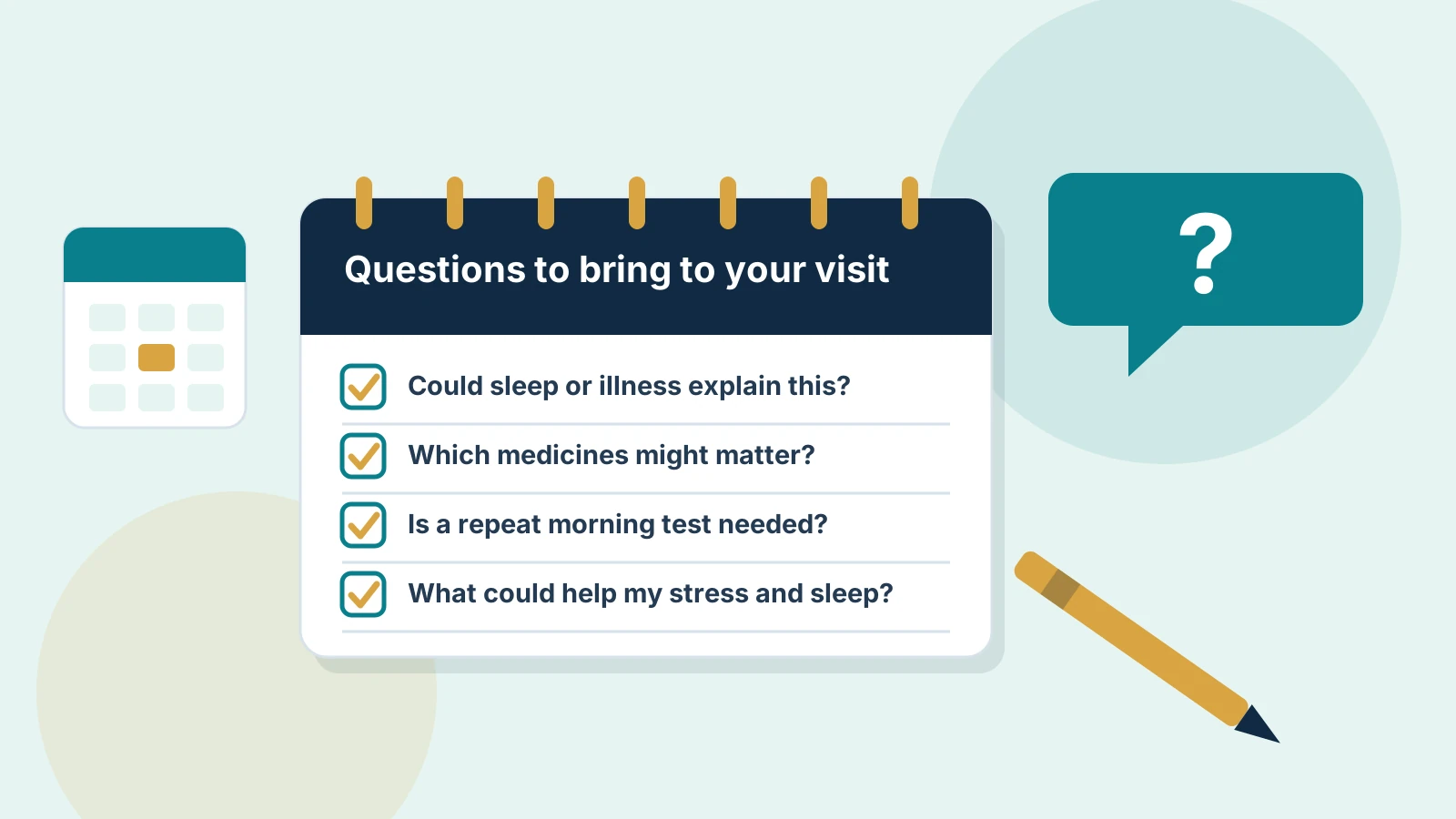
Write your questions down before you go, and put the most important ones first. Useful starters include: Could something other than testosterone explain how I feel? Does my symptom pattern justify blood testing, and how many morning samples are needed? Could stress, sleep, weight, or illness have affected the timing of my results? Could any of my medications or supplements be contributing? Should my mood or anxiety be evaluated on its own? If a result is low, what further tests would help find the cause, and what are the benefits, risks, and fertility effects of any treatment? Clinicians appreciate direct questions, and asking them is part of being an active partner in your care. The checklist below summarizes the preparation steps, and it is a planning aid rather than a way to diagnose yourself.
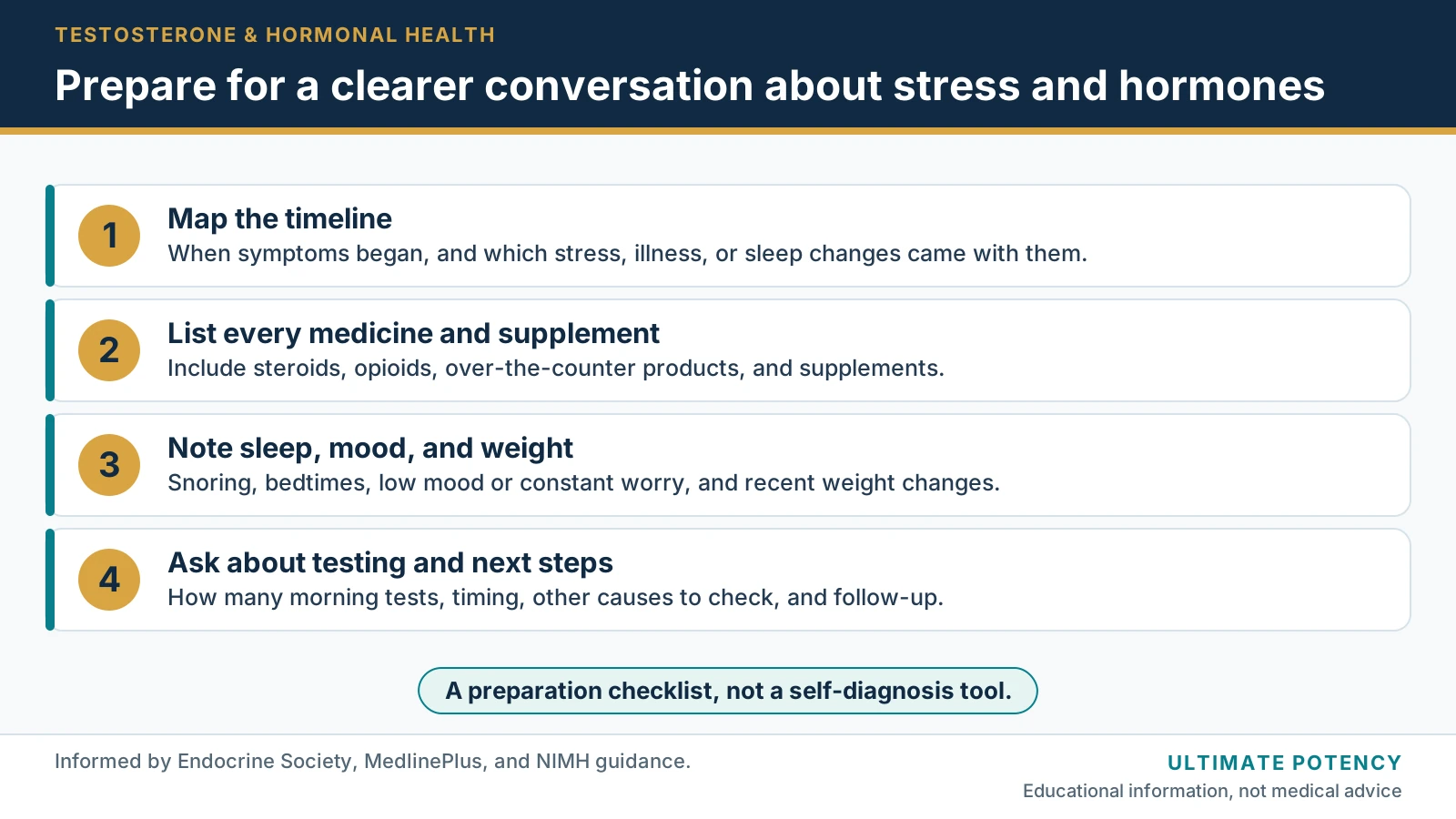
Text version: Step 1: map the timeline of symptoms and life changes. Step 2: list every medicine and supplement. Step 3: note sleep, mood, and weight. Step 4: ask about testing, timing, other causes, and follow-up.
Information to Bring
Bring specifics, because specifics make guessing unnecessary. A short written timeline helps: when your symptoms began, how often they happen, what makes them better or worse, and what else changed around then, such as a new job, a move, a breakup, or a new medicine. Stress tends to blur the calendar, so dates written down in the moment are far more reliable than memory. Rough notes on your phone work fine, and nothing needs to be polished. The table below shows what to note and why each item helps, and you can adapt it to your own situation.
This table lists items worth gathering before a visit about stress and testosterone, with a reason for each.
| What to note | Why it helps | What to bring up |
|---|---|---|
| Timeline of symptoms | Shows whether changes track a stressful period or began earlier | When it started, how often, what changed |
| Sleep pattern and snoring | Sleep loss and sleep apnea can overlap with stress and low T | Bed and wake times, snoring, daytime sleepiness |
| Every medicine and supplement | Some medicines affect hormones and test results | Prescription, over-the-counter, and supplement names |
| Recent illness or surgery | Being sick can briefly lower testosterone | Dates and any treatment received |
| Mood and anxiety changes | Mental health care may be needed regardless of labs | How you feel most days and how it affects daily life |
| Earlier lab results | Allows comparison and avoids repeating tests | Dates, lab name, and units if you have them |
Sources: Endocrine Society statement (July 2026); MedlinePlus, Testosterone Levels Test; Cleveland Clinic, Low Testosterone. Editorial preparation aid.
Also write down your typical alcohol and caffeine use and any recent weight changes, since a clinician will want to see the whole picture. If a partner or friend has noticed changes you can’t see, such as restless sleep, snoring, or a shift in your mood, their observations can fill gaps and are worth bringing along. You don’t have to share anything about your sex life that you’re not comfortable with, but the more context you can offer, the easier it is to work out which questions come first.
Making Decisions With Your Clinician
Once the information is on the table, decisions become easier to make together. The goal is a plan that fits your health, your priorities, and your tolerance for trade-offs.
Weighing Benefits, Risks, and Practical Fit
Any option, whether better sleep, talk therapy, a medication, or testosterone therapy, comes with benefits, risks, and practical considerations such as time, cost, and follow-up visits. It helps to ask what outcome you’re hoping for and how you will recognize it. For testosterone therapy in particular, the questions worth raising include whether your diagnosis is confirmed, what monitoring is required, how treatment could affect fertility and blood pressure, and what happens if your symptoms don’t improve. The Endocrine Society statement and the FDA labeling update both underline that benefits and risks need to be weighed individually. Take the time you need, and it’s fine to ask for a second opinion. A good plan may include more than one approach, such as improving sleep, starting talk therapy, and repeating labs, while you decide whether anything more is needed.
Agreeing on a Follow-Up Plan
Follow-up is where the plan meets real life. Ask how soon you should check back, what changes would be worth reporting sooner, and who to call if symptoms worsen. If tests were ordered, ask how results will reach you and whether a repeat is planned. If you start any treatment, agree on how you’ll both judge whether it’s working, such as changes in sleep, energy, mood, or sexual function, and keep a brief log between visits because memory flattens the details. Call or text 988 right away if you have thoughts of harming yourself, and seek urgent care for any new, severe, or alarming symptoms. Whatever the outcome, you’re gathering information to make better choices, and that is progress even when the answer is still “not yet.”
Sources
- Statement on Testosterone Replacement Therapy. Endocrine Society. July 16, 2026. Checked 2026-10-16.
- Low Testosterone (Male Hypogonadism). Cleveland Clinic. Last updated February 23, 2026. Checked 2026-10-16.
- Male hypogonadism: Symptoms and causes. Mayo Clinic. Published September 20, 2024. Checked 2026-10-16.
- Evaluation and Management of Testosterone Deficiency (2024). American Urological Association. Published 2018; validity confirmed 2024. Checked 2026-10-16.
- Testosterone Levels Test. MedlinePlus (NIH). Last updated June 5, 2025. Checked 2026-10-16.
- Cortisol Test. MedlinePlus (NIH). Last updated December 23, 2024. Checked 2026-10-16.
- I'm So Stressed Out! Fact Sheet. National Institute of Mental Health. No review date shown (NIH Publication No. 20-MH-8125). Checked 2026-10-16.
- Stress effects on the body. American Psychological Association. Last reviewed October 21, 2024. Checked 2026-10-16.
- FDA issues class-wide labeling changes for testosterone products. U.S. Food and Drug Administration. February 28, 2025. Checked 2026-10-16.
- Glucocorticoids Affect Male Testicular Steroidogenesis. Physiological Research (Hampl and Starka). 2020; 69 (Suppl. 2): S205-S210. Checked 2026-10-16.
- Salivary Testosterone Levels Under Psychological Stress and Its Relationship with Rumination and Five Personality Traits in Medical Students. Psychiatry Investigation (via PubMed Central). 2016; 13(6): 637-643. Checked 2026-10-16.
- Association of stress, hostility and plasma testosterone levels. Neuroendocrinology Letters (King et al.). 2005; 26(4): 355-360. Checked 2026-10-16.
- Chronic noise exposure and testosterone deficiency: meta-analysis and meta-regression of experimental studies in rodents. Endokrynologia Polska (Dzhambov and Dimitrova). 2015; 66(1): 39-46. Checked 2026-10-16.
- Effect of 1 Week of Sleep Restriction on Testosterone Levels in Young Healthy Men. JAMA (Leproult and Van Cauter), CDC Stacks copy. 2011; 305(21): 2173-2174. Checked 2026-10-16.
- Low Testosterone and Fertility. Cleveland Clinic Health Essentials. Published August 29, 2022. Checked 2026-10-16.
Ultimate Potency is an educational publication. It does not diagnose, prescribe, or provide medical care. This article does not replace advice from a licensed healthcare professional who knows your history.