If you’ve been handed a lab report where SHBG is flagged low and testosterone looks low, borderline, or confusing, you’re not alone in wondering what to make of it. Low SHBG and testosterone results often show up side by side, and the two numbers pull on each other in ways that aren’t obvious at first glance. SHBG stands for sex hormone-binding globulin, a protein that attaches to sex hormones such as testosterone. When there’s less of it, the math behind your total testosterone changes, and so does the question your clinician needs to answer.
This guide focuses on that overlap. It explains how to read the pieces of a report, what can sit behind a low SHBG, why symptoms and numbers don’t always agree, and which questions are worth bringing to an appointment. It can’t tell you what your results mean, because that depends on your history, your symptoms, and repeat testing. For the wider hormone picture, see our guide to low testosterone symptoms. If your report shows the opposite pattern, with SHBG running high, the article on high SHBG and low free testosterone covers that side of the coin.
A quick word on tone. A hormone result says nothing about your worth, your masculinity, or your relationship. It’s one piece of health information, and the most useful response is calm curiosity rather than alarm.
Understanding Low SHBG and Testosterone Results
Before the numbers make sense, the vocabulary has to. People say “low T,” “free T,” and “SHBG” as if everyone shares the same definitions, and online articles often blur them together. This section sets out what each term means, how the pieces fit, and why a low SHBG changes how a testosterone result should be read.
Key Concepts
This subsection separates the main players on your report: the carrier protein, the total amount of hormone, and the portion your tissues can use. Once those are clear, the rest of the article is much easier to follow.
What Low SHBG and Testosterone Results Means
SHBG is a protein in your blood that attaches to sex hormones, including testosterone and estrogen. MedlinePlus explains that when SHBG is low, more of your total testosterone is likely free and available for your body to use. That’s the heart of the matter. A low SHBG result describes the carrier, not the cargo, so it can’t tell you on its own whether your testosterone is low, normal, or high.
When people search for low SHBG and testosterone results, they usually mean one of two situations. Either the SHBG is flagged low while total testosterone is also low or borderline, or the SHBG is flagged low and they want to know whether that’s good, bad, or neutral. The honest answer is that it depends on the full report and on how you feel. A clinician reads SHBG as context for testosterone, and as a possible clue about other health factors such as insulin sensitivity or thyroid function.
This table puts the main terms from a testosterone and SHBG report into plain language, with the misunderstanding that tends to go with each one.
| Term | Plain-language meaning | Common misunderstanding |
|---|---|---|
| SHBG | A carrier protein that attaches to testosterone and other sex hormones | That low SHBG automatically means low testosterone |
| Total testosterone | Bound plus free testosterone together | That it shows exactly how much your body can use |
| Free testosterone | The unattached portion that tissues can use more readily | That it is always measured directly on a routine panel |
| Bioavailable testosterone | Free testosterone plus testosterone loosely bound to proteins other than SHBG | That it is the same thing as free testosterone |
| Hypogonadism (“low T”) | A clinical diagnosis based on symptoms plus repeated, accurate low results | That one low number settles it |
Sources: MedlinePlus (SHBG and testosterone tests). Definitions are simplified; labs and clinicians may use slightly different terms.
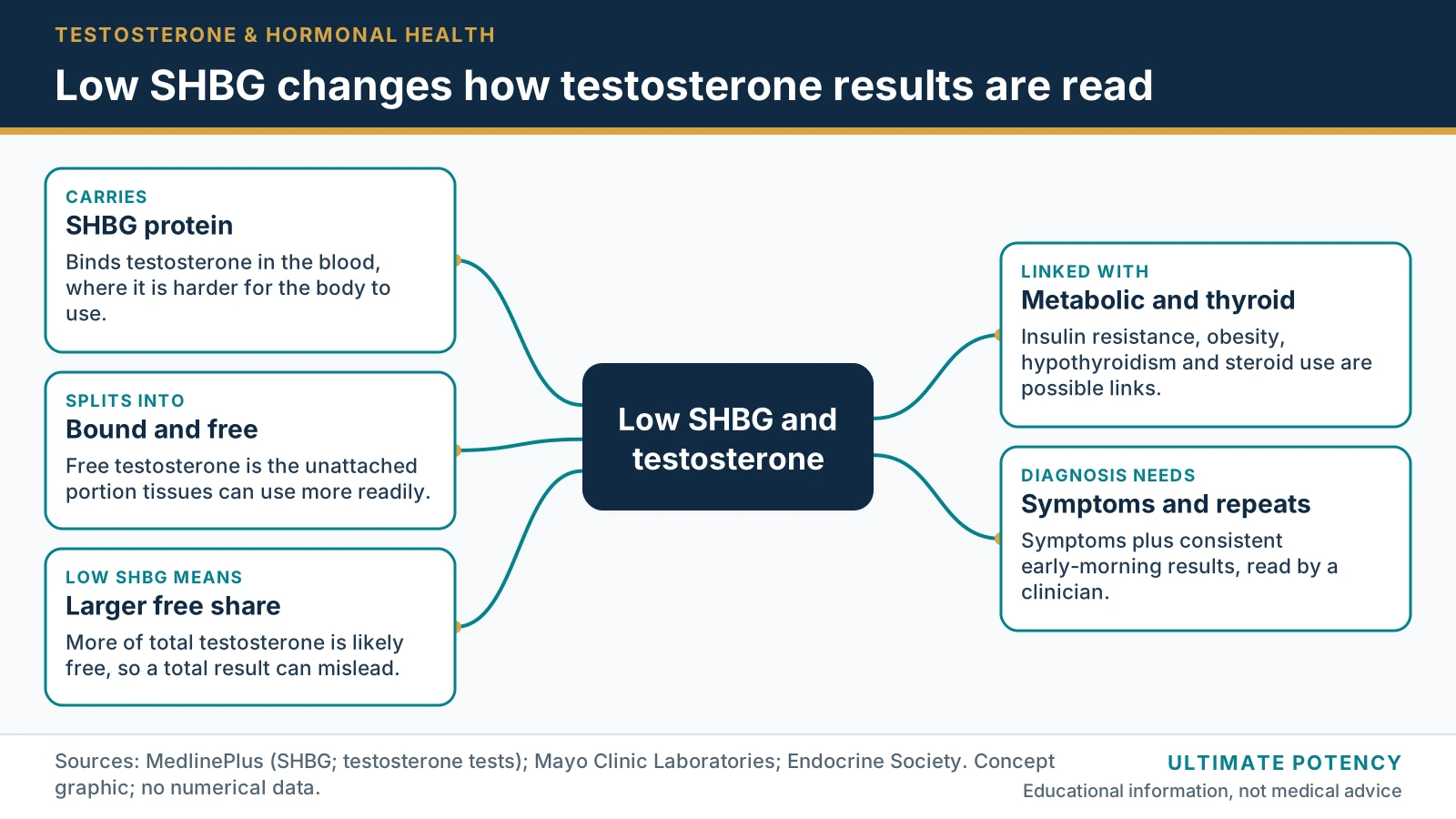
Text version: Low SHBG and testosterone connect to five ideas. SHBG protein carries testosterone in the blood. Testosterone splits into bound and free portions. Low SHBG means a larger free share. Low SHBG is linked with metabolic and thyroid factors. Diagnosis needs symptoms and repeat testing, read by a clinician.
Total, Free, and Bound Testosterone
Most testosterone in your blood travels attached to proteins, mainly SHBG and albumin, according to MedlinePlus. Bound testosterone is harder for your body to use. The remaining free portion is more available to tissues, which is why clinicians sometimes care about it as well as the total.
Think of total testosterone as everyone in a stadium, and free testosterone as the people actually standing at the gates. A routine total testosterone test counts the whole crowd. A free testosterone test looks at the unattached group only and is less common. MedlinePlus also describes bioavailable testosterone, which adds testosterone bound to proteins other than SHBG, and notes that it too is ordered less often.
Why does this matter for low SHBG? Because the fractions shift. With less SHBG on hand, a different share of the testosterone is unattached, so the same total number can mean something different than it would with typical SHBG. That’s the reason professional guidance points clinicians toward free testosterone measurement in some situations, which later sections cover in more detail.
Why Low SHBG Changes the Picture
This subsection looks at how a carrier protein can bend the interpretation of a hormone number, and why you can find confident but conflicting explanations online.
When a Low Total Number Can Mislead
The 2018 Endocrine Society guideline advises measuring free testosterone when total testosterone sits near the lower limit of normal or when SHBG is altered. The reasoning is straightforward. Your body regulates how much testosterone is free, and SHBG is one of the things that sets the balance between bound and free. If SHBG is low, a person can have a total testosterone that looks modest on paper while the free fraction is doing better than the total suggests.
That doesn’t mean a low total is always a false alarm. Some men with low SHBG have low free testosterone too, and some have symptoms that deserve attention either way. The point is narrower: a total testosterone result can’t be judged in isolation when SHBG is off. A clinician may want a free testosterone measurement, a repeat test, or other labs before deciding anything.
Here’s a rule of thumb that holds up well. Treat a low SHBG as a reason to look at more information, not as a reason to either relax or worry. It’s a flag that the interpretation needs one more step, and that step belongs to someone who has your whole record in front of them.
Why Online Explanations Disagree
If you’ve read several pages about low SHBG, you’ve probably noticed they don’t agree. Some say low SHBG is good news because more testosterone is free. Others warn that it signals metabolic trouble. A few list long symptom lists that read like a catalog of everything men worry about. They’re each describing a different piece of a larger picture.
Here’s a fair way to sort them. The statement that low SHBG leaves more testosterone free is supported by MedlinePlus. The statement that low SHBG is often linked with insulin resistance is supported by the laboratory interpretation notes at Mayo Clinic Laboratories. Neither statement tells you about your own body. Consumer pages, including some telehealth and supplement-adjacent ones, often add symptom claims or “fixes” that go beyond what the primary sources say.
When a page promises that one number explains your fatigue, your mood, and your sex drive, treat that as a signal to slow down. Good sources describe a pattern, state its limits, and point you toward testing and a clinician. If a page mostly sells a product, it’s a benchmark for what people are searching, not a guide to your health.
Reading Your Lab Report
A hormone report can look like a wall of abbreviations. This section walks through what each line usually represents, how free testosterone is arrived at, why timing matters, and what to do with reference ranges that differ from one lab to another.
What the Tests Measure
Here we look at the specific measurements that tend to appear together on a testosterone and SHBG panel and what each one adds.
Total Testosterone and SHBG on One Report
On a typical order, total testosterone is the starting point. It’s the most common test and measures both bound and free forms, as MedlinePlus notes. SHBG is then added when a clinician wants to understand how much of that total is likely to be usable, or when the total result doesn’t match your symptoms.
Read the two together rather than one at a time. A low SHBG with a low total testosterone raises a different question than a low SHBG with a normal total. In the first case, the clinician may ask whether the free fraction is also low. In the second, they may be more interested in why SHBG is low, since Mayo Clinic Laboratories describes SHBG as regulated by insulin and often lower when insulin resistance is present.
It’s also worth noticing what the report doesn’t include. A standard panel usually can’t tell you your pituitary signals, your fertility, or your cause. Those come from follow-up tests, such as luteinizing hormone, which a clinician may add. For background on how clinicians separate testicular from pituitary causes, see primary versus secondary hypogonadism.
Calculated Versus Measured Free Testosterone
Free testosterone can reach your report in two ways. One is a direct laboratory measurement, usually by a method called equilibrium dialysis, which physically separates the free portion. The other is a calculation that estimates free testosterone from total testosterone and SHBG. Mayo Clinic Laboratories notes that measuring free testosterone by equilibrium dialysis avoids needing SHBG to calculate the free fraction.
Why should you care? Because a calculated value inherits the uncertainty of the numbers feeding it. If SHBG is very low or the assay is imprecise, the estimate can wobble. A measured value has its own practical limits, including cost, availability, and turnaround time, so it isn’t always the default choice.
A useful question for your visit is simple: “Is my free testosterone calculated or measured, and which method did this lab use?” The answer helps you and your clinician decide how much weight to put on the number. It also explains why two labs can return slightly different free testosterone values for the same person. For a plain-language comparison, our guide to free versus total testosterone goes through the differences step by step.
Timing and Quality of Testing
Hormone numbers move. This subsection covers when blood should be drawn, why a single result is rarely enough, and how reference ranges and units can trip people up.
Morning, Fasting, and Repeat Testing
Testosterone is usually highest in the morning. MedlinePlus says blood is typically drawn between 7 and 10 a.m., and that fasting for several hours may be needed in some cases. The Endocrine Society’s July 2026 statement says diagnosis should rest on at least two early-morning, fasting tests, with symptoms present too.
That requirement matters for anyone looking at a low SHBG result. A single sample drawn at 3 p.m., after a poor night of sleep, during an illness, or after a heavy meal may not represent your usual level. Repeat testing under better conditions often changes the story, in either direction.
Practical habits help here. Tell the person ordering the test about your medications, supplements, and anything unusual in the past few weeks. MedlinePlus advises not stopping any medicine unless your provider tells you to, and that’s worth repeating: don’t stop a prescription on your own to prepare for a lab draw. For more on timing, the guide to the morning testosterone blood test explains why the clock matters.
Reference Ranges, Units, and Lab Differences
A reference range is the span of values a lab considers typical for its method and population. It isn’t a pass/fail line, and it differs between labs. As one example, Mayo Clinic Laboratories lists an adult male SHBG interval of 13.3 to 89.5 nmol/L for its own assay. Your lab may use a different interval, so always compare your number against the range printed on your own report.
Units trip people up as well. Testosterone is commonly reported in ng/dL or nmol/L, and SHBG in nmol/L. The Endocrine Society statement mentions a common clinical threshold near 300 ng/dL and says assays should be CDC HoST-certified because uncertified assays can vary widely. That threshold is a reference point for clinicians, not a number for self-diagnosis.
This table lists lines you may see on a report, what each tells you, what it can’t tell you, and a question to bring to your visit.
| Report line | What it can tell you | What it can’t tell you | Question to ask |
|---|---|---|---|
| Total testosterone | The combined bound and free amount at that draw | How much your tissues can use | Was this drawn early in the morning, and should it be repeated? |
| SHBG | How much carrier protein is present | Whether your testosterone is low | What might be influencing my SHBG? |
| Free testosterone | The unattached portion, by measurement or calculation | A diagnosis by itself | Was it calculated or measured, and by which method? |
| Reference range | The lab’s typical span for its assay | Whether a value is right for you | Is this range specific to this lab and method? |
Sources: MedlinePlus; Mayo Clinic Laboratories; Endocrine Society. A reading aid, not an interpretation of your results.
What Can Sit Behind a Low SHBG
A low SHBG rarely arrives alone. It tends to travel with other health factors, which is why clinicians treat it as a prompt to look wider. This section reviews the contributors that reputable sources connect with low SHBG, and it keeps the limits of that evidence in view.
Metabolic Contributors
This subsection covers the factors tied to how your body handles insulin, weight, and fat, which are the most commonly mentioned links.
Insulin Resistance and Type 2 Diabetes
MedlinePlus lists type 2 diabetes and insulin resistance among the conditions that can be linked with low SHBG. Mayo Clinic Laboratories goes a step further in its interpretation notes: SHBG is regulated by insulin, low levels often suggest insulin resistance, and low SHBG may predict type 2 diabetes. The same page adds that this use is described particularly in women, so it shouldn’t be stretched into a screening rule for men.
What does that mean for you? A low SHBG can be a nudge to ask about blood sugar, not a diagnosis of diabetes. Clinicians have direct tools for that question, such as fasting glucose or hemoglobin A1c testing, and those answer it far better than SHBG can.
The link also runs in more than one direction in everyday life. Diabetes and low testosterone are often discussed together, and each can make the other harder to untangle. Our guide to low testosterone and diabetes explores that overlap in depth. For this article, the practical takeaway is modest: if your SHBG is low, ask whether metabolic health has been checked recently, and don’t assume the answer.
Body Weight and Fatty Liver
Obesity appears on the MedlinePlus list of possible links with low SHBG, and the consumer health site Healthline also lists nonalcoholic fatty liver disease. Neither page claims that weight or liver fat is the cause in every case. They describe associations, and associations are not the same as proof that one thing drives the other.
Body weight also matters from the testosterone side. The Endocrine Society’s 2026 statement names obesity as one of the reversible contributors clinicians should consider before settling on a low testosterone diagnosis. That means weight can touch both numbers on your report at once, which is part of why the combination of low SHBG and low or borderline testosterone is common.
None of this is a verdict on your habits. Weight, liver health, sleep, and blood sugar are tangled together, and genetics play a role too. A clinician can sort out which pieces apply to you, using your exam and labs rather than assumptions. If you want a closer look at the weight and hormone connection, bring it up directly, and ask whether any liver or metabolic testing makes sense for you.
Hormone and Medication Contributors
This subsection turns to thyroid and other hormone conditions, then to medicines and supplements, which clinicians always want to hear about when SHBG looks off.
Thyroid and Other Hormone Conditions
Thyroid hormones influence SHBG. MedlinePlus lists hypothyroidism, an underactive thyroid, among possible links with low SHBG. Mayo Clinic Laboratories notes the reverse pattern as well: thyrotoxicosis, meaning too much thyroid hormone, and estrogens raise SHBG. So thyroid status can push SHBG either way, depending on the condition.
MedlinePlus also names Cushing’s syndrome, a condition of prolonged excess cortisol, in its list. Healthline adds acromegaly, a growth hormone excess condition, though that page is a secondary source and these are rarer explanations. The common thread is that endocrine conditions can move several hormones at once.
For a reader, the useful step is not to guess which one might apply. Instead, ask whether thyroid testing has been done and whether other hormone tests are warranted given your symptoms. Our article on thyroid problems and testosterone explains how thyroid conditions can overlap with testosterone concerns. A clinician decides which tests fit your situation, and a pattern across several labs is more informative than any single abnormal flag.
Medicines, Steroids, and Supplements
MedlinePlus lists steroid overuse among possible links with low SHBG, and Healthline mentions androgen steroid use. Anabolic steroid use, in particular, can distort several hormone measurements at once, which is why clinicians ask about it plainly. Being open helps them read your labs correctly, and the question isn’t a judgment.
Medicines can also influence testosterone itself. The Endocrine Society statement names corticosteroids and opioids as examples of reversible contributors to consider before diagnosing low testosterone. That’s a statement about testosterone, not SHBG, so keep the two ideas separate. Some medicines may affect one, the other, or both, and the details depend on the specific drug.
Supplements deserve the same honesty. Bring the bottle or a photo of the label to your appointment, including protein powders, “testosterone support” blends, and anything marketed for hormones. Natural doesn’t mean risk-free, and supplement labels don’t always tell you what matters for interpreting a blood test. A clinician or pharmacist can review your full list for anything that may matter.
Symptoms and Why Numbers Are Not Enough
Symptoms bring most people to a lab in the first place. This section looks at which symptoms overlap, what claims about low SHBG symptoms the primary sources don’t support, and why a number and a symptom can disagree.
Symptoms That Overlap
This subsection sorts everyday complaints into what the sources actually connect to testosterone and SHBG testing, and what they don’t.
Desire, Erections, and Energy
MedlinePlus says men are often tested for symptoms such as reduced sex drive, trouble getting an erection, fatigue or muscle loss, and fertility problems. Its testosterone test page lists a similar set and adds enlarged breasts, reduced body hair, unexplained bone thinning, and anemia. Notice what that list is: reasons clinicians order tests, not features that prove a hormone problem.
Every item on it has other common explanations. Poor sleep, stress, low mood, relationship strain, alcohol, medicines, heart and blood vessel health, and thyroid conditions can all change desire, erections, and energy. A symptom that is real and bothersome still deserves attention even when a hormone isn’t the answer.
This decision aid pairs common observations with a question you could bring to a clinician, without suggesting what the cause is.
| If you notice | A useful question is | Helpful information to bring |
|---|---|---|
| Lower sex drive over several months | Could my hormones, medicines, mood, or sleep be involved? | When it changed and what else changed then |
| Trouble getting or keeping erections | Should a hormone test be part of the workup, or other checks first? | Pattern, timing, and whether morning erections still happen |
| Ongoing fatigue or less muscle | Which causes should be ruled out before attributing it to hormones? | Sleep habits, weight changes, and activity level |
| A low SHBG result with no clear symptoms | What is the next step, if any, given my symptoms and history? | Your full report and prior results for comparison |
Original decision aid based on MedlinePlus symptom and testing guidance; it is not a diagnostic tool.
For a closer look at how symptoms and hormones fit together, our guide to low testosterone symptoms covers the broader pattern. The thread running through all of it is the same: describe what you notice, in your own words, with dates if you can.
Claims About Low SHBG Symptoms
Some consumer pages attach specific symptoms to low SHBG in men, such as acne, fluid retention, appetite changes, and mood swings, on the theory that more free hormone produces effects of “too much.” Healthline is one example of a page that lists them. In the primary sources we reviewed, we did not find direct support for those symptom lists in men, so they should be read as unconfirmed.
This is an important distinction. SHBG isn’t known as a symptom marker the way a blood pressure reading is a risk marker. It describes how testosterone is packaged, and its main value is to help interpret other labs and flag possible metabolic links. A page that tells you your acne or your mood is caused by your SHBG is claiming more than the evidence can show.
If you recognize some of those symptoms, you’re allowed to bring them up. Just present them as observations rather than conclusions. “I’ve noticed these changes, and my SHBG is low. Do you think they’re related, or should we look elsewhere first?” is a better opening than “My SHBG explains everything.” The first invites a real conversation. The second can steer the visit off course.
Why Symptoms Cannot Settle the Question
This subsection explains why symptoms and lab numbers must agree before a diagnosis is made, and what happens when they don’t.
Persistent Symptoms With Reassuring Results
Consider a hypothetical situation: a man in his forties notices lower energy and less interest in sex. His report shows a low SHBG, a total testosterone within the lab’s reference range, and a free testosterone that is not clearly low. He’s relieved for about a day, then frustrated, because he still feels off.
What might a clinician do with that? A good response doesn’t dismiss his symptoms or force a hormone explanation. The Endocrine Society says symptoms alone don’t establish a low testosterone diagnosis, and that clinicians should first rule out reversible contributors. So the conversation would likely turn to sleep, stress, mood, medicines, alcohol, and metabolic health, and possibly to repeating labs if the first draw wasn’t well timed.
This is only an illustration, not advice for anyone’s real situation. The lesson is that a reassuring number doesn’t erase a real symptom, and a worrying number doesn’t prove a symptom’s cause. Both deserve a careful look. If you ever feel brushed off, it’s reasonable to ask what other explanations are being considered and what the plan is if things don’t improve.
Other Causes Clinicians Consider
When symptoms persist and hormone numbers don’t explain them, clinicians widen the net. Common areas include sleep quality, including whether sleep apnea might be present, mood and stress, medications, alcohol use, heart and blood vessel health, thyroid function, and blood sugar. Each of these can change desire, erections, energy, or mood without a testosterone problem being involved.
Hormone issues can also have causes that sit outside the testicles. The pituitary gland sends signals that tell the testicles to make testosterone, and problems there look different from problems in the testicles themselves. MedlinePlus lists testicular problems, chronic liver or kidney disease, pituitary disorders, testicular injury, alcohol use disorder, and genetic conditions such as Klinefelter syndrome among causes of low results.
That breadth is the reason a single low SHBG shouldn’t pull you toward one explanation. A methodical workup can feel slow, but it protects you from chasing the wrong answer. If you’re curious how clinicians distinguish the two main hormonal pathways, our guide to primary versus secondary hypogonadism explains the difference in plain language.
Comparing Relevant Factors
By now you have the pieces: what SHBG does, what labs measure, and what can influence both. This section weighs how strong the evidence is behind each idea, and compares the result patterns that clinicians may discuss when SHBG is low, without turning them into a self-diagnosis chart.
Evidence and Limitations
This subsection separates what the sources establish from what they leave open, so you can tell a firm statement from a plausible guess.
Association Versus Cause
Most of what is said about low SHBG is about association. A low SHBG tends to appear alongside insulin resistance, obesity, and certain hormone conditions. That’s useful for spotting patterns, but it doesn’t show that low SHBG causes those conditions, or that raising SHBG would fix them. Mayo Clinic Laboratories uses careful language: low SHBG “may” predict type 2 diabetes, and its use in assessing risk is described particularly in women.
A second limit concerns age. The sources we reviewed describe it differently: MedlinePlus says SHBG levels tend to fall with age, while Mayo’s interpretation notes refer to an age-related rise in SHBG in men. We couldn’t reconcile that from the pages themselves, so age alone is a weak guide to what your SHBG should be.
A third limit is that no source we reviewed gives a single SHBG cutoff that separates healthy from unhealthy in men. Labs publish their own intervals, and clinicians interpret results against your symptoms and other tests. When you see a page declaring one number as the line, it’s going further than the primary sources do. Treat that as marketing confidence rather than medical consensus, and ask your clinician how they weigh your specific result.
How the Evidence Applies
Here’s a practical way to apply the evidence without overreading it. Three statements are well supported by the sources we reviewed. First, low SHBG means more of the total testosterone is likely free (MedlinePlus). Second, clinicians should consider measuring free testosterone when total testosterone is near the lower limit or SHBG is altered (Endocrine Society, 2018). Third, diagnosing low testosterone requires symptoms plus consistently low, accurately measured results on repeated early-morning testing (Endocrine Society, 2026).
Other statements are weaker. Whether low SHBG itself causes particular symptoms in men is unconfirmed in the sources we reviewed. Whether deliberately changing SHBG improves symptoms or health is also not established there. The American Urological Association frames testosterone deficiency as low levels combined with associated symptoms or signs, a standard that keeps a lone SHBG flag from carrying a diagnosis.
The graphic below summarizes how those layers stack up, from firmer statements to open questions.
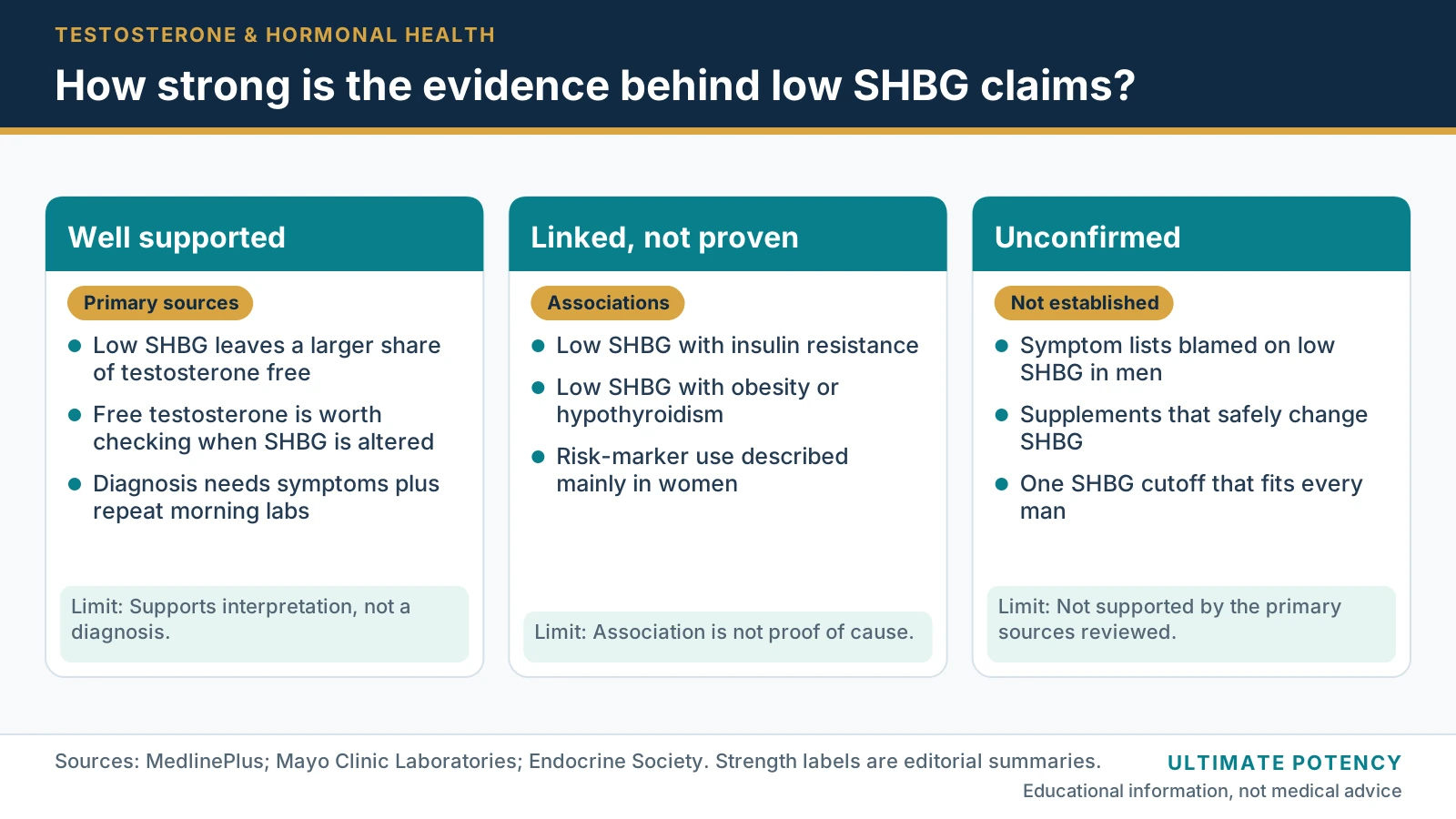
Text version: Well supported: low SHBG leaves a larger share of testosterone free; free testosterone is worth checking when SHBG is altered; diagnosis needs symptoms plus repeat morning labs. Linked, not proven: insulin resistance, obesity or hypothyroidism, and risk-marker use mainly in women. Unconfirmed: symptom lists in men, SHBG-changing supplements, and one universal cutoff.
Comparing Result Patterns
This subsection compares the combinations of results that tend to prompt different follow-up questions. They are discussion patterns, not diagnoses.
Low SHBG With Low Total Testosterone and Free Testosterone Not Clearly Low
One familiar pattern is a low SHBG, a total testosterone that is low or borderline, and a free testosterone that is normal or not clearly low. Because low SHBG means more testosterone is likely free, the total can understate what’s available. A clinician might read this as a case where the total number overstates the concern, but they would still want confirmation.
Confirmation usually means repeating the test under good conditions, per the Endocrine Society guidance, and checking how the free value was obtained. It may also mean looking at why SHBG is low, because the cause could matter more to your long-term health than the testosterone number.
This table compares three result patterns by what a clinician may consider and a question you could ask, and it is not a way to classify your own results.
| Result pattern | What a clinician may consider | A question you could ask |
|---|---|---|
| Low SHBG, low or borderline total, free not clearly low | Whether the total understates usable testosterone; repeat timing; reasons for the low SHBG | Should we repeat this early in the morning and confirm how free testosterone was found? |
| Low SHBG, low total, and low free | Whether low testosterone is confirmed; the cause; reversible contributors | What further tests would show where the problem starts? |
| Low SHBG, total in range, symptoms present | Other causes of symptoms; metabolic and thyroid review | What else could explain how I feel, and what is the plan if nothing changes? |
Sources: Endocrine Society 2018 guideline and 2026 statement; MedlinePlus; Mayo Clinic Laboratories. Illustrative discussion patterns only.
The point of the table is orientation. No row tells you what to do, and each ends with a question for your clinician because the next step depends on details a report can’t capture. Ask about the method used to arrive at the free value, since that influences how much to trust it.
Low SHBG With Low Total and Low Free Testosterone
A different pattern is a low SHBG with both total and free testosterone low. Here the SHBG doesn’t offer the same cushion. If symptoms are present and results are repeatedly low on early-morning testing, a clinician may consider whether a diagnosis of low testosterone is supported. The Endocrine Society statement describes that diagnosis as requiring both symptoms and consistently low, accurately measured total and free testosterone.
Confirming low testosterone is only the first step. The next question is why. Clinicians look for reversible contributors first, and they may check pituitary signals to see whether the problem starts in the testicles or higher up. Those answers shape what, if anything, comes next. The Endocrine Society’s 2018 guideline recommends investigating the cause of confirmed androgen deficiency instead of treating the number alone.
A low SHBG in this setting doesn’t by itself change that path, but it may point toward metabolic factors worth checking. If this is your pattern, keep the conversation open about what has been ruled out, what remains to be tested, and how fertility goals fit in. Our guide to how low testosterone is evaluated and the comparison of primary and secondary hypogonadism can help you follow the discussion.
Treatment Conversations and Safety
Once a result is confirmed and explained, the next question is often “what can be done?” This section covers the sensible first steps, why supplements aimed at SHBG deserve skepticism, and what you should know about testosterone therapy before anyone prescribes it.
Addressing Contributors First
This subsection explains why clinicians usually start with the underlying drivers of a result instead of the result itself.
Reviewing Reversible Contributors
The Endocrine Society’s 2026 statement says that symptoms alone don’t establish low testosterone, and that clinicians should first rule out reversible contributors such as obesity and medicines like corticosteroids or opioids. Healthline makes a similar point about SHBG: treatment depends on the cause, and underlying conditions come first.
In practice, this might mean reviewing blood sugar and thyroid function, looking at your medication list, and asking about alcohol, sleep, and weight changes. Some of those steps lead to treatment of a specific condition. Others lead to lifestyle conversations. A clinician should tailor those to you, with realistic expectations about what’s likely to change.
It’s worth being careful with promises. Habits like regular activity, sleep, and nutrition support general health, and a clinician may encourage them. But in the sources we reviewed, there’s no firm evidence that any specific habit will move a man’s SHBG by a predictable amount, so beware any page that quotes one. Reasonable goals are better sleep, steadier energy, and improved metabolic markers, not a target SHBG number. And if a prescription may be contributing, don’t stop it without your prescriber’s guidance.
Why SHBG Supplements Call for Caution
Search for low SHBG and you’ll find products marketed to change it or to “free up” testosterone. Healthline cautions that supplements are regulated differently than food, can cause side effects, and can interact with medications, so check with a doctor first. That’s a sensible rule to apply to any hormone-related supplement.
There are several reasons for skepticism. Evidence on a single ingredient doesn’t prove a finished product works. Labels may not match contents. And a supplement that changes one lab value hasn’t necessarily improved how you feel or your health. A change in a blood marker is not the same as a benefit.
There’s also a testing problem. If you start a supplement before a blood draw, it can muddy the picture your clinician is trying to read, which may lead to repeat tests or confusing results. If you already take something, say so, and bring the label. If you’re considering one, talk with a clinician or pharmacist first. ”Natural” is not a safety guarantee, and with hormones, a quiet experiment on yourself is rarely worth the risk.
Testosterone Therapy Considerations
This subsection covers what the FDA label and professional guidance say about testosterone therapy, and why a low SHBG alone is not a reason for it.
Label Limits and Who Is Considered
The FDA states that testosterone is “approved solely for use in men who lack or have low testosterone levels in conjunction with an associated medical condition.” Its February 2025 labeling announcement also retained the Limitation of Use language for age-related hypogonadism, added TRAVERSE trial results to labels, and removed cardiovascular language from the Boxed Warning. It also noted blood-pressure warnings: studies confirmed a class-wide increase in blood pressure.
Consider a hypothetical situation: a man sees “low SHBG” and a low total testosterone on his report, and a friend suggests asking for a testosterone prescription. His free testosterone is not clearly low, his symptoms are mild, and nobody has checked his blood sugar or thyroid yet. A sensible visit wouldn’t start with therapy. It would start with confirming results, finding causes, and discussing fertility plans, because the label, the guideline, and the risks all point to a diagnosis first.
That’s an illustration, not advice. The Endocrine Society’s 2018 guideline recommends offering therapy to symptomatic men with confirmed deficiency after discussing benefits, risks, and monitoring. It also advises against starting therapy in men planning near-term fertility or with certain conditions, such as breast or prostate cancer or elevated hematocrit.
Fertility, Monitoring, and Warning Signs
Testosterone therapy affects fertility. The American Society for Reproductive Medicine fact sheet says treatment can reduce sperm production by lowering follicle-stimulating hormone, that the effect is usually reversible, that recovery can take months, and that a small percentage of men may not recover. If you hope to have children, say so before any treatment decision. Our guide to TRT and fertility goes deeper.
Monitoring also matters. The 2018 guideline recommends watching symptoms, hematocrit, testosterone levels, and prostate cancer risk during the first year of treatment. The Endocrine Society’s 2026 statement says that long-term safety, including prostate cancer risk, has not been established, and that in the TRAVERSE trials treated men had about a 50% relative increase in pulmonary embolism and more bone fractures, with no meaningful increase in heart attack or stroke over one to four years.
Common Questions
Readers who land on a low SHBG result tend to ask the same handful of questions. This section answers them directly, in two groups: questions about what the result means, and questions about what to do next.
Result Questions
These two questions deal with how to feel about the result and how to understand its effect on testosterone.
Is a Low SHBG Result Bad News?
Not by itself. A low SHBG is a lab finding, and it doesn’t carry a verdict. MedlinePlus says it means more of your total testosterone is likely free, and it lists possible links such as hypothyroidism, type 2 diabetes or insulin resistance, obesity, and steroid overuse. Those links are the reason clinicians take a second look.
So the fair answer is “it depends on why.” Some people have a low SHBG and no other problem that anyone can find. Others have a low SHBG that points toward something worth treating, such as insulin resistance. The result is a reason to ask questions, not a reason to panic.
If it helps to have a mental picture, imagine a smoke detector. It tells you to check the house, but it doesn’t tell you whether there’s a fire or burnt toast. A clinician checks the rest of the house: your symptoms, your other labs, your medications, and your history. If you feel well and your clinician has no concerns after reviewing everything, that’s a perfectly reasonable outcome. If something turns up, finding it early is usually better than not looking.
Does Low SHBG Mean Extra Usable Testosterone?
It can mean a larger share of your testosterone is free, but that doesn’t guarantee you have a surplus. The share is one half of the equation. The other half is how much testosterone you make in the first place. If total production is low, a bigger free share may only partly make up for it, and in some men free testosterone is low as well.
This is where the idea that low SHBG is “good news” comes from, and it isn’t wrong so much as incomplete. The Endocrine Society requires that low testosterone be diagnosed using consistently low, accurately measured total and free testosterone alongside symptoms. A free fraction that looks adequate on paper doesn’t rule out a problem if symptoms persist, and a low total doesn’t prove one if free testosterone is fine.
A useful question for your clinician is “What does my free testosterone look like, and how was it determined?” From there, the conversation can focus on whether your symptoms fit a hormone explanation or whether other causes deserve attention first. The honest answer is often “we need more information,” and that’s a respectable place to be.
Action Questions
These two questions deal with what you can reasonably do on your own and who should guide the process.
Can I Raise SHBG on My Own?
Many readers ask this, usually because a page told them a low SHBG is a problem to fix. The sources we reviewed don’t support that framing. Healthline says treatment of low SHBG depends on the cause and that underlying conditions must be addressed first, and it warns that supplements marketed around SHBG can cause side effects or interact with medications.
Fixing the number isn’t the same as fixing a problem. If low SHBG reflects insulin resistance, the goal is better metabolic health, not a higher SHBG on a lab slip. If it reflects a thyroid condition, the goal is proper thyroid evaluation and care. Chasing the marker can distract from the thing that actually matters.
Everyday habits that support general health, such as sleep, regular movement, and balanced eating, are reasonable to discuss with your clinician. Just keep expectations realistic, and avoid anything that promises a specific SHBG change. Don’t start hormone products, borrowed prescriptions, or stacked supplements to move a lab value. If you’re unsure whether something is safe with your medicines, a pharmacist or your prescriber can check before you take it.
Who Should Review These Results?
Start with whoever ordered the test, often a primary care clinician, since they know your history and can interpret the report in context. Depending on the findings, they may involve a specialist. An endocrinologist focuses on hormone conditions, and a urologist focuses on the male reproductive system and often manages testosterone concerns. If fertility is a priority, a clinician with experience in male reproductive health is a good addition.
Where you get tested matters less than what happens next. Whether a panel is ordered through a clinic, a hospital, a direct-to-consumer lab, or a telehealth service, the key is a real conversation with a licensed clinician who can examine you, review your medications, repeat labs when needed, and follow up. A report with no interpretation can leave you guessing.
It’s also fine to ask directly about their experience. You can say, “Do you often evaluate low testosterone and SHBG results, or would a specialist be a better fit?” Good clinicians welcome that question. If you’re weighing options, our guide to when to test testosterone levels may help you think through timing and who to involve.
Your Next Steps
You don’t need to leave an appointment with every answer. You need to arrive with clear information and a few good questions. This section helps you prepare, and then explains how to follow up and when something shouldn’t wait.
Preparing for Care
This subsection focuses on gathering your information and shaping your questions so a short visit can go further.
Gathering Your Notes and Medication List
Start with the report itself. Bring the full document, not a screenshot of one line, and any earlier results for comparison, since trends are often more informative than a single snapshot. Note the date and time of the blood draw, whether you had eaten, and whether you were sick, sleeping poorly, or under unusual stress that week.
Then build a complete medication and supplement list. Include prescriptions, over-the-counter products, vitamins, protein powders, and anything marketed for hormones or energy. Add any steroid or hormone use, past or present, even if it feels awkward. Clinicians ask because it changes how they read your labs, and the question isn’t about judgment.
Finally, write down what you’ve noticed in your own words: what changed, when it started, and how it affects your day. Your observations matter, and they help the clinician decide which tests to prioritize.
This table lists the information worth gathering, why each item helps, and where to find it.
| What to gather | Why it helps | Where to find it |
|---|---|---|
| Full lab report and earlier results | Shows trends and which method and range the lab used | Patient portal or the lab’s printed report |
| Time of blood draw and fasting status | Testosterone varies through the day | Your lab order or appointment record |
| Medications, supplements, and steroid history | Several can influence hormone results | Pill bottles, pharmacy list, supplement labels |
| Symptom notes with dates | Gives context a number can’t | Your own notes or phone calendar |
| Fertility plans | Affects which options are appropriate | A conversation with your partner, if you have one, and with yourself |
Original preparation aid informed by MedlinePlus testing guidance; a checklist, not a self-diagnosis tool.
Questions About Low SHBG and Testosterone Results
A short list of good questions can reshape a visit. Start with the result itself: “Is my SHBG low for a known reason, and what might be influencing it?” Then ask about testosterone: “Was my testosterone drawn early in the morning, and should it be repeated? Is my free testosterone calculated or measured?”
Next, ask about causes: “Should we check blood sugar, thyroid function, or other hormones? Could any of my medicines or supplements be involved?” Then, about the bigger picture: “What else could explain my symptoms, and what is the plan if my hormones turn out to be fine?”
If treatment comes up, ask about both sides. “What are the benefits and risks for me? How would fertility be affected? What monitoring would be needed, and how often?” If you have fertility goals, state them early, because they shape every option.
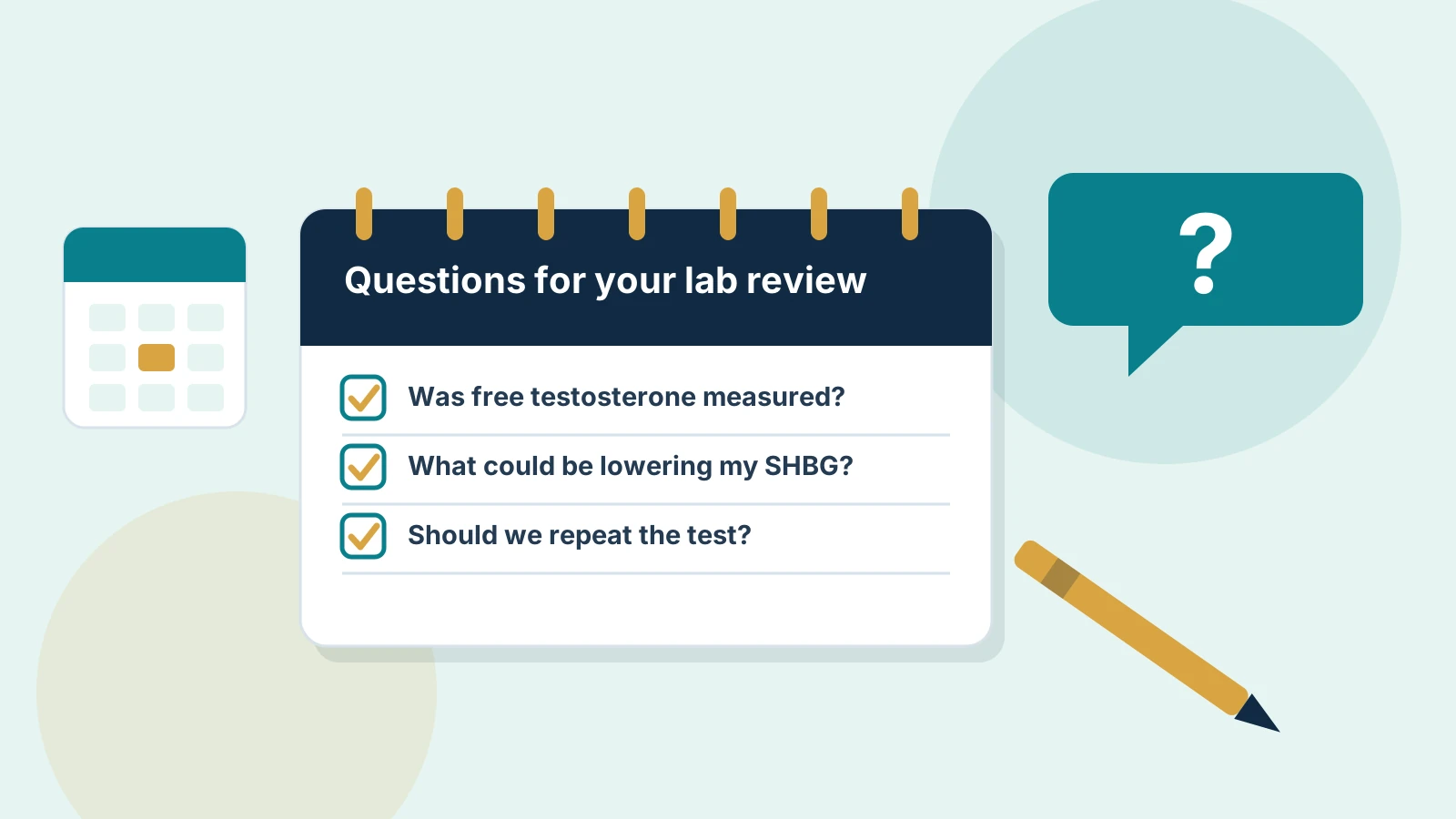
Finally, ask about logistics: “When will you contact me about results, and who do I call if something changes?” You don’t need to ask everything. Pick the three or four that matter most to you, and write the answers down. The checklist below captures the essentials.
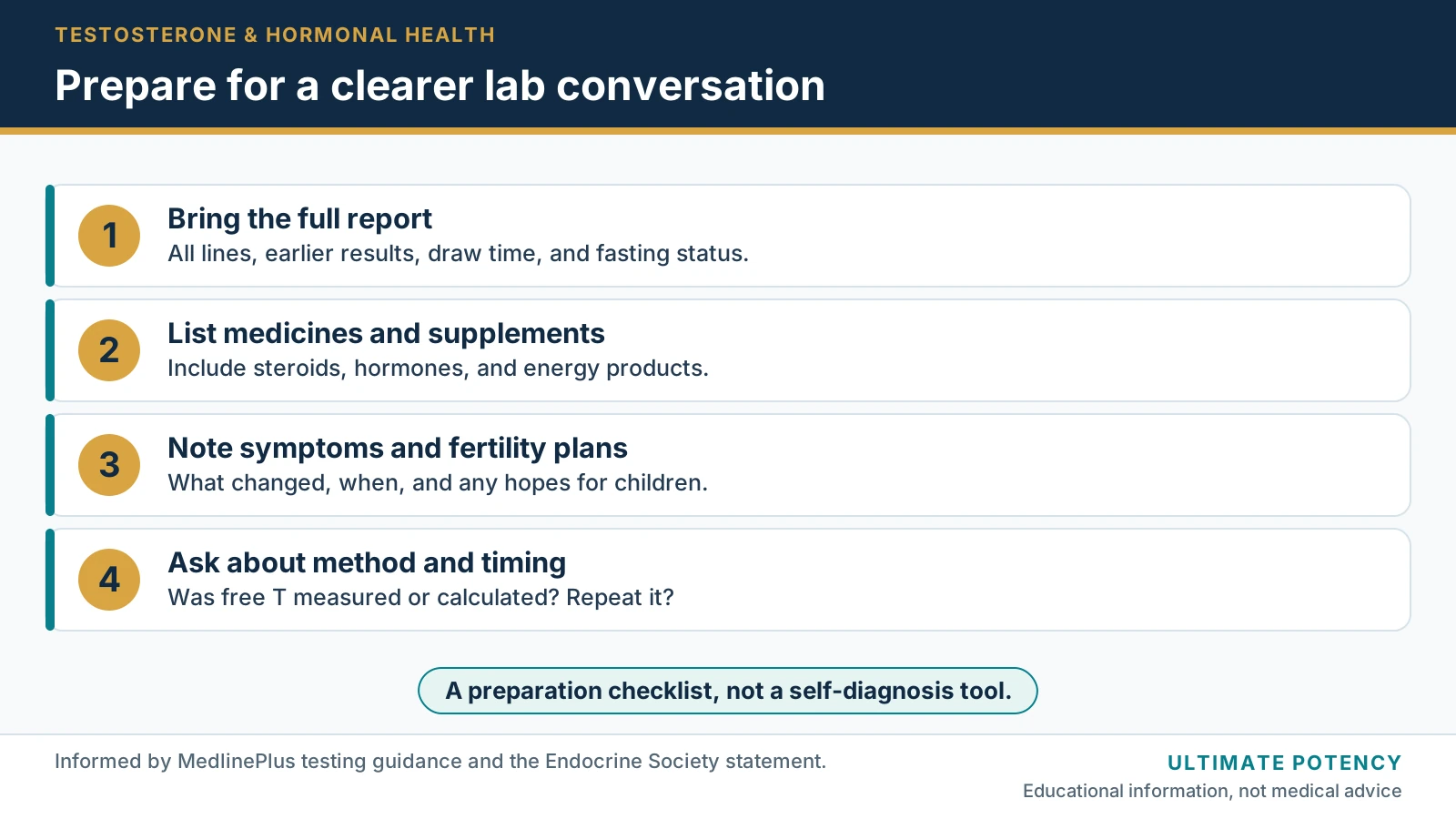
Text version: Step 1: bring the full report with the draw time and fasting status. Step 2: list medicines and supplements. Step 3: note symptoms with dates and share fertility plans. Step 4: ask whether free testosterone was measured or calculated and whether to repeat it.
After the Visit
This subsection covers what to do with the plan you leave with, and when a symptom shouldn’t wait for a scheduled follow-up.
Understanding the Plan and Follow-Up
Before you leave, try to summarize the plan in your own words: what’s being checked, what’s being watched, and what happens next. If a repeat blood test is planned, ask what the conditions should be, such as the time of day and fasting, and whether you should keep taking your usual medicines. MedlinePlus advises not to stop any medicine unless your provider tells you to, and that applies here too.
Keep a simple record. Note the date of each test, the result, and what your clinician said about it. If you begin any treatment, write down any changes you notice, including side effects, and share them at follow-up rather than waiting to see if they fade. Monitoring is part of safe care, not a sign something has gone wrong.
It also helps to agree on a timeline. Some follow-ups are weeks away, and others are months. Knowing what to expect keeps the waiting period from feeling like limbo. If you’ve been given lifestyle or metabolic goals, ask what progress would look like and how it will be measured, so you’re not left guessing whether you’re on track.
Knowing When to Seek Care Sooner
Most low SHBG questions can wait for a scheduled visit, but some symptoms shouldn’t. Seek emergency care for chest pain, sudden shortness of breath, pain or swelling in one leg, or signs of a stroke such as sudden weakness on one side, confusion, or trouble speaking. These matter especially if you’re taking testosterone, since the Endocrine Society’s statement notes an increased relative rate of pulmonary embolism, a blood clot in the lungs, in treated men in the TRAVERSE trials.
Contact your clinician promptly, rather than waiting for the next visit, if you notice new swelling, a significant mood change, new breast tenderness or enlargement, or anything that worries you after starting or changing a treatment. Also reach out if your symptoms are getting in the way of work, relationships, or daily life, whatever your labs say.
You’ve done the hard part by reading carefully and preparing. Whatever your report shows, the next step is a conversation, and the best conversations begin with questions like the ones in this guide. For more on the broader topic, return to our overview of low testosterone symptoms, or read about high SHBG and low free testosterone if your report shows the opposite pattern.
Sources
- SHBG Blood Test. MedlinePlus (National Library of Medicine). Last updated January 12, 2026. Checked 2026-10-16.
- Testosterone Levels Test. MedlinePlus (National Library of Medicine). Last updated June 5, 2025. Checked 2026-10-16.
- SHBG1: Sex Hormone-Binding Globulin, Serum. Mayo Clinic Laboratories. Test catalog page; no revision date shown. Checked 2026-10-16.
- Statement on Testosterone Replacement Therapy. Endocrine Society. July 16, 2026. Checked 2026-10-16.
- FDA Issues Class-Wide Labeling Changes for Testosterone Products. U.S. Food and Drug Administration. Sponsors informed February 28, 2025. Checked 2026-10-16.
- Testosterone Therapy in Men With Hypogonadism: An Endocrine Society Clinical Practice Guideline. Journal of Clinical Endocrinology & Metabolism (Bhasin et al.). 2018; J Clin Endocrinol Metab 103(5):1715-1744. Checked 2026-10-16.
- Testosterone Use and Male Infertility (fact sheet). American Society for Reproductive Medicine (ReproductiveFacts.org). Created 2015. Checked 2026-10-16.
- Evaluation and Management of Testosterone Deficiency (2024). American Urological Association. Published 2018, reviewed and validity confirmed 2024. Checked 2026-10-16.
- Low SHBG: Levels Chart, Symptoms, Causes, Treatment, and More. Healthline. Last updated August 4, 2026. Checked 2026-10-16.
Ultimate Potency is an educational publication. It does not diagnose, prescribe, or provide medical care. This article does not replace advice from a licensed healthcare professional who knows your history.