

If you’ve been comparing testosterone gel vs injections, you’re probably past the first big question and into the practical one: how would this actually fit into my life? That’s a fair thing to weigh. Both forms are approved by the FDA for adult men who have low testosterone together with an underlying medical cause, and both aim to bring blood levels back toward a typical range. They get there in very different ways, and those differences touch daily routines, safety precautions, blood test schedules, cost, and even who might be exposed in your household.
This guide walks through those differences one at a time. It explains how each form is used, what the labels and clinical sources say about safety, what the research can and can’t tell you, and which questions are worth bringing to an appointment. It does not tell you which one to choose, because that decision belongs in a conversation with a clinician who knows your history. For the broader picture, our guide to TRT benefits and risks covers what testosterone therapy can and can’t do, and the low testosterone symptoms guide explains why symptoms alone can’t confirm a diagnosis.
One more thing before we start. Whether your testosterone is low, and which treatment suits you, says nothing about your worth or your masculinity. It’s a health question, and it’s best handled with good information and a calm pace.
Understanding Testosterone Gel vs Injections
Before comparing the two forms, it helps to set out what each one is and who the comparison is meant for. This section defines the key terms, explains why a confirmed diagnosis comes before any decision about delivery method, and clarifies the limits of what this guide covers.
Key Concepts
This subsection explains what the two forms are and how they relate to the larger picture of testosterone replacement therapy, often shortened to TRT. Getting the vocabulary right makes every later comparison easier to follow.
What Testosterone Gel vs Injections Means
Testosterone gel is a prescription medicine you rub onto clean, dry skin, where the hormone is absorbed through the skin into the bloodstream. It’s usually applied once a day, in the morning. Testosterone injections deliver the hormone as a liquid that’s injected, either into a muscle (intramuscular) or under the skin (subcutaneous), on a schedule that ranges from weekly to every several weeks depending on the product. The MedlinePlus drug information on topical testosterone and the MedlinePlus page on testosterone injection describe these routes in plain language.
The medicine inside is the same hormone. What changes is the delivery method, and delivery shapes how quickly the hormone enters your blood, how high it climbs, how long it lasts, and what precautions apply. That’s why this comparison is really about patterns and trade-offs, not about a stronger or weaker drug. A simple rule of thumb: gel asks for a small daily habit and some care around other people’s contact with your skin, while injections ask for a less frequent but more involved step.
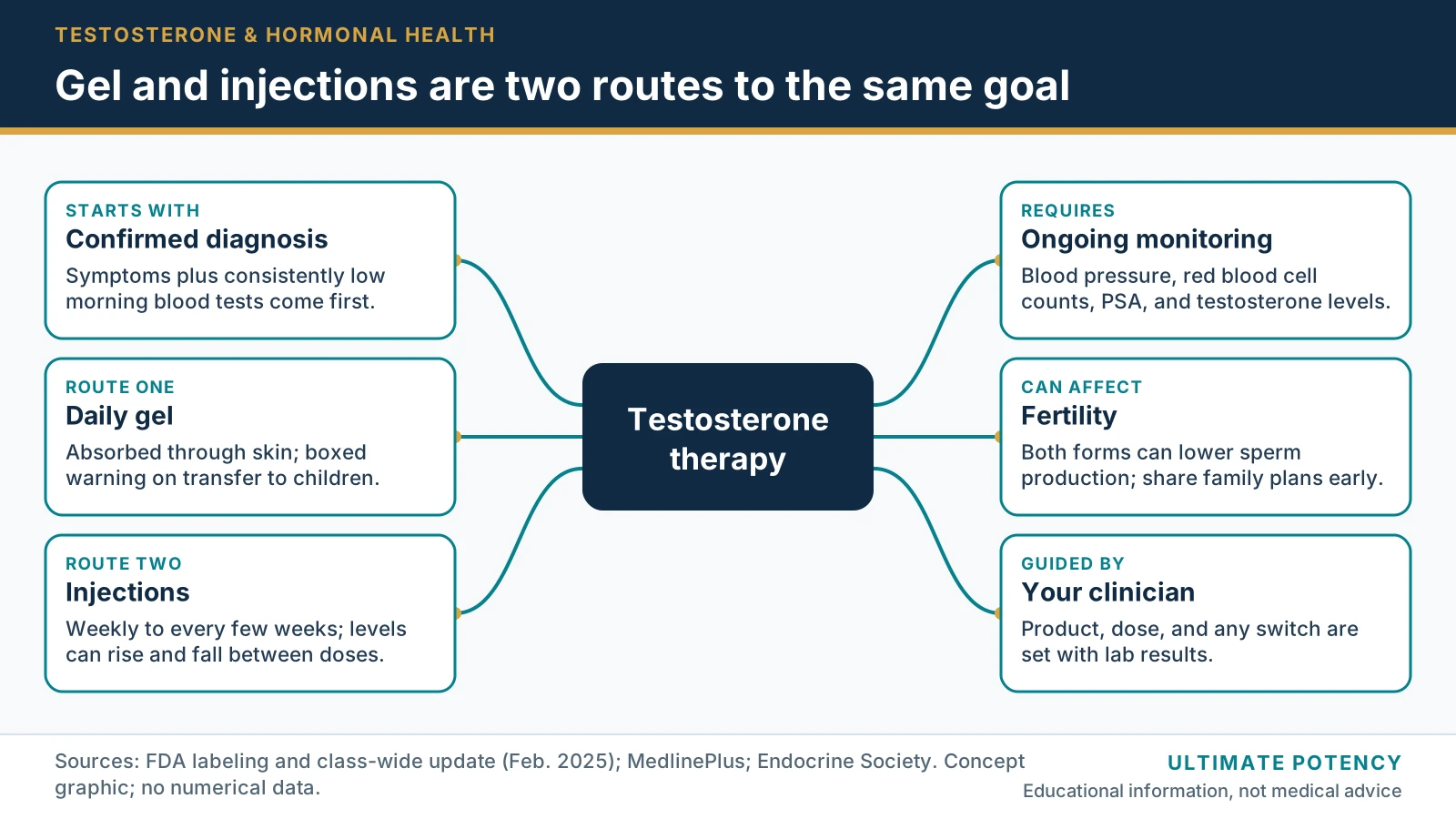
Text version: Testosterone therapy starts with a confirmed diagnosis. Two routes are compared: daily gel, absorbed through the skin with a boxed warning about transfer to children, and injections given weekly to every few weeks, which can raise and lower levels between doses. Both require ongoing monitoring, can affect fertility, and are guided by a clinician.
Hypogonadism, Low T, and Why Diagnosis Comes First
You’ll hear several terms used almost interchangeably. Low T is the everyday phrase for a testosterone level that’s lower than expected. Hypogonadism is the clinical term for testes that make too little testosterone, either because of a problem in the testes themselves (primary) or in the brain signals that drive them (secondary). Treatment is aimed at hypogonadism, not at a number on its own or a list of vague symptoms.
According to the Endocrine Society’s July 2026 statement on testosterone therapy, diagnosis requires both symptoms of testosterone deficiency and consistently low, accurately measured testosterone, and symptoms alone are not diagnostic. The statement also describes using at least two early-morning, fasting tests. Fatigue, low mood, and reduced sex drive have many possible causes, so a delivery method is only worth discussing once the diagnosis is on solid ground. Our guide on how low testosterone is diagnosed goes through that process step by step.
Who This Comparison Applies To
The comparison matters most for a specific group of readers, and the labels are clear about the boundaries. This subsection explains who testosterone products are approved for and which related forms this guide leaves to other articles.
Adult Men With a Confirmed Deficiency
In its February 2025 announcement of class-wide labeling changes, the FDA states that testosterone is approved solely for men who lack or have low testosterone levels in conjunction with an associated medical condition. The labels for individual products, such as the testosterone gel 1% label on DailyMed, describe replacement therapy in adult males for conditions associated with a deficiency or absence of the body’s own testosterone. They also say that safety and effectiveness have not been established for so-called age-related hypogonadism, or for males under 18.
In plain terms, a dip that comes with getting older, with poor sleep, or with extra weight isn’t automatically a reason to start testosterone. The Endocrine Society statement notes that for obesity-related hypogonadism without another identified cause, weight loss is typically the first-line therapy. If your situation is less clear-cut, the right conversation is about causes first and delivery methods second. Our article on who should not take testosterone covers the groups for whom treatment is usually avoided.
Forms This Guide Leaves for Other Articles
Testosterone comes in more forms than gel and injections. The FDA’s labeling announcement lists oral, topical gel, transdermal patch, buccal (cheek) system, and injection formulations as approved, and Mayo Clinic Care Network content also describes nasal gel and implanted pellets. Each has its own routine and its own precautions.
This guide sticks to gel and injections because that’s the comparison many people are actually weighing. If you’re also curious about skin patches, the separate article on testosterone patch vs gel covers that pairing. We’ll mention pellets and other forms only where they help explain a point.
It’s also worth saying what this guide is not. It isn’t a dosing guide, and it won’t suggest starting, stopping, or switching anything. Dose, product, and schedule are set by a prescriber based on your labs, your health history, and your goals, and they’re adjusted over time.
How Testosterone Gel Works
Testosterone gel is the form many men picture first, partly because it’s a daily routine rather than a medical procedure. This section covers how gel is applied, how doses are adjusted using blood tests, and the single most important safety feature of topical products: the possibility of transfer to other people.
Daily Application
Gel is simple to use but unforgiving about details. The next two subsections explain the usual application routine and how a prescriber fine-tunes treatment after you start.
Where and When the Gel Goes On
Labels spell out the routine. The testosterone gel 1.62% label says to apply it once daily in the morning to clean, dry, intact skin of the upper arms and shoulders, and not to the abdomen, genitals, or chest. The newer 1% gel label on DailyMed names the upper arms and shoulders and/or the abdomen, and also excludes the genitals. Different products use different sites, so follow the instructions that came with yours.
Timing after application matters. The 1.62% label advises avoiding swimming, showering, or washing the site for a minimum of 2 hours, while the 1% label says at least 5 hours. MedlinePlus adds that you should let the gel dry for a few minutes, dress in clothing that completely covers the area, wash your hands with soap and water afterward, and keep away from open flames and smoking until it dries.
Because these details vary by product, your pharmacist or prescriber is the best source for the exact steps. Never apply gel to broken or irritated skin, and don’t use a different product’s instructions for your own.
How Dose Adjustment Follows Blood Tests
Gel doses aren’t guessed at, and they aren’t set by how you feel alone. The 1.62% label says the dose should be titrated based on the pre-dose morning serum testosterone concentration, with checks at about 14 and 28 days after starting and after any adjustment. In other words, your clinician measures your blood level at a consistent point in the day, then nudges the dose up or down based on what the test shows.
That’s one reason absorption matters. Skin absorbs medicine differently from person to person, so two men using the same product can end up with different blood levels. A blood test takes the guesswork out of it. Following the MedlinePlus guidance on topical testosterone, your doctor will check testosterone levels before you begin to confirm they’re low, and further lab tests monitor how your body responds.
Please don’t change how much gel you use on your own, even if a friend swears by a different amount. The labs and the symptoms have to be read together, and a prescriber does that job. If something seems off, call the office rather than experimenting.
Skin Contact and Secondary Exposure
Because gel is absorbed through the skin, anyone who touches treated skin can pick up some of the hormone. This subsection explains the risk, who is most affected, and how households manage it.
Protecting Partners and Children
The testosterone gel labels carry a boxed warning, the FDA’s strongest type of warning, about secondary exposure. The 1.62% label states that virilization (the development of male traits) has been reported in children who were secondarily exposed to testosterone gel, and that children should avoid contact with unwashed or unclothed application sites in men using the gel.
MedlinePlus says topical testosterone may harm women and children who touch the skin where it was applied. It lists signs to watch for. A woman should call a doctor right away if she notices new hair growth in unusual places or acne. A child should see a doctor right away for enlarged genitals, pubic hair growth, increased erections, increased sexual desire, or aggressive behavior.
If someone in your household may have touched the treated area, wash the spot and call your prescriber or pharmacist for advice. None of this is meant to scare you away from gel. It’s meant to make clear that gel treatment is a household matter, not only a personal one, particularly if young children or someone who is pregnant share your space.
Everyday Habits That Reduce Transfer
The labels and MedlinePlus point to a short list of habits. Apply the gel after bathing or showering, let it dry completely, and then cover the area with clothing. Wash your hands with soap and water right after applying. If skin-to-skin contact is expected before the next wash, MedlinePlus says to wash the area thoroughly first, and anyone who touches unwashed treated skin should wash promptly.
Think through your day the way you’d plan a medication routine. If a toddler climbs into your lap in the morning, when is the gel already dry and covered? If you share a bed, which shoulder or area do you use, and is it covered? These questions can sound awkward, but they take the pressure off later because the plan is already in place.
Your pharmacist can walk you through your specific product, including how long to wait before swimming or showering. If you ever find it hard to follow the routine consistently, that’s useful information for your prescriber, who may discuss a different approach.
How Testosterone Injections Work
Injections are the other major route, and they come in more variations than most people expect. This section explains the common types and schedules, why injected testosterone can produce a different hormone pattern than gel, and who actually gives the injection.
Types and Schedules
Not all testosterone injections follow the same routine. The next two subsections separate the familiar intramuscular shots from the subcutaneous and longer-acting options.
Intramuscular Injections
The most familiar injectable products are testosterone cypionate and testosterone enanthate, which are oils given into a muscle. The testosterone cypionate label on DailyMed states that intramuscular injections should be given deep in the gluteal (buttock) muscle, that the product is not for intravenous use, and that dosing is every two to four weeks. The American Urological Association’s dosing profile table for testosterone formulations lists shorter intervals of roughly one to two weeks for these same injectable forms.
That gap is worth noticing. It shows that schedules are a clinical judgment, not a fixed rule, and a prescriber may choose a plan based on your blood tests and how you feel between doses.
You shouldn’t set or change an injection interval yourself. MedlinePlus lists common side effects of testosterone injection, including acne, injection-site pain or bruising, tiredness, sleep problems, mood swings, weight gain, headache, joint pain, and back pain. Mention any of these to your prescriber, because they may point to a need for adjustment rather than something to tolerate.
Subcutaneous and Longer-Acting Options
Some injectable products aren’t given into the muscle at all. MedlinePlus describes a subcutaneous form injected under the skin once a week by the patient or a caregiver, with the first dose given in the doctor’s office. The FDA label for Xyosted, a subcutaneous testosterone enanthate product, describes once-weekly injection in the abdomen and carries a boxed warning that it can cause blood pressure increases that raise the risk of major adverse cardiovascular events.
Another option is testosterone undecanoate (brand name Aveed), which is given far less often. MedlinePlus warns that serious breathing problems and allergic reactions can occur with it and that you need to remain in the healthcare setting for at least 30 minutes after each injection. Pellets, which MedlinePlus says are implanted under the skin by a doctor or nurse, are a related long-acting approach.
Longer intervals can be attractive, but they come with their own conditions, such as supervised visits or specific warnings. These labels are older than the FDA’s 2025 class-wide updates, so ask your prescriber what the current label says for your product.
Hormone Patterns Between Doses
A big part of the gel vs injections discussion is about what happens to hormone levels over time, not just on the day you take the medicine. This subsection explains the concept of peaks and troughs and the practical logistics that go with it.
Peaks and Troughs Explained
When a medicine is absorbed slowly through the skin each day, blood levels tend to stay within a narrower band. When a larger amount enters the body at once from a muscle depot, levels can climb after the shot and then drift down before the next one. Those high points are called peaks and the low points just before the next dose are called troughs.
A University of North Carolina summary of a large insurance-claims study reported that the researchers attribute part of the difference they saw between injections and gels to this pharmacokinetic pattern, with injections causing spikes in testosterone levels while gels and patches produce more gradual increases. That’s an explanation offered by the authors, not a proven mechanism. In a small clinic-based comparison at Baylor, injectable testosterone produced significantly higher overall total and free testosterone levels than gel.
Some men notice that how they feel changes across the injection cycle. If that sounds familiar, write down when the changes happen. It’s a practical clue a clinician can use when discussing the schedule, and it’s worth asking when in your cycle your blood is drawn.
Who Gives the Injection and Where
For intramuscular products, MedlinePlus says the injection is given by a doctor or nurse in an office or clinic. That means regular visits, which can be a plus if you like having a professional involved and a hurdle if your schedule is tight. Mayo Clinic Care Network content notes that patients or family members can also learn to give injections at home, which some men prefer for convenience.
If home injection is on the table, a clinician or nurse should teach you the technique, the site, and what to do about any problems. Ask who to call if you have a reaction, what to do with used needles and syringes, and how often you’ll need to come in for blood tests even if you inject at home.
Comfort matters too. Some people are fine with needles, while others find a recurring shot stressful. That’s a legitimate factor in the decision, and a good prescriber will treat it as one rather than brushing it aside. Gel avoids needles entirely, but, as covered above, it brings its own routine.
Safety and Monitoring for Both Routes
Most of the serious safety questions around testosterone therapy aren’t specific to gel or injections. They apply to the hormone itself, which is why monitoring matters whichever route you use. This section covers the shared risks, what follow-up usually involves, and how treatment affects fertility.
Risks That Apply to Both Forms
Two groups of risks come up again and again in the sources: those affecting the heart and blood pressure, and those involving red blood cells, clots, sleep, and the prostate. The next two subsections go through them.
Blood Pressure and Heart Health
The FDA says that completed ambulatory blood pressure monitoring studies confirmed an increase in blood pressure with use of all testosterone products, class-wide, and that labels are being updated with blood pressure information. The same announcement says the TRAVERSE trial concluded there was no increase in the risk of adverse cardiovascular outcomes in men using testosterone for hypogonadism, and that cardiovascular-outcome language is being removed from the boxed warning for all testosterone products.
Those two points can sit side by side. A medicine can raise blood pressure and still not increase the rate of heart attack or stroke over the time frame a trial covered. Cleveland Clinic’s summary of TRAVERSE reports 5,246 men aged 45 to 80 who used a daily 1.62% testosterone gel or a placebo gel for about 22 months, with major cardiac events in 7.0% of the testosterone group and 7.3% of the placebo group.
Blood pressure still deserves attention. The testosterone cypionate label says testosterone can increase blood pressure and is not recommended in patients with uncontrolled hypertension. Our article on TRT and blood pressure takes this topic further.
Red Blood Cells, Clots, Sleep Apnea, and the Prostate
Testosterone can stimulate red blood cell production, which is why labs track hemoglobin and hematocrit (the share of your blood made up of red cells). The gel labels say to check hematocrit before starting treatment and to stop therapy until it decreases if it becomes elevated. Labels for both gel and injection also describe postmarketing reports of venous thromboembolism, meaning clots in the veins such as deep vein thrombosis and pulmonary embolism, and tell prescribers to stop treatment if one is suspected.
In its July 2026 statement, the Endocrine Society notes that the TRAVERSE trials showed roughly a 50% relative increase in pulmonary embolism, along with more bone fractures, in testosterone-treated men. The gel labels also say testosterone may worsen sleep apnea in some people and may worsen benign prostate enlargement, and they call for prostate evaluation before and during treatment.
This table summarizes what clinicians commonly track during testosterone therapy and why, using label and guideline language.
| Topic | Why it is checked | What may be reviewed | Applies to |
|---|---|---|---|
| Blood pressure | FDA says testosterone raises blood pressure class-wide | Readings before and during treatment | Gel and injections |
| Hematocrit and hemoglobin | Testosterone can raise red blood cell counts | Blood counts before starting and periodically after | Gel and injections |
| Blood clot symptoms | Venous clots are reported with testosterone products | Leg swelling, chest pain, sudden breathlessness | Gel and injections |
| Prostate health | Androgens may worsen benign enlargement; cancer risk is evaluated | PSA, urinary symptoms, prostate evaluation | Gel and injections |
| Sleep apnea | Labels say treatment may worsen it in some people | Snoring, pauses in breathing, daytime sleepiness | Gel and injections |
| Testosterone level | Dose and schedule are adjusted from results | Morning or timed blood draws | Gel and injections |
Sources: DailyMed gel and cypionate labels; MedlinePlus; Endocrine Society 2018 guideline and 2026 statement. A summary for discussion, not a monitoring schedule for any individual.
Follow-Up and Fertility
Starting treatment is the beginning of a monitoring relationship, not the end of the process. This subsection explains what follow-up usually involves and why fertility plans need to come up early.
Blood Tests and Follow-Up Visits
The Mayo Clinic Care Network says anyone taking testosterone replacement should have a checkup and blood tests several times during the first year and then yearly. The 1.62% gel label says to re-evaluate hematocrit at 3 to 6 months and annually thereafter, and to monitor testosterone, PSA, hemoglobin, hematocrit, liver function, and lipids periodically. The 2018 Endocrine Society guideline recommends assessing prostate cancer risk before starting and 3 to 12 months after starting, with a urology referral if PSA rises by more than 1.4 ng/mL above baseline in the first year.
Your own schedule may differ, and that’s normal. The Endocrine Society’s 2026 statement emphasizes that screening and monitoring are needed once therapy begins, and that long-term safety, including for prostate cancer, remains unestablished. Our article on TRT monitoring blood tests explains how to read the results.
Put follow-up dates on your calendar when you start. Missed labs are one of the easiest things to let slip and one of the most important to keep.
Fertility and Sperm Production
This is the point many men don’t hear about until later. The 1.62% gel label says that with large doses of exogenous androgens, spermatogenesis (sperm production) may be suppressed and that the impact on fertility may be irreversible. MedlinePlus says testosterone injection may cause a decrease in sperm number, especially at high doses, and that high doses of topical testosterone may reduce sperm production.
The 2018 Endocrine Society guideline recommends against starting therapy in men who are planning fertility in the near term. The reason is that testosterone supplied from outside the body can dampen the hormone signals that normally drive sperm production, which the gel label calls feedback inhibition. Whether you use gel or injections, the fertility question applies.
If you want to have children now or in the future, tell your prescriber before starting. There may be other ways to approach low testosterone when fertility matters, and that’s a conversation for a clinician. Our article on TRT and fertility goes into the details.
Comparing Relevant Factors
Now that each route has been described, it’s time to line them up. This section compares everyday practicalities, then looks honestly at what the research does and doesn’t show about gel vs injections, because the evidence is thinner than many online comparisons suggest.
Practical Factors Side by Side
Daily life is where most men feel the difference between these two forms. The next two subsections compare routine and privacy, then the costs and access questions that tend to surprise people.
Convenience, Routine, and Privacy
Gel is a daily ritual. It takes a minute or two, needs drying time, and requires attention to clothing, showers, and who touches your skin. Many men like that it’s private and needle-free. Others find the daily step easy to forget or inconvenient around workouts, swimming, or shared living spaces.
Injections trade frequency for complexity. Weekly or every-few-weeks dosing means fewer touchpoints, but you need either regular clinic visits or the comfort and training to inject yourself or have a caregiver do it. Some injection schedules also come with extra conditions, such as the 30-minute observation period MedlinePlus describes for testosterone undecanoate.
No row in the table below makes one option better across the board. It’s a way to see where the trade-offs sit so you can decide which ones matter most to you.
This table compares routine, hormone pattern, and precautions so you can see where the trade-offs fall.
| Factor | Testosterone gel | Testosterone injections | Question to ask |
|---|---|---|---|
| Schedule | Once daily, usually in the morning | Weekly to every several weeks, depending on the product | Which schedule can I keep up with reliably? |
| Who administers | You, at home | Clinic staff for intramuscular shots; you or a caregiver for some subcutaneous products after a first office dose | Will I be taught to inject, and who do I call with problems? |
| Hormone pattern | Generally more gradual rise | Can rise after a dose and fall before the next | When in my cycle should my blood be drawn? |
| Key precautions | Boxed warning on transfer to children; drying time; covering skin | Product-specific, such as a blood pressure boxed warning (weekly subcutaneous) or a 30-minute observation (undecanoate) | What warnings apply to my exact product? |
| Common local effects | Skin redness, irritation, dryness, or itching | Injection-site pain or bruising | What should I do if I notice these? |
Sources: DailyMed labels; MedlinePlus; Xyosted label; University of North Carolina study summary. Product details vary, and older labels may not reflect current wording.
Cost, Coverage, and Access Questions
The source pages reviewed for this guide did not give dependable, dated U.S. prices for either route, so this article doesn’t quote any, and what you pay can differ by product, pharmacy, and insurance plan. What matters more is knowing the pieces that add up. A medicine’s listed price is rarely the whole story, and the cheapest-looking option isn’t always the cheapest in practice once visits, labs, and supplies are included.
Insurance can shape the decision, too. Some plans cover certain products and not others, and some may ask for documentation before approving a prescription. A pharmacist or your insurer’s member line can tell you what’s covered for a specific product before you commit.
Be cautious with websites that advertise a low monthly price without explaining who prescribes the medicine, how labs are handled, or what follow-up is included. Testosterone requires a diagnosis and monitoring, so a price that leaves those out can be misleading. Use the table below as a checklist of things to confirm.
This table lists the parts of the cost picture without quoting prices, which change often and depend on insurance.
| Cost component | What may vary | What to verify |
|---|---|---|
| Visits and labs | Number of follow-up visits and blood tests in the first year | Whether each visit and lab is covered, and how often they are needed |
| Medication | Product, strength, generic or brand, and quantity | The price for the exact product and amount you were prescribed |
| Supplies | Syringes, needles, and sharps disposal for injections; pumps, packets, or tubes for gel | Whether supplies are included or billed separately |
| Pharmacy and refills | Retail, mail-order, or clinic dispensing, and refill length | Pickup or delivery options and what happens if a refill is delayed |
| Insurance steps | Coverage rules and documentation requests | Whether prior authorization or specific lab results are needed |
Editorial summary of cost components; no price data were verified for this article. Confirm every item with your prescriber, pharmacy, and insurer.
Evidence and Limitations
It would be convenient if a large trial had compared gel and injections head to head. That isn’t what the sources in this guide show. This subsection lays out what the available studies found, what they can’t tell us, and how to apply them sensibly.
What the Research Can and Cannot Show
The most direct comparison in the sources reviewed is a retrospective study from Baylor College of Medicine of 178 men with secondary hypogonadism. Injectable testosterone produced higher testosterone levels, and 66.7% of men on injections developed a hematocrit of 50% or more, compared with 12.8% on gel. No significant PSA increases appeared in any group. The study was small, wasn’t randomized, and the injection group was younger, so the groups weren’t perfectly matched.
An observational analysis of insurance claims, summarized by the University of North Carolina, found injections were associated with a greater risk of cardiovascular events, stroke, hospitalization, and death than gels, with gels and patches looking similar. The summary didn’t provide numbers, and observational data can’t prove cause and effect.
Then there’s TRAVERSE, the large randomized trial, which used a gel and found no increase in major cardiac events versus placebo over about 22 months. It didn’t test injections, so it can’t settle the comparison. Each study answers a different question, and none was built to declare a winner.
This table sets the key studies and labeling side by side so their different strengths and limits are easy to see.
| Source | Design | Main finding | Limitation |
|---|---|---|---|
| Baylor study (2015) | Retrospective review of 178 men with secondary hypogonadism, followed up to 3 years | Higher testosterone levels and more high hematocrit values with injections than gel; no significant PSA rise | Not randomized; small; groups not perfectly matched |
| Insurance claims analysis (2015) | Observational comparison of new users, up to 1 year | Injections linked to more cardiovascular events than gels; gels and patches similar | Observational; numbers were not available in the summary reviewed |
| TRAVERSE trial | Randomized, placebo-controlled; 5,246 men aged 45 to 80; daily 1.62% gel; about 22 months | Major cardiac events in 7.0% on testosterone and 7.3% on placebo; more atrial fibrillation, acute kidney injury, and venous clots | Gel only; no injection comparison; funded by a consortium of testosterone makers |
| FDA labeling update (2025) | Regulatory review of blood pressure monitoring studies and TRAVERSE | Blood pressure increases with all testosterone products; cardiovascular language removed from boxed warnings | Does not rank gel against injections |
Sources: Pastuszak et al. 2015 (Sexual Medicine); University of North Carolina summary of Layton et al. 2015 (JAMA Internal Medicine); Cleveland Clinic summary of TRAVERSE; FDA, February 2025. Summaries only; the full papers were not all reviewed.
How the Evidence Applies
So what do you do with all this? A fair reading is that the research doesn’t crown a universal winner. The claims-based and clinic-based studies raise questions about injections, especially hematocrit and short-term cardiovascular risk, but they’re observational and small, and they predate the FDA’s 2025 review. The best trial evidence for heart safety comes from gel, so it’s reassuring for gel in the group studied but silent on injections.
That means your own situation carries real weight. A man with a history of high red blood cell counts, uncontrolled blood pressure, or sleep apnea has different concerns from one whose main worry is a toddler at home. Those factors don’t translate into a rule, but they give your clinician useful points to weigh.
If a website or social media post says one form is flatly safer or stronger, look for what it’s based on. Is it a randomized trial, an observational study, or a company’s sales pitch? You can also bring this section’s table to your appointment and ask how the findings relate to your own history and goals.
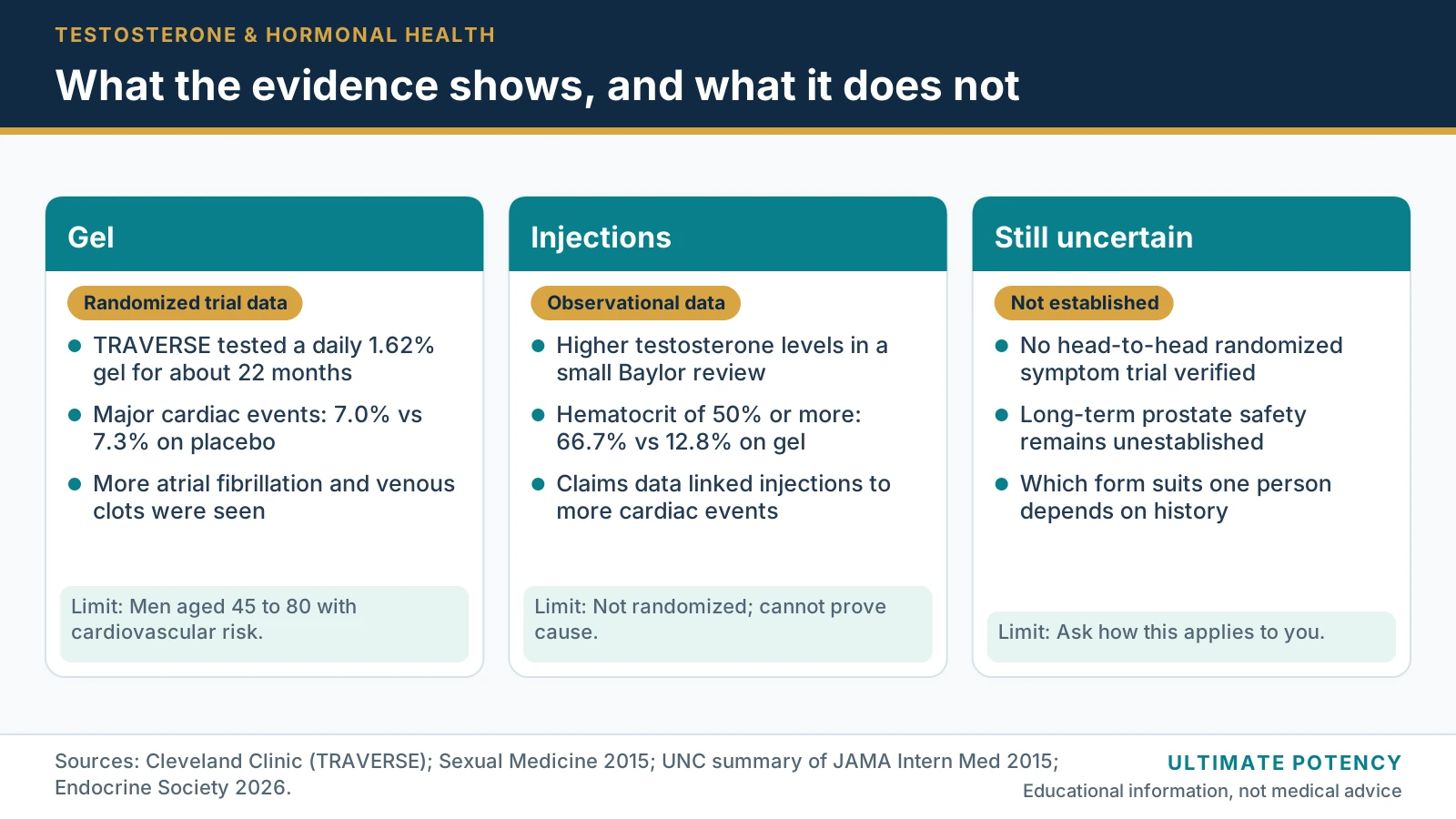
Text version: Gel: the TRAVERSE randomized trial used a daily 1.62% gel for about 22 months; major cardiac events were 7.0% on testosterone and 7.3% on placebo, with more atrial fibrillation and venous clots. Injections: observational data show higher testosterone levels, high hematocrit in 66.7% versus 12.8% on gel, and more cardiac events in claims data; these cannot prove cause. Still uncertain: head-to-head symptom trials, long-term prostate safety, and individual fit.
Choosing and Reviewing Treatment With a Clinician
Choosing between gel and injections is a shared decision, and it often gets revisited after treatment begins. This section turns the comparison into practical questions, shows how health history and household factors play in, and explains what to do when results aren’t what you expected.
Factors That Shape the Conversation
Several personal factors tend to matter more than any general rule. This subsection covers household and lifestyle considerations first, then medical history and other medicines.
Household, Skin, and Lifestyle Factors
The best choice often comes down to how your days actually run. Do you shower in the evening or morning? Do you swim, lift, or work in a setting where skin contact with others is common? Do you travel for work? Do you live with young children, or with someone who is pregnant? Each of these affects gel more than injections, while travel, clinic hours, and comfort with needles affect injections more.
The decision aid below pairs everyday observations with questions to ask. It’s not a way to pick a treatment on your own. It simply helps you turn vague concerns into specific questions.
Consider a hypothetical situation: a man in his forties with a toddler who climbs into his lap every morning is told he has confirmed low testosterone and that gel is one option. He doesn’t need to decide on the spot. He might ask how long he’d need to wait before holding his child, which area is least likely to be touched, and whether an alternative would make the household routine simpler. This is an illustration of the kinds of questions to ask, not advice for anyone’s real situation.
This table links common practical observations to questions that may help you and your clinician talk through the options.
| If you notice | A useful question | Why it matters |
|---|---|---|
| Young children or a pregnant person share close contact with you | How would gel fit our household, and would another form be simpler? | Gel carries a boxed warning about transfer to children |
| Needles worry you, or clinic visits are hard to schedule | Which options avoid frequent shots or visits? | A routine you can keep is part of safe treatment |
| You feel different in the days before a scheduled injection | Could dose timing or lab timing explain this? | Injected testosterone can rise and fall between doses |
| Redness, itching, or irritation where gel is applied | Is this a reaction to the product, and what are my choices? | Skin irritation is a listed gel side effect |
| Your blood pressure is rising, or you snore and stop breathing at night | Should my blood pressure or sleep be checked first? | Labels note blood pressure and sleep apnea concerns |
| You may want to father a child | How will treatment affect my sperm, and are there alternatives? | Both forms can reduce sperm production |
Original editorial decision aid based on labeling and guideline language. It is not a diagnostic or treatment algorithm.
Health History and Other Medications
Your medical history can narrow or widen your options. Labels and guidelines highlight blood pressure, sleep apnea, prostate health, red blood cell counts, and a history of blood clots as topics to bring up. The Endocrine Society’s 2018 guideline advises against testosterone therapy in men with breast or prostate cancer, untreated severe sleep apnea, or elevated hematocrit, among other conditions.
Other medicines matter, too. The Endocrine Society’s 2026 statement says clinicians should first rule out reversible causes of low testosterone such as obesity and corticosteroid or opioid use. That means a complete list of prescriptions, over-the-counter products, and supplements is part of the evaluation, not a side note.
Consider a hypothetical situation: a man with treated high blood pressure notices loud snoring and daytime sleepiness while also being told his morning testosterone is low on two tests. Before choosing a form, he might ask whether his blood pressure control and possible sleep apnea should be assessed first. Again, this is a generic illustration, not a recommendation for any real person.
When Treatment Is Not Going as Hoped
Sometimes treatment doesn’t feel the way people expected. This subsection explains how clinicians usually think about that situation and why changes should go through them.
Reviewing Symptoms and Lab Results Together
If you’re a few weeks or months in and feel little change, it’s tempting to assume the form is the problem. It might be, but it might not. Symptoms such as tiredness, low mood, or low sex drive overlap with sleep problems, stress, depression, other medications, and many health conditions, which is why the low testosterone symptoms guide stresses that symptoms alone can’t confirm a cause.
A clinician usually looks at several things together: whether the product is being used as directed, what your blood levels show, whether the timing of your lab draw matches your dosing, and whether another factor could explain the symptoms. For gel, that might include checking application technique. For injections, it might include discussing where your blood draw falls in the cycle.
Keep a simple log of symptoms, dates of doses, and any side effects. It gives your prescriber something concrete to work with, and it’s much more helpful than a general impression at the end of a long month.
Why Switching Needs a Clinician
It can be tempting to swap forms on your own, particularly if a friend or an online forum suggests it. But gel and injections aren’t interchangeable milligram for milligram. They differ in how fast levels rise, how long they last, which precautions apply, and which labs make sense afterward.
If a switch is appropriate, a prescriber will usually plan new blood tests, adjust the dose, and make sure the new product’s precautions are understood. Gel to injection brings new needle and schedule considerations. Injection to gel brings the secondary exposure rules.
Please don’t stop, change, or combine testosterone products without talking to your prescriber. If a side effect worries you, call the office or pharmacy and describe what you’re noticing. For urgent symptoms like chest pain, sudden shortness of breath, or signs of a clot, seek urgent medical care immediately.
Common Questions
Some questions come up again and again when people compare testosterone gel and injections. The answers below stay close to the sources reviewed and, where the evidence is thin, say so plainly.
Effectiveness and Safety Questions
These first questions deal with the two worries most men bring to the comparison: which one works better and which one is safer.
Is Gel or Injection More Effective?
Both gel and injections raise testosterone levels in men with hypogonadism, and the Baylor comparison found that all studied formulations increased total and free testosterone. In that study, injections produced higher levels on average, but higher isn’t automatically better. The goal of treatment is to bring levels into a suitable range and ease symptoms of confirmed deficiency, not to push a number as high as possible.
On symptoms, the sources reviewed for this guide did not include a large randomized trial that directly compares gel with injections, so there’s no solid basis to say one relieves symptoms more reliably than the other. Response depends on the underlying cause, the dose, how consistently the product is used, and other health factors.
A truthful answer is that effectiveness depends more on the right diagnosis, dose, and follow-up than on the delivery form alone. If you’re not noticing benefit, the next step is a review with your prescriber, not a switch on your own.
Is One Form Safer for the Heart?
The honest answer is that nobody can say for certain. Observational data summarized by the University of North Carolina linked injections to more cardiovascular events than gels, but observational data can’t prove cause. The strongest randomized trial, TRAVERSE, used gel and found no increase in major cardiac events compared with placebo over about 22 months in men with hypogonadism and cardiovascular risk. It did not test injections.
The FDA says blood pressure rises with all testosterone products, so blood pressure monitoring applies to both forms. The same trial program also showed more atrial fibrillation, acute kidney injury, and venous clots in the testosterone group, according to Cleveland Clinic’s summary, which is another reason to treat this as a decision requiring monitoring.
If you have heart disease, high blood pressure, or a history of clots, tell your prescriber so they can weigh those factors. Our guide on TRT benefits and risks gives a wider view of the safety picture.
Daily Life and Planning Questions
The next two questions are about what happens after you start, including changes to your routine and how long treatment lasts.
Can I Change My Schedule or Switch on My Own?
No. Schedules, doses, and product choices are set using lab results, your health history, and the product’s labeling, and they’re adjusted by your prescriber. MedlinePlus says your doctor may change your dose based on blood levels and that you should tell lab staff you’re using testosterone. The gel labels describe titration based on morning blood testosterone, and the injection intervals in the sources reviewed ranged from one week to several weeks, depending on the product and the source.
Skipping, doubling up, or stretching a dose to fit your calendar can change hormone levels in ways that make results harder to interpret. For a missed gel application, MedlinePlus says to apply it when you remember unless the next dose is nearly due, and not to double up. Injection schedules are different, so ask your prescriber in advance what to do if you miss a shot.
If your routine isn’t working, say so. A different form or schedule may be an option, but it needs to be planned with monitoring.
Will I Need Treatment Forever?
It depends on the cause. When low testosterone results from a disease of the testes, pituitary, or hypothalamus, the Endocrine Society’s 2026 statement describes clear benefits of treatment for appropriately diagnosed men, and ongoing treatment with monitoring may be part of that picture. When another factor is involved, such as obesity or certain medications, addressing that factor may change the situation, and the same statement describes weight loss as typically the first-line therapy for obesity-related hypogonadism without another identified cause.
Whether treatment is long-term is a decision to revisit with your clinician over time. Monitoring continues while you’re on therapy. The same statement cautions that the long-term prostate cancer picture is still unsettled, so periodic reassessment is part of responsible care.
One point deserves repeating. If you hope to father children, treatment can reduce sperm production and the gel label says the impact on fertility may be irreversible. Raise that early rather than after you’ve started.
Your Next Steps
A good appointment starts before you walk in the door. This section explains what to gather, which questions to bring, and how to weigh the trade-offs so you leave with a plan you understand.
Preparing for Care
Preparation takes some pressure off the visit itself. The next two subsections cover what to bring and what to ask.
Information to Bring to Your Visit
Clinicians can do more with specific details than with general impressions. Bring a list of everything you take, including prescriptions, over-the-counter products, and supplements. Bring any previous testosterone or other lab results, along with the dates they were drawn. If you track your blood pressure at home or at a pharmacy, bring those readings.
Write down what you’ve noticed and when it started. Think about sleep, energy, mood, sex drive, and whether you’ve had changes in weight or snoring. You don’t have to make sense of the pattern yourself. Your clinician will sort through what might be connected.
Also bring practical information. Note who lives with you, especially young children or anyone who is pregnant. Mention any fertility plans, your work schedule, your comfort with needles, and your insurance details. These practical details often influence which options are realistic, and they’re easy to forget in the moment. Our guide to low testosterone symptoms can help you organize what you’ve noticed.
Questions About Testosterone Gel vs Injections
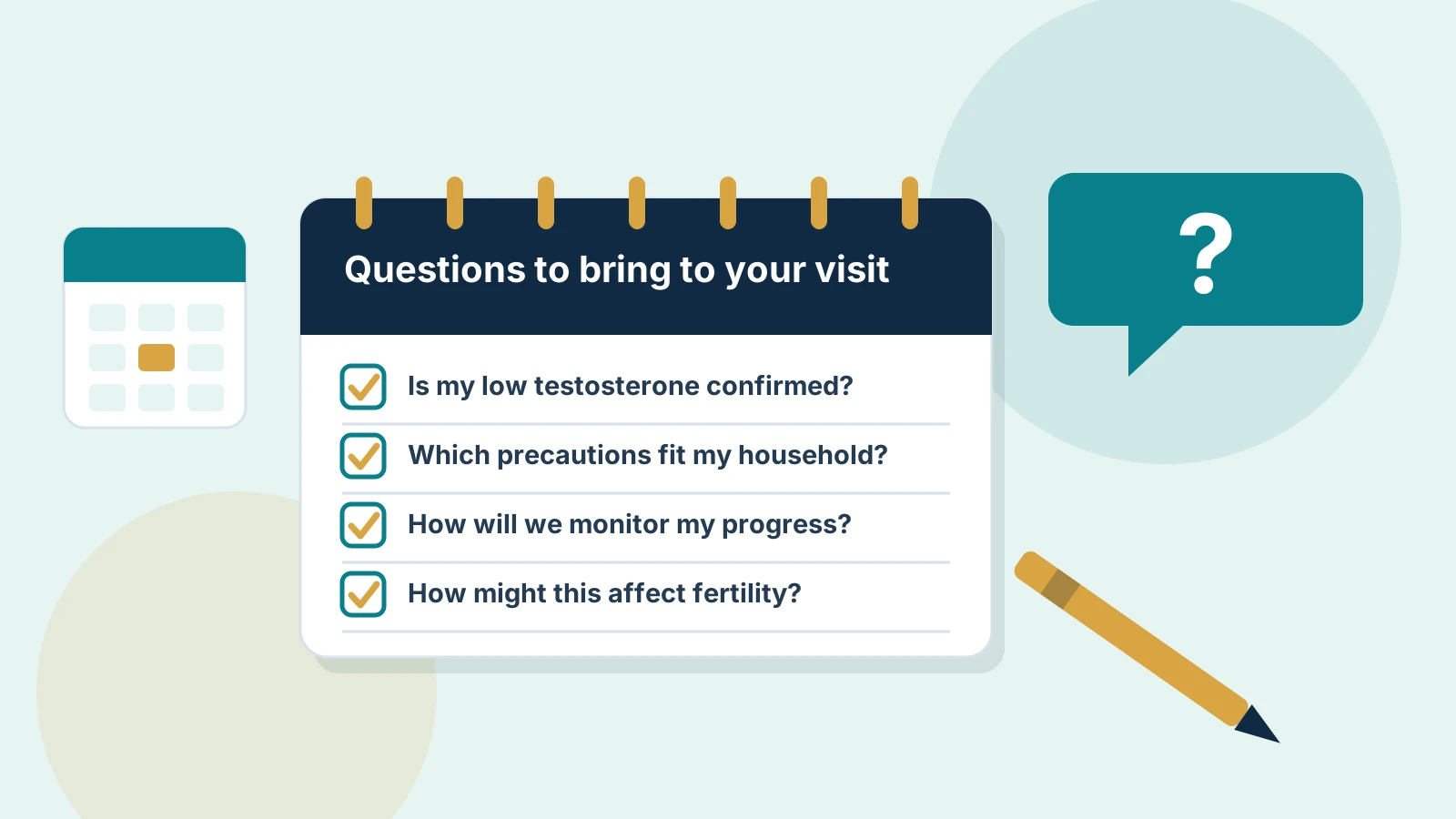
Questions turn a visit into a conversation. You might ask: Has my low testosterone been confirmed with repeat morning tests, and what’s the suspected cause? Which forms make sense for my history, and why? What precautions apply to my specific product? How will we monitor blood pressure, red blood cell counts, and prostate health? What are the alternatives if I want to preserve fertility?
Also ask practical questions. Who will teach me the routine? What should I do if I miss a dose? Who do I call about side effects? What will it cost in total, including labs and follow-up? Writing the questions down keeps the visit on track, especially if you feel rushed.
If you’re not sure where to start, begin with the question that worries you most. A good clinician will welcome it. The checklist below summarizes the main steps in a form you can screenshot or print.
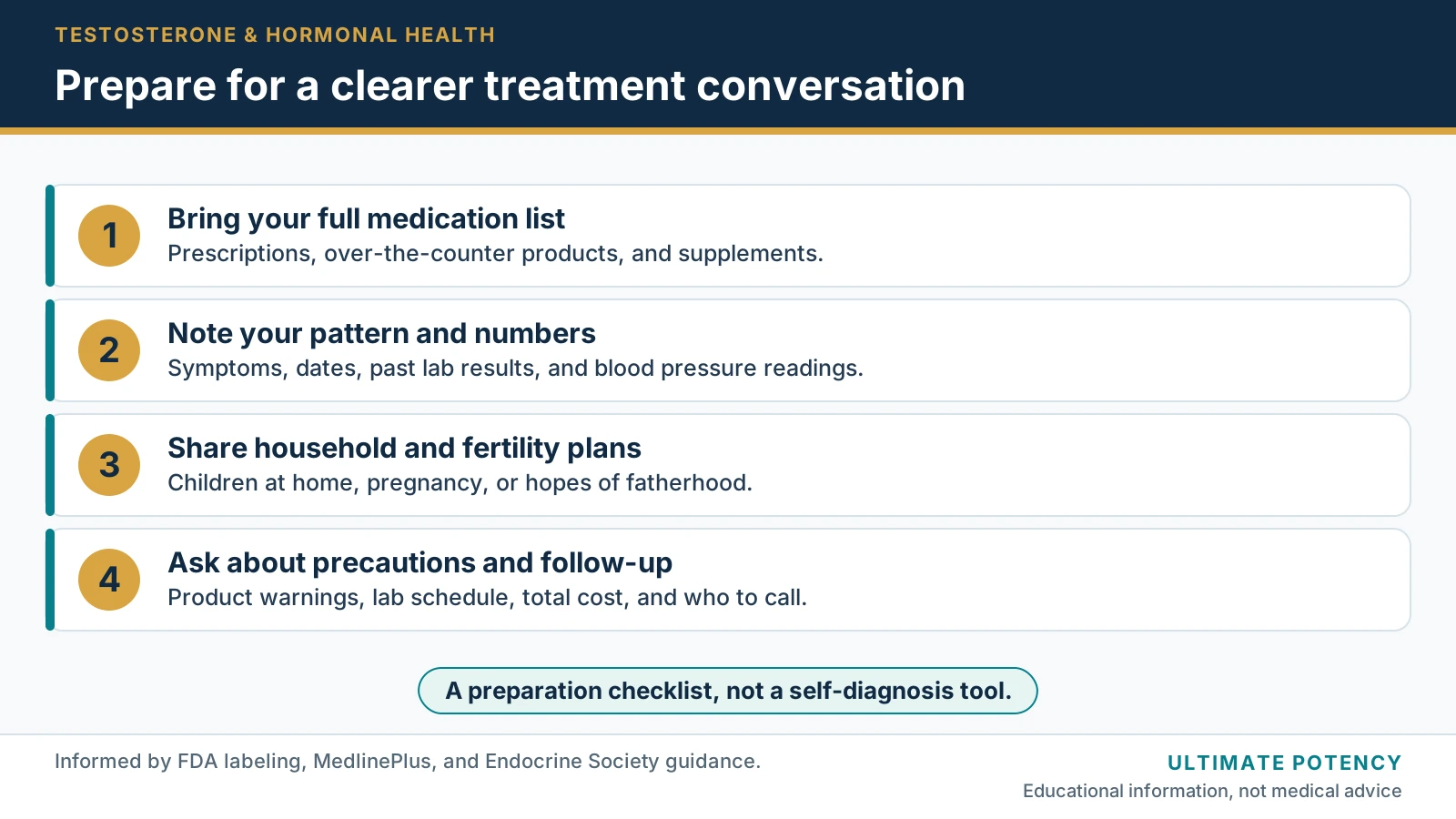
Text version: Step 1: bring your full medication list, including supplements. Step 2: note your symptom pattern, dates, past lab results, and blood pressure readings. Step 3: share household and fertility plans. Step 4: ask about product precautions, lab schedule, total cost, and who to call.
Making an Informed Decision
Once you have information and questions in hand, the last step is weighing everything together. This subsection explains how to balance benefits, risks, and routine, and how to agree on follow-up.
Weighing Benefits, Risks, and Practical Fit
Think of the decision as three overlapping questions. First, benefits: what symptoms are you hoping to improve, and how will you and your clinician judge whether treatment is helping? Second, risks: which of the shared and route-specific risks matter given your health, and how will they be watched? Third, fit: which routine can you actually keep up for months or years without strain on you or the people around you?
There’s rarely a perfect answer. One option may ask more of your daily routine, another may ask more of your calendar. One may raise more household precautions, another more monitoring steps. The point is to choose the set of trade-offs you can live with, with eyes open.
It’s also fine to take time. Unless a clinician tells you something is urgent, you don’t have to decide in one visit. You can ask for written information, check the details with your pharmacist, and come back with follow-up questions. Our guide on testosterone patch vs gel may help if you’re also considering a skin patch.
Agreeing on a Follow-Up Plan
Before you leave, make sure you know what happens next. When will blood tests be drawn, and at what time of day or point in your dosing cycle? When is your next visit? What symptoms should prompt a call, and which ones need emergency care? Who handles refills and insurance paperwork?
Write the plan down or ask for it in your patient portal. The sources reviewed describe monitoring as a continuing part of therapy: blood pressure, red blood cell counts, PSA, and testosterone levels are all tracked over time. A clear plan helps you stay on schedule.
Finally, give yourself credit for asking good questions. Understanding the differences between gel and injections doesn’t mean you have to make the decision alone. It means you can take part in it, with a clinician who knows your history and a plan to check in along the way.
Sources
- Statement on Testosterone Replacement Therapy. Endocrine Society. July 16, 2026. Checked 2026-10-16.
- FDA issues class-wide labeling changes for testosterone products. U.S. Food and Drug Administration. February 28, 2025. Checked 2026-10-16.
- Testosterone gel, 1% (DailyMed label). DailyMed, National Library of Medicine. Label revised 10/2025. Checked 2026-10-16.
- Testosterone Topical: MedlinePlus Drug Information. MedlinePlus, National Library of Medicine. Last revised 05/15/2025. Checked 2026-10-16.
- Testosterone Injection: MedlinePlus Drug Information. MedlinePlus, National Library of Medicine. Last revised 05/15/2025. Checked 2026-10-16.
- Testosterone gel 1.62% prescribing information (generic equivalent). Lupin Pharmaceuticals. Label revised 03/2019. Checked 2026-10-16.
- Testosterone cypionate injection (DailyMed label, Hikma). DailyMed, National Library of Medicine. Label revised June 2025. Checked 2026-10-16.
- Dosing Profiles of Testosterone Formulations (Table Two). American Urological Association. Undated table. Checked 2026-10-16.
- Xyosted (testosterone enanthate) prescribing information. U.S. Food and Drug Administration (Drugs@FDA). Label revised 09/2018. Checked 2026-10-16.
- Study finds testosterone injections carry greater risk of adverse effects than gels, patches. UNC Gillings School of Global Public Health. Summary of Layton et al., JAMA Internal Medicine, May 2015. Checked 2026-10-16.
- Comparison of the Effects of Testosterone Gels, Injections, and Pellets on Serum Hormones, Erythrocytosis, Lipids, and PSA. Sexual Medicine (Pastuszak et al.), via PubMed Central. 2015. Checked 2026-10-16.
- Cleveland Clinic-led trial finds testosterone replacement therapy does not increase incidence of major adverse cardiac events. Cleveland Clinic Newsroom. June 16, 2023. Checked 2026-10-16.
- Male hypogonadism (Mayo Clinic Care Network content). Mayo Clinic Care Network via Mosaic Life Care. Undated; copyright 2026. Checked 2026-10-16.
- Testosterone Therapy in Men With Hypogonadism: An Endocrine Society Clinical Practice Guideline. Endocrine Society. March 2018. Checked 2026-10-16.
Ultimate Potency is an educational publication. It does not diagnose, prescribe, or provide medical care. This article does not replace advice from a licensed healthcare professional who knows your history.